How to Stay Safe From Lightning While Camping and Hiking
-
| Founder & Content Creator

Latest Posts


A peaceful camping trip and a lightning storm can exist in the same afternoon. You have been out all day, the views were excellent, camp is almost set up — and then the sky does something dramatic. Dark clouds roll in from the ridge, the air changes, and the distant rumble starts.
The good news is that lightning safety while camping is not complicated. It does not require specialist training or expensive equipment. It requires knowing a few things that most people do not — specifically, how lightning actually injures people (the answer is not what most campers think), where you are genuinely safe, and what to do in the minutes before a storm reaches you.
Getting lightning safety while camping right comes down to understanding a few things most people never learn and this guide covers all of that: the science behind lightning behavior, how to choose a safer campsite, the warning signs that give you precious extra minutes, what to do when a storm catches you outdoors, the myths that could actively get you hurt, and how to help if someone in your group is struck.
Lightning and heavy rain almost always travel together — our guide to wet weather camping covers the broader preparation picture for storm conditions at camp.
How Lightning Actually Works: What Every Camper Needs to Know
Understanding how lightning behaves changes how you respond to it. Most of the advice in this guide makes much more sense once you know the basic mechanics — and one of those mechanics is something most campers never hear about.
Lightning Follows the Path of Least Resistance
When a storm cloud builds up enough electrical charge, it needs to discharge — and it does so by finding the quickest route to earth. That route tends to follow the tallest, most conductive points available: exposed hilltops, isolated trees, bodies of water, metal objects, and sometimes people standing in the wrong place at the wrong time.
The temperature of a lightning bolt is roughly five times hotter than the surface of the sun. It lasts for a fraction of a second. The visible flash travels upward from the ground into the cloud — which is the opposite of what most people assume.
LIGHTNING FACT
Lightning strikes the United States roughly 25 million times a year. That sounds alarming until you consider that most of it hits empty ground. The risk to any individual camper is genuinely low — but unlike most low-probability events, the consequences of being in the wrong place are severe enough to be worth taking seriously.
Ground Current: The Danger Most Campers Never Hear About
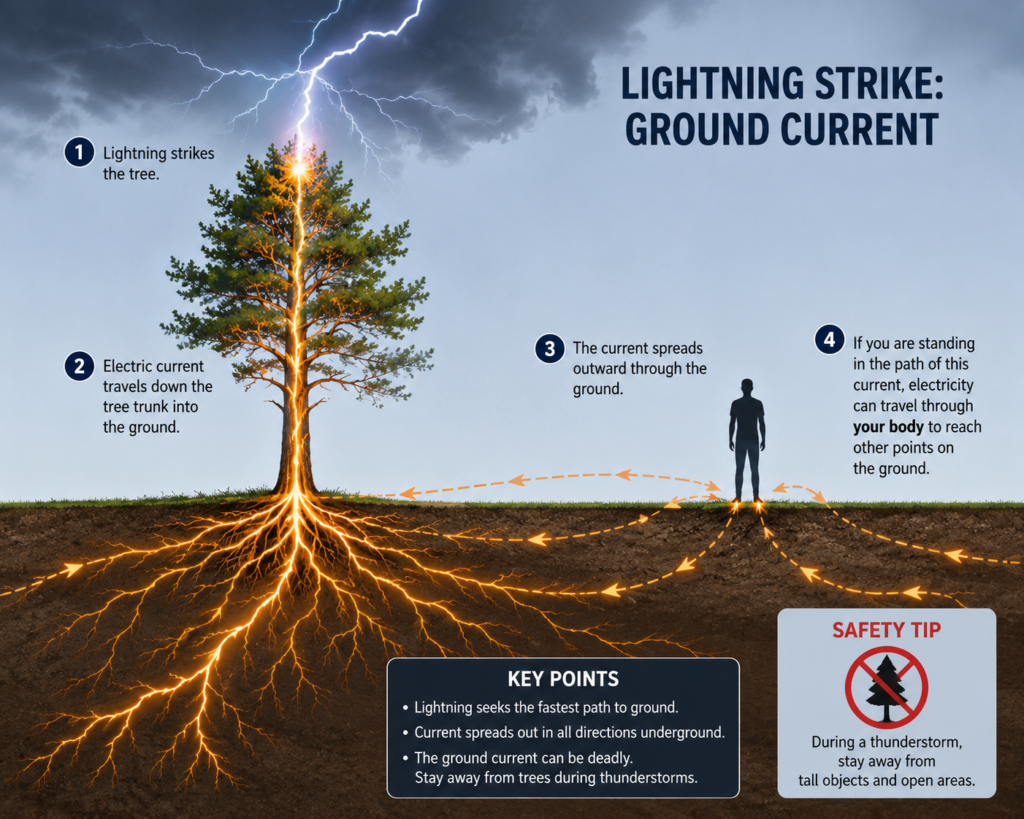
Here is the thing that changes everything about lightning safety while camping, and that very few people outside the outdoor education community know: a direct lightning strike causes only around 3-5% of all lightning-related injuries. The leading cause — responsible for up to half of all lightning injuries — is something called ground current.
When lightning hits any object — a tree, a boulder, a metal pole — the electrical charge does not simply stop there. It radiates outward through the wet ground in all directions, like ripples from a stone thrown into water. The difference in voltage between where your front foot is standing and where your back foot is can be enough to send current through your lower body. You do not need to be anywhere near a direct strike for this to happen.
This is why the advice to crouch with your feet together matters so much — not to make yourself a smaller target for a direct strike, but to minimise the voltage difference between your two feet. It is also why lying flat on the ground is significantly more dangerous than standing up. Lying down maximizes your contact with the ground, dramatically increasing your exposure to ground current.
IMPORTANT
A metal bear-hang pole, trekking poles left upright, or a metal tent frame can conduct ground current and send it jumping to any person or tent within 10-20 feet. Store metal gear flat on the ground — not upright — during a storm. This is one of the most consistently overlooked campsite lightning risks.
Pre-Trip Planning: Your First Line of Lightning Defense
Camping in a thunderstorm tips start at home, not at the campsite. The most effective lightning safety decisions you will make on any trip are the ones you make before you leave.
Checking Weather Before You Leave
Check a weather forecast specifically designed for outdoor use. Standard weather apps are useful but often lack the localized elevation detail that matters for camping and hiking. Apps and websites like Mountain Forecast, Weather Underground, and the National Weather Service radar give you a more accurate picture of what is actually coming.
- Check the forecast two or three times in the 48 hours before departure — not just the morning you leave
- Pay attention to afternoon thunderstorm probability, not just overall rain chance
- If significant storm activity is predicted, consider delaying or adjusting your route
- Enable Wireless Emergency Alerts on your phone before any camping trip — these broadcasts reach phones in affected areas without requiring an app or signal
- Download a NOAA weather radio app or bring a battery-powered NOAA weather radio for areas without reliable phone signal — these continue working when your data connection does not
Sometimes, postponing a trip is the most courageous camping decision you make. Nature will still be there next weekend. You want to be too.
Knowing Your Terrain: When Afternoon Storms Are the Rule, Not the Exception
Different regions have dramatically different lightning risk profiles, and knowing yours before you go shapes every other decision you make.
- Mountain and alpine terrain: afternoon thunderstorms develop almost daily in summer, particularly in the Rockies, Alps, and other high mountain ranges. The rule used by experienced mountain campers: reach your exposed high points by midday and be below treeline or in camp by early afternoon
- Open plains and grasslands: storms develop fast with few landmarks to gauge distance. Lightning detection apps become particularly valuable here
- Dense forests: generally safer than open terrain but not safe — tree canopy reduces direct strike risk but ground current from nearby strikes remains a concern
- Coastal and lake areas: water and wet ground dramatically increase ground current risk. Get off the water at the first rumble.
Afternoon storms are particularly predictable in mountain environments — our mountain camping for beginners guide covers how to plan your hiking day around weather windows and when the conditions say turn back.
Choosing a Lightning-Safe Campsite
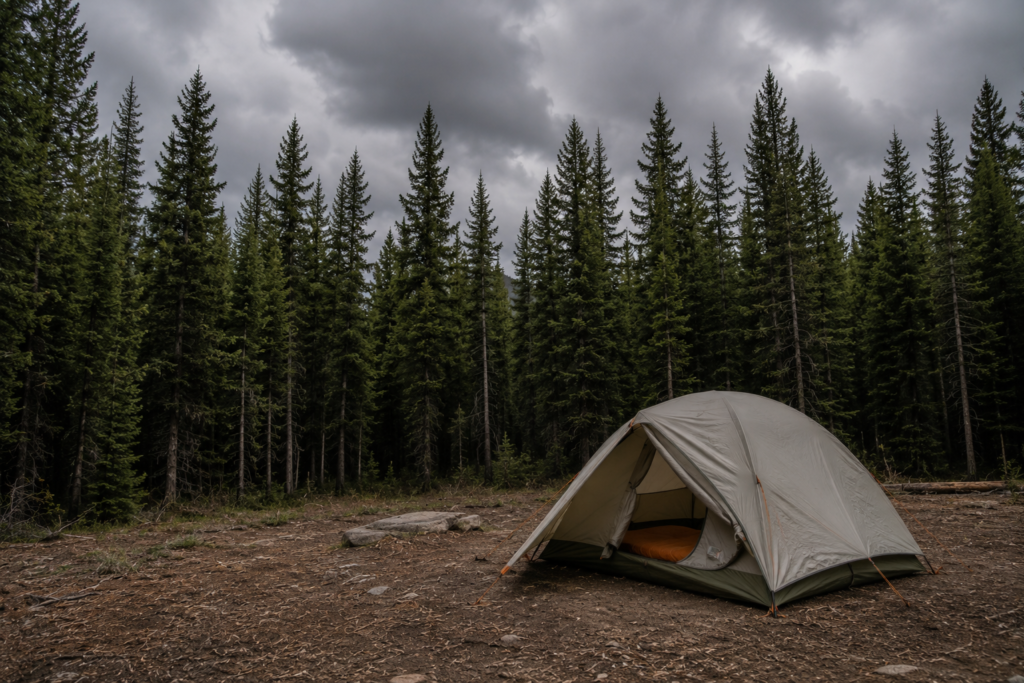
Where you pitch your tent is one of the most impactful lightning safety for hikers decisions you will make. A well-chosen campsite does not make you immune to lightning — nothing does — but it meaningfully reduces your risk.
Where Not to Camp: The High-Risk List
- Hilltops, ridgelines, and exposed peaks — the classic lightning target
- Open fields and meadows — you become the tallest point
- Near lakes, rivers, ponds, or streams — water and wet soil conduct electricity effectively
- Under isolated tall trees — a direct strike to the tree sends ground current radiating outward in all directions
- Near metal structures, fences, or power lines
- In shallow caves or rock overhangs — lightning current jumps across gaps and a person standing in the mouth of a cave or overhang is at serious risk
Shallow caves deserve special mention because they feel like obvious shelter. They are not. Lightning current jumping the gap between the cave ceiling and the floor — with a person in the middle — causes injuries every year.
Where to Camp: Finding Safer Ground
- Low-lying areas — valleys and hollows below the ridgeline, away from drainage areas that could flood
- Dense forest with trees of uniform height — no single tree stands tall enough to be the obvious strike point
- Naturally sheltered spots — a boulder formation or hillside on the upwind side can reduce both storm exposure and wind
- Established campgrounds with lightning rods installed nearby
- At least 50 feet from any isolated tall tree
There is no perfectly safe campsite in a lightning storm. The goal is to avoid the obviously high-risk options and choose the least exposed alternative available.
How Far Away From Trees — And Why That Distance Matters
The common advice to stay away from isolated tall trees is correct — but the reason is more specific than most people know. It is not primarily about the tree being struck directly. It is about ground current.
When lightning hits a tree, the charge travels down through the trunk and then radiates outward through the roots and ground. Anyone within a significant radius of that tree is at risk from the ground current — even if the lightning never came anywhere near them directly. This is why being under a tree is sometimes more dangerous than standing in the open: you are close to a much more likely strike point, and you are in line for the aftershock.
The practical rule: stay at least 50 feet from any isolated tree during a storm. In dense forest with uniform tree heights, spread your group and stay low rather than sheltering directly against any single trunk.
Warning Signs That Lightning Is Imminent: Read These Before It’s Too Late
Lightning does give warning signs before it strikes. Knowing them gives you extra seconds — sometimes enough to make a significant difference.
The Hair-Standing-Up Warning — and What to Do Immediately
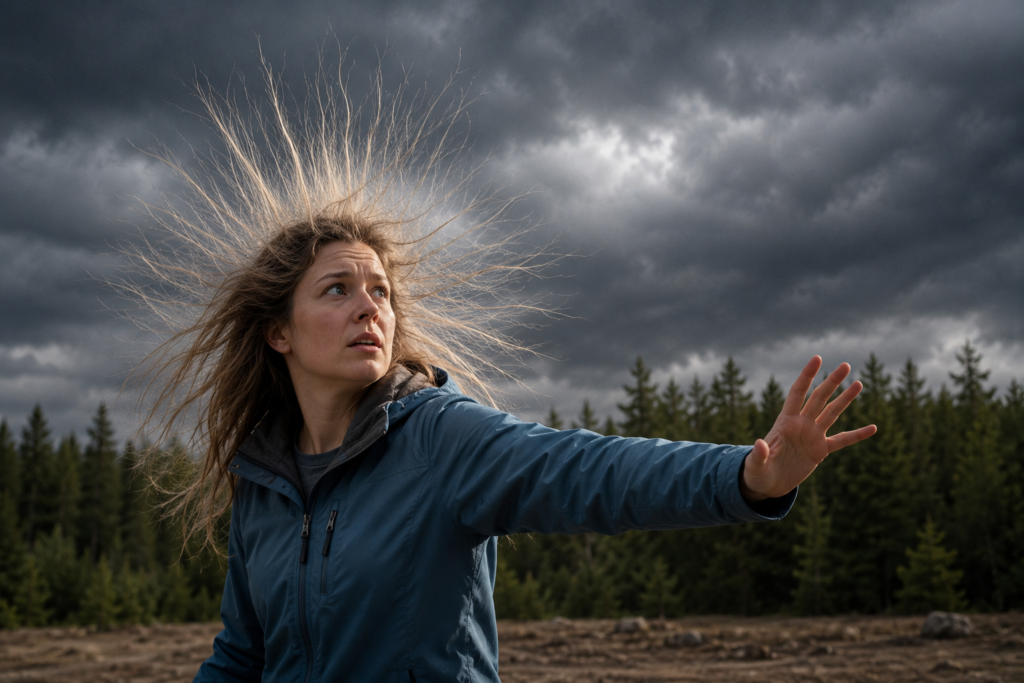
If the hairs on your arms or head start rising, or you notice a tingling sensation across your skin, or you hear a buzzing or crackling sound near metal objects like trekking poles or your tent poles — these are physical signs that electrical charge is building in the air around you and your body may be about to become a conductor.
This is not something to watch with curiosity. This is a signal to move immediately. Drop or lower any metal objects you are carrying. Do not run — move quickly and purposefully to lower ground and away from isolated tall objects. If you cannot move to better terrain and the sensation intensifies, assume the crouch position (described in H2-5).
Your hair standing on end outdoors in a storm is your body doing its best impression of a lightning rod — which is exactly what you do not want to be. Unlike a good lightning rod, you do not have a copper cable running to earth. Move immediately, wonder about the physics later.
The 30-30 Rule: Your Portable Lightning Alarm
Count the seconds between a lightning flash and the thunder it produces. Thunder travels approximately one mile every five seconds. If the gap is 30 seconds or less — the storm is within six miles of you. That is close enough to be dangerous and close enough to be reaching you in minutes.
The second 30: once the last clap of thunder has died away, wait a full 30 minutes before leaving shelter or resuming exposed outdoor activity. Lightning can continue striking long after the visible storm has passed your location. The 30-minute clock resets with every new thunder clap.
- Count seconds between flash and thunder
- 30 seconds or less = within 6 miles = seek shelter NOW
- Wait 30 full minutes after the last thunder before going back outside
- The clock resets with every new clap of thunder — it is 30 minutes from the last sound, not the first
THE MANTRA:
The National Weather Service uses a phrase worth memorizing: ‘When Thunder Roars, Go Indoors.’ It is short, accurate, and actionable. If you hear thunder — any thunder, however distant — you are already within potential striking distance of the storm. Do not wait for it to get closer before making a decision.
What to Do When a Storm Catches You: In Order of Priority
The most important update in thunderstorm camping safety from the last decade of wilderness medicine research is this: everything in your response to a lightning storm should be organized as a priority hierarchy. The options are not equal. Some are genuinely safe. Some are much better than nothing. Here they are in order.
Priority One: Reach a Hard-Topped Vehicle or Solid Building
These are the only two places that genuinely protect you from lightning. A hard-topped metal vehicle works because of the Faraday cage effect . We will discuss more in the coming section on this. A solid building with wiring or plumbing provides a route for lightning current to earth that bypasses the occupants.
If you can reach either of these before the storm arrives — do it. Everything else in this section is for when you cannot.
If conditions mean you cannot safely reach your vehicle or building, our wilderness emergency evacuation guide covers shelter-in-place strategies and how to signal for help if things escalate.
Priority Two: Descend From High Ground Immediately
If you cannot reach a vehicle or building, your next priority is to get off elevated terrain and away from exposed positions. Leave the ridge, summit, or hilltop before the storm arrives — not during it.
- Descend from any ridgeline, peak, or elevated open area at the first sign of building storm clouds
- Get below treeline if you are above it — exposed alpine terrain above treeline has no shelter of any kind
- Move away from any open water — lake edges, riverbanks, and beaches are high-risk
- Stay away from wet ropes, metal poles, and fences — these can conduct electricity at distance
- Do not shelter in shallow caves or rock overhangs — lightning current jumps these gaps
Priority Three: The Lightning Crouch — Last Resort Only
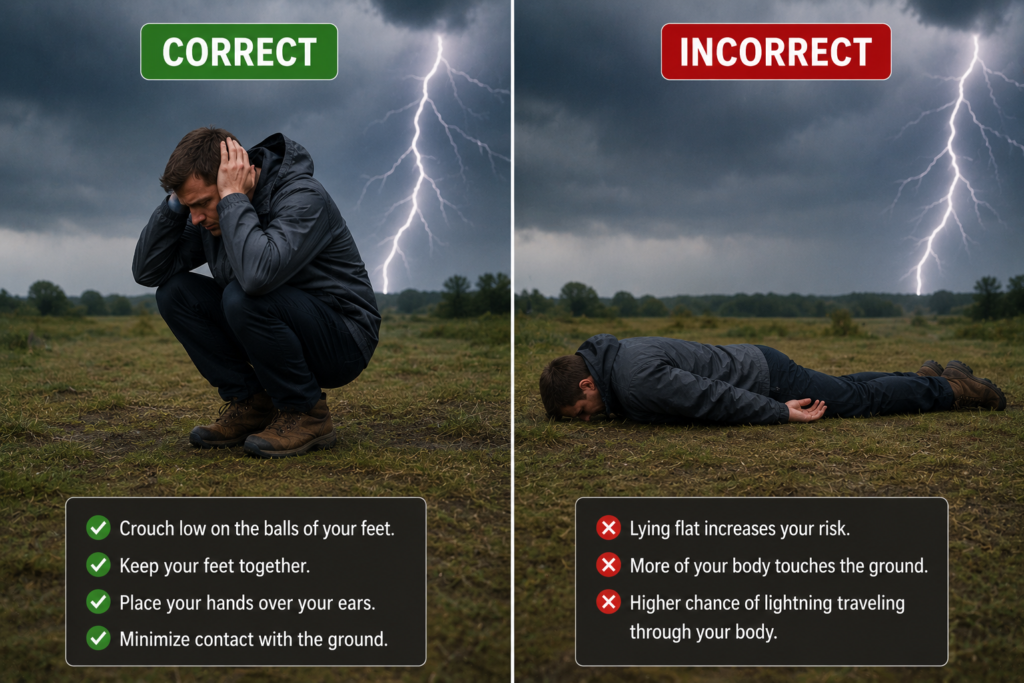
The lightning crouch — crouching low on the balls of your feet, feet together, hands over your ears, head tucked down — is widely taught and widely misunderstood. It is a last resort for when you are exposed in open terrain and cannot reach safer ground or a vehicle. It is not a primary response strategy, and it does not make you safe.
What it does is reduce your profile, minimise your ground contact (which reduces ground current exposure), and slightly lower your risk compared to standing upright. What it does not do is protect you from a direct strike or a nearby ground current.
- Crouch on the BALLS of your feet — not flat-footed
- Keep feet TOGETHER — minimises voltage difference between feet
- Do NOT lie down — this massively increases ground current risk
- Do NOT touch the ground with your hands — place them over your ears instead
- Insulate yourself from the ground if possible — sit on a sleeping pad or pack
- Move away from isolated trees, metal objects, and trekking poles before crouching
If you are with a group in the crouch position, everyone should be at least 100 feet apart. If one person is struck, the others will be unaffected and able to help.
Group Safety: Why Spreading Out Matters
When camping or hiking in a group, the instinct to stay close together during a scary storm is natural — but it is the wrong call from a lightning safety perspective. If the group is clustered together and a strike hits nearby, the ground current can incapacitate multiple people simultaneously, leaving no one capable of helping.
Spread your group members at least 50-100 feet apart — enough that a single ground current will not reach everyone. Designate one person to monitor the weather while others seek the safest positions available. Agree on a meeting point to reassemble once the storm has fully passed.
If you are camping with children, group spacing and emergency communication are especially important to think through in advance — our camping with kids guide covers emergency planning for family camping trips.
Does a Tent Protect You From Lightning? The Honest Answer
No. A tent offers no meaningful protection from lightning — and this is important enough to be worth saying clearly.
Most tent materials are synthetic fabrics that do not conduct electricity, which means they also do not redirect it. A lightning strike near your tent or a ground current traveling through wet ground under your tent will not be stopped or diverted by the fabric. Tent poles, whether aluminum or carbon fiber, can conduct electricity and increase the risk to anyone inside if a strike occurs nearby. A metal bear-hang pole within 20 feet of your tent is a ground current risk that most campers never consider.
This does not mean tents are useless in storms — they keep you dry and out of the rain, which is meaningful for comfort and hypothermia prevention. What they do not do is protect you from lightning.
The practical implication: if a storm is approaching and you have a choice between staying in your tent and running to a hard-topped vehicle 200 metres away — run to the vehicle. Getting slightly wet on the way is irrelevant.
Your tent’s lightning protection consists primarily of fabric walls, a vaguely aerodynamic shape, and the psychological comfort of not being able to see the storm. The psychological part is genuinely valuable. The lightning part is not.
Vehicle and RV Safety in a Lightning Storm: The Faraday Cage Effect
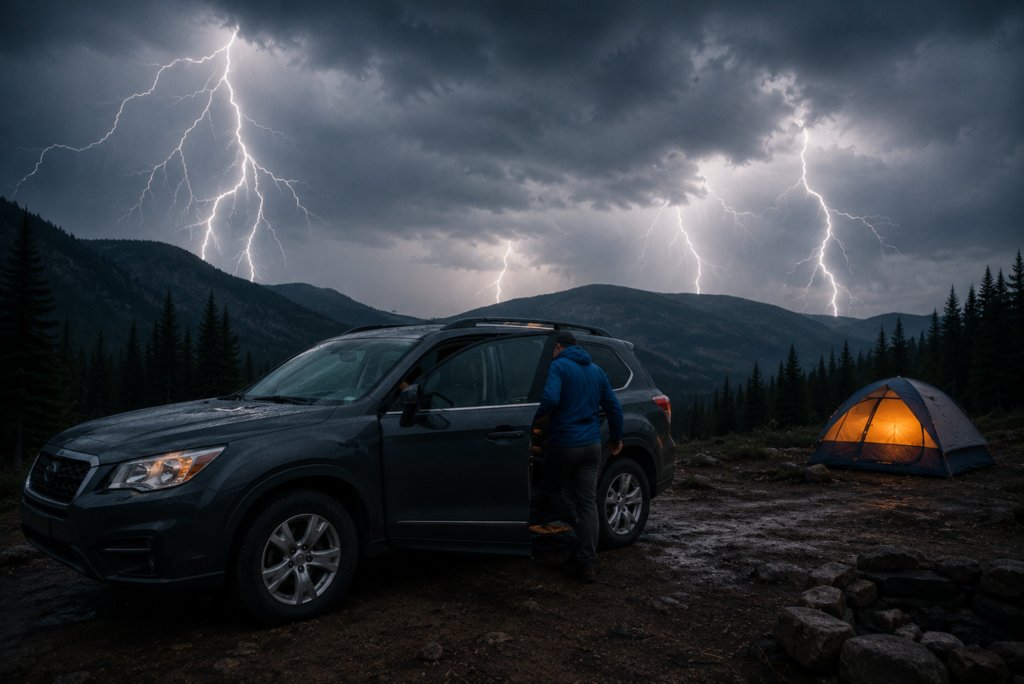
A hard-topped metal vehicle is one of the safest places available during a lightning storm — but not for the reason most people think. It is not because rubber tyres insulate you from the ground. Rubber tyres are far too thin to block the voltage of a lightning strike. The protection comes from the metal body of the vehicle acting as a Faraday cage.
A Faraday cage is any metal enclosure that conducts electricity around its exterior surface, protecting whatever is inside. When lightning strikes a metal-topped vehicle, the charge travels around the outside of the car and discharges to earth through the tyres — without passing through the interior where the occupants are sitting. This is why the instruction to avoid touching any metal surfaces inside the vehicle matters: touching the door frame, dashboard, or steering wheel creates a path from the exterior to you.
- Stay inside the vehicle with windows closed
- Do NOT touch any metal interior surfaces — door frames, dashboard, steering wheel
- Avoid using electronic devices with external connections
- Keep the engine off if possible — running engines create additional electrical paths
- Wait 30 minutes after the last thunder before exiting
A convertible vehicle offers no Faraday cage protection. An RV or motorhome with a metal roof provides similar protection to a car. A tent provides none.
Lightning Safety Myths Busted: What You Think You Know That Could Get You Hurt
Lightning safety is one of the outdoor topics most affected by myths — advice that sounds plausible, has been repeated so many times it feels authoritative, and is genuinely wrong. Here are the ones that matter most.
MYTH: Rubber-soled shoes protect you from lightning.
The rubber sole of a shoe or boot provides zero protection against a lightning strike. A typical lightning bolt carries hundreds of millions of volts. The few millimeters of rubber between your foot and the ground makes no meaningful difference to that energy. Wear whatever footwear makes sense for the terrain — do not add lightweight trainers to your pack for lightning safety.
MYTH: Lightning can’t strike the same place twice.
Lightning not only can strike the same place twice — it routinely does. Tall structures like radio towers, skyscrapers, and lone trees get struck repeatedly in single storms because they are consistently the most attractive conductors in their area. The origin of this myth is unclear, but its persistence is impressive given how straightforwardly wrong it is.
MYTH: If it is not raining, there is no lightning risk.
Lightning can travel up to ten miles ahead of or beside its parent storm — sometimes under a clear sky. This is called a bolt from the blue, and it kills people every year who assumed they were safe because the sky overhead was clear. If you hear thunder at any distance, you are within potential striking range of lightning. The storm does not need to be directly above you.
MYTH: Crouch in the lowest point you can find — a ditch, a hollow, a low point in the ground.
This one is understandable but dangerous. Low points in the terrain collect water — and water and wet soil are excellent conductors of ground current. Crouching in a puddle during a lightning storm is a genuinely bad idea. Find low terrain relative to the ridgeline and hilltops, but avoid actual water collecting points.
MYTH: Metal objects attract lightning.
Metal does not attract lightning. What metal does is conduct electricity extremely well — which means that if lightning strikes nearby, any metal in the path between the strike point and you can carry ground current directly to you. Leave trekking poles horizontal on the ground rather than upright, but carrying metal gear does not make you a lightning magnet in open terrain.
Lightning does not have preferences. It does not know your tent cost more than your first car, that you are on your honeymoon, or that you specifically chose this campsite because it looked safe on Google Maps. It follows physics, not fairness. This is ultimately reassuring — because physics is predictable, which means it can be planned around.
What to Do If Someone Is Struck by Lightning
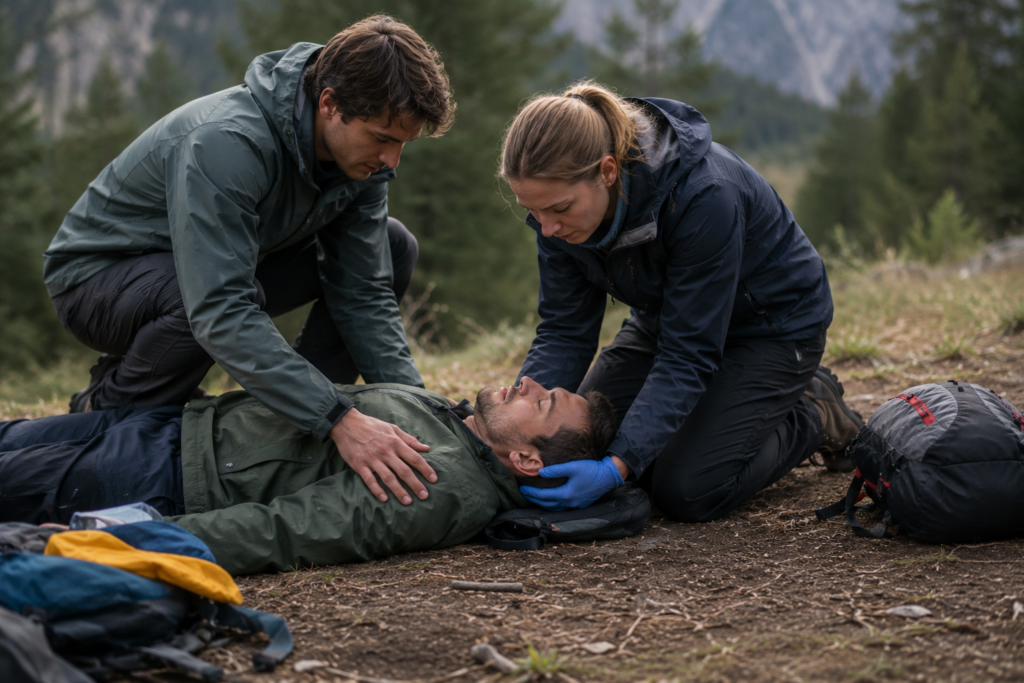
This section is one that most campers hope never to need. Know it anyway.
The single most important fact: a person who has been struck by lightning carries no electrical charge. It is completely safe to touch them immediately. You will not be shocked. Many lightning victims survive — including some who experience cardiac arrest — because of prompt CPR. Do not hesitate to approach and help.
- Check for breathing and pulse immediately
- If no pulse: begin CPR straight away. Lightning strike victims, including those with cardiac arrest, can respond to CPR when it is started quickly.
- Call for emergency help — if you have a satellite communicator, activate it now
- Lightning burns are often deceptive — the visible surface damage may appear minor while internal burns are severe. The person needs professional medical assessment.
- Treat for shock: keep the person warm, still, and reassured. Move them only if they are in immediate danger.
- Watch for delayed symptoms: confusion, headache, vomiting, vision problems — these can develop after the initial incident
Make sure your essential camping first aid kit includes burn treatment supplies and is accessible quickly — lightning burns are deep and serious even when external damage looks minor.
Post-Storm Safety: What to Check Before Going Back Outside
The 30 minutes after a storm are when most people relax too quickly. The storm has passed overhead but the electrical activity may not be finished. Wait until you have had 30 clear minutes with no thunder before resuming outdoor activity — and then check these things before returning to normal camp life.
- Walk the campsite perimeter — look for any fallen trees, broken branches hanging overhead, or damaged structures that could fall
- Check for pooled water — standing water near your tent or cooking area may be connected to downed power sources in established campgrounds
- Inspect all camping equipment — lightning damage to electronics, melted tent material, or scorched ground are all signs that something nearby was struck
- Check every member of your group for signs of shock or injury — some lightning injury symptoms develop slowly and may not be obvious immediately
- Avoid flooded areas — water hides debris, soft ground, and in established areas, downed electrical lines
Essential Gear for Camping in Lightning-Prone Areas
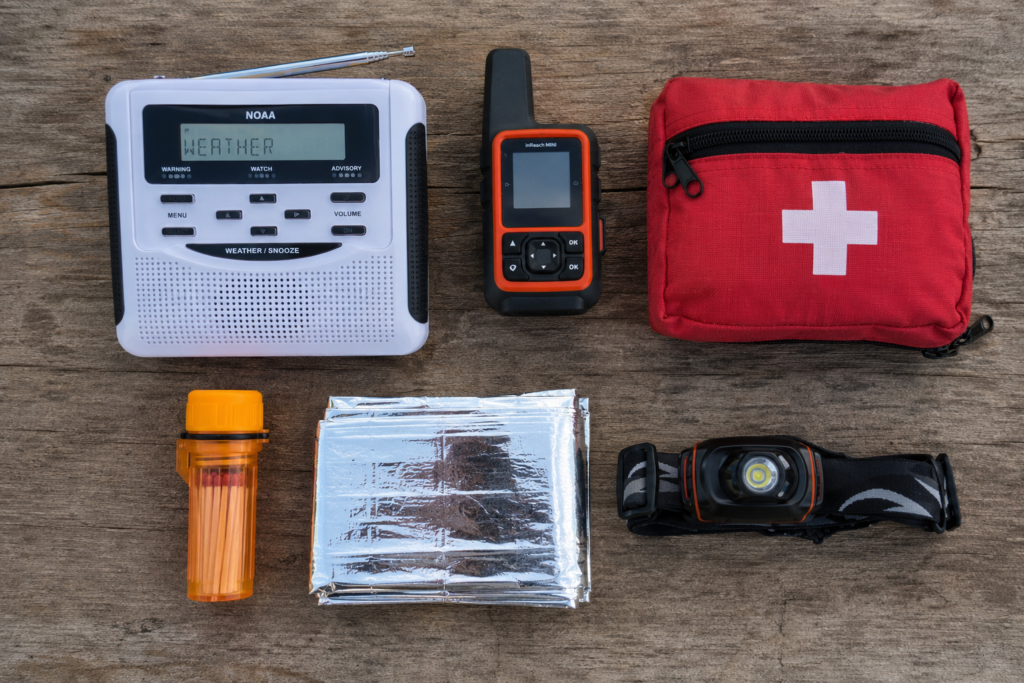
None of this gear makes you lightning-proof — nothing does. What it does is give you better information, faster, so you can make better decisions before conditions become dangerous.
- NOAA battery-powered weather radio: Receives emergency weather alerts without cell signal. Works during the power outages and signal drops that often accompany severe weather. One of the highest-value items in any camp kit relative to weight and cost.
- Weather apps with lightning detection: Apps like Mountain Forecast, Weather Underground, and the National Weather Service radar give you real-time storm tracking that standard weather apps often lack.
- Satellite communicator (Garmin inReach, SPOT): If a lightning strike creates a serious injury and you are in a remote area without cell signal, a satellite communicator is how you call for help.
- First aid kit with burn treatment: Include burn dressings, antiseptic, and antihistamine. Lightning burns are often more serious than they appear on the surface.
- Sleeping pad or closed-cell foam: Useful as ground insulation if you ever need to use the lightning crouch — it slightly reduces ground current exposure.
- Headtorch with spare batteries: Storms often coincide with low light. Having your hands free matters when you are moving quickly in difficult conditions.
A weather radio and emergency kit belong on every camper’s pre-trip pack list – our complete camping checklist for new campers gives you the full picture of what to bring.
Frequently Asked Questions About Lightning Safety While Camping
What should I do if I am caught in a lightning storm while camping?
In order of priority: reach a hard-topped metal vehicle or a solid building with wiring or plumbing — these are the only genuinely safe shelters. If neither is accessible, descend from any elevated position, get away from isolated tall trees and open water, and seek lower terrain in dense uniform forest. If you are fully exposed with nowhere to go, assume the lightning crouch: low on the balls of your feet, feet together, hands over ears, not touching the ground. This is a last resort — not a primary strategy.
Is it safe to stay in a tent during a thunderstorm?
A tent offers no lightning protection. Tent fabric does not redirect or absorb electrical current, and tent poles can conduct ground current into the living space. If you have access to a hard-topped vehicle, go there instead. If you have no option but to shelter in your tent, stay off the ground as much as possible (sit on a sleeping mat rather than lying down), stay away from the tent poles and any metal objects, and wait out the storm. Your tent keeps you dry and warm — which is valuable — but it does not protect you from lightning.
What is the 30-30 rule for lightning?
The 30-30 rule gives you two critical timing numbers. First: if the gap between a lightning flash and the thunder it produces is 30 seconds or less, the storm is within six miles of you and you should seek shelter immediately — not in a few minutes. Second: once the last clap of thunder has died away, wait a full 30 minutes before returning to outdoor activity. The clock resets every time you hear new thunder. If you hear thunder again after 25 minutes, start the count again from zero.
Does a car protect you from lightning?
Yes — a hard-topped metal vehicle provides good protection from lightning through the Faraday cage effect. The metal shell conducts lightning current around the exterior of the car and discharges it to earth, without passing through the interior. Stay inside with windows closed and avoid touching any metal surfaces: door frames, steering wheel, dashboard. This is why rubber tyres are irrelevant — the protection comes from the metal body, not from insulation at the bottom. A convertible or canvas-topped vehicle offers no equivalent protection.
What are the warning signs that lightning is about to strike nearby?
The most alarming warning sign: the hair on your arms or head begins to stand on end, or you feel a tingling sensation across your skin. This indicates that electrical charge is building in the air around you and a strike may be imminent. Other warning signs include a crackling or buzzing sound from nearby metal objects, a sharp metallic smell in the air, and unusually loud static on any radio equipment. If you experience any of these, lower or drop any metal objects and move quickly to lower ground. Do not stand still to observe what happens next.
Lightning Doesn’t Wait: Build Your Plan Before the Storm Does
The reason most lightning injuries involve people who were caught in the wrong place is not usually a lack of knowledge — it is a lack of a plan. They were enjoying themselves, the storm built faster than expected, and they had not pre-decided what they would do when the sky turned serious.
Lightning safety while camping is not complicated. Check the weather before you leave. Know your campsite’s risk profile. Know the 30-30 rule. Know what shelter means — a hard-topped vehicle or solid building, not a tent. Know that the crouch is a last resort, not a strategy. Spread out if you are in a group. Wait the full 30 minutes.
That is most of it. The rest is paying attention to the sky and being willing to change your plans when it tells you something you need to hear. Camping is about the long game — the trips that happen safely, again and again, for years. Build your plan before the storm does.