Camping Security Systems That Actually Work: Radar Alarms & Wildlife Detection
-
| Founder & Content Creator

Latest Posts

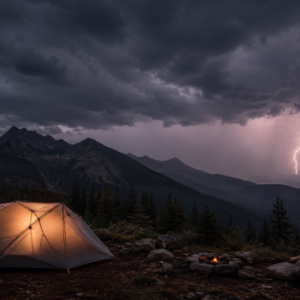
You are settled in your sleeping bag, the campfire has died down, and everything is quiet. Then something rustles at the edge of camp. A branch cracks. You lie there staring at the tent ceiling, ears sharp, waiting to find out whether it is a deer passing through or something that actually needs your attention.
That is exactly what [FK] camping security systems are designed to solve — not to make camping feel like a military operation, but to give you that calm, early heads-up so you can sleep instead of listening to every sound in the dark.
This guide covers every type of campsite alarm that genuinely works, from sophisticated radar motion detectors to the classic paracord-and-tin-cans tripwire that experienced backcountry campers have used for decades. It includes what forum communities and real campers recommend, the common mistakes that lead to false alarms all night, and how to choose the right setup for your specific camping style and budget.
Knowing what is actually out there is the first step — our wildlife safety while camping guide covers bear, snake, and mountain lion behavior so you can position your sensors where wildlife actually approaches from.
Why Campsite Security Matters — Even on a ‘Safe’ Trip
Whether you’re camping deep in the wilderness, pitching a tent by a quiet lake, or resting in a hammock under the stars, nighttime can bring its share of unpredictability. Wildlife may wander. People sometimes stumble across campsites. Gear can get stolen or trampled.
That’s why many campers look for reliable tools like camping alarms, bear alarms, and wildlife detection devices. While no alarm can replace smart camping habits, combining these tools with simple precautions can make your nights feel much safer and more relaxed.
The best camping security system doesn’t have to be complicated—it just needs to work consistently in the environment you’re exploring.”
Essential Wildlife Detection Systems for Campers
Motion-Activated Trail Cameras: The Eyes of Your Campsite
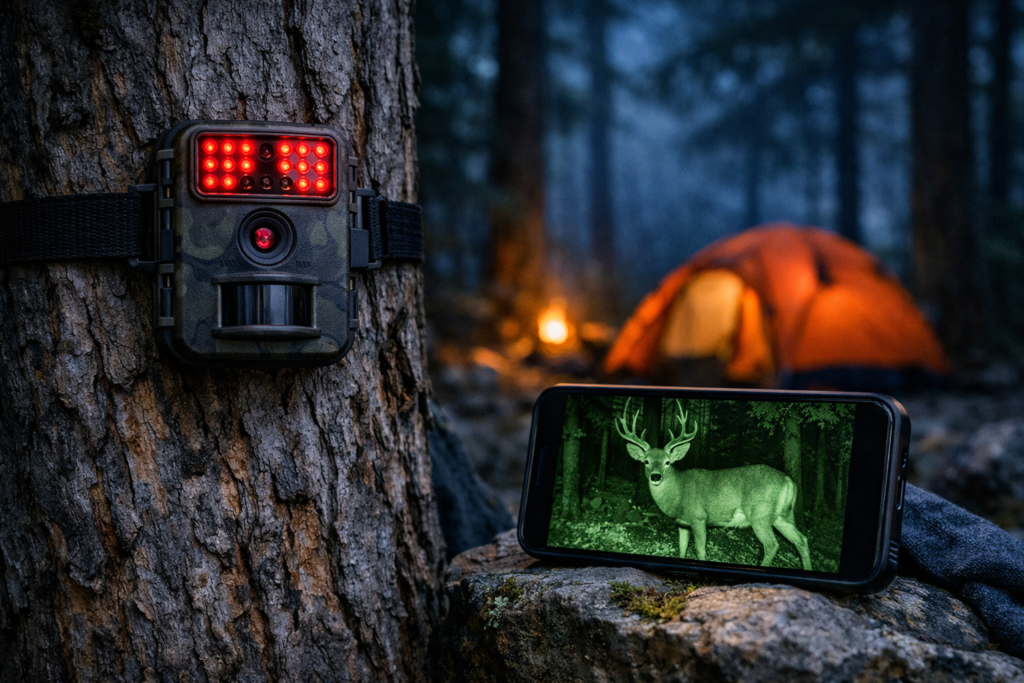
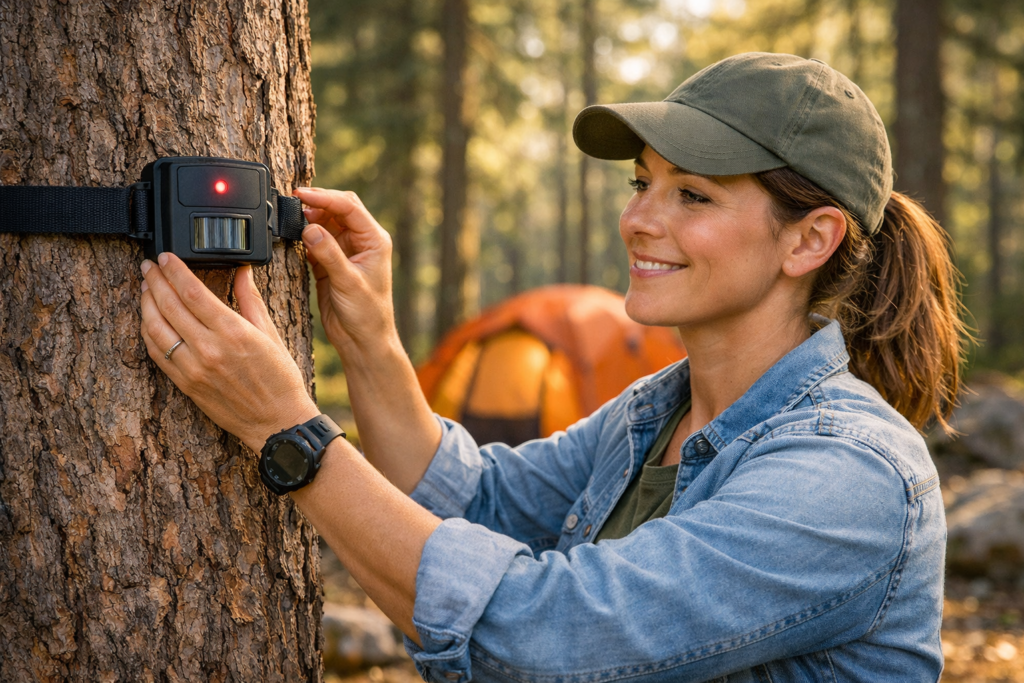
Trail cameras are the most versatile campsite security tool available. Mount one on a tree pointing toward a likely approach route and it automatically photographs or videos anything that passes — day or night — without you having to do anything.
Modern trail cameras use passive infrared sensors that detect body heat and movement, triggering the camera only when something warm-blooded passes. Infrared LEDs capture clear images in complete darkness without a visible flash that would disturb wildlife or give away the camera’s location.
- Detection range: look for 80-100 feet minimum for useful campsite coverage
- Battery life: quality cameras last 6-12 months on a set of AAs — ideal for extended trips
- Storage: SD card stores footage locally; some models send alerts to your smartphone via wireless connection
- IP65 weatherproof rating or above — protects against rain, dust, and temperature swings
Trail cameras are particularly valuable for reviewing what visited your campsite while you slept — the footage is often fascinating and rarely alarming. They are passive monitors rather than active deterrents.
| CAMPER TIP | Point your trail camera slightly downward rather than straight ahead. This catches smaller animals crossing low to the ground and reduces false triggers from swaying branches in the background. |
Infrared PIR Sensors: Early Warning for Large Animals
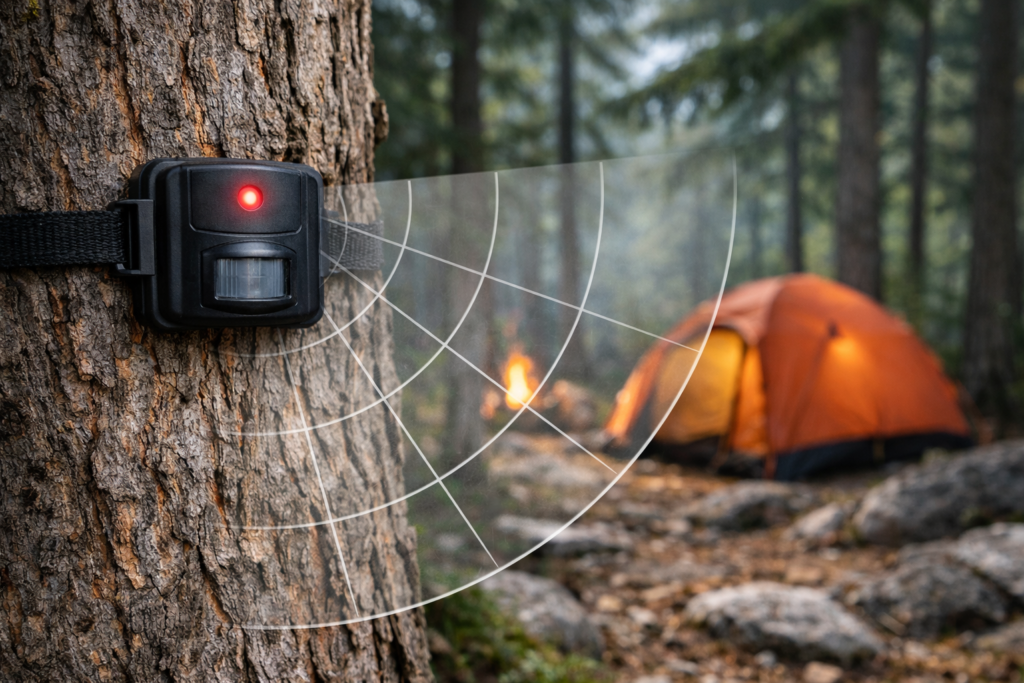
PIR stands for Passive Infrared — these sensors detect the heat signature of warm-blooded animals passing through their detection zone. Unlike trail cameras which record passively, PIR sensors trigger an active alert — a sound, a vibration to a paired receiver, or a smartphone notification — the moment something is detected.
The key advantage of PIR sensors for wildlife detection camping is their ability to be tuned. Better models can be adjusted to ignore small animals under a certain size threshold — so a fox or a rabbit does not wake you up at 2am, but a bear at 80 feet does. Detection ranges typically run from 30 to 150 feet depending on the model.
- Mount at animal eye-level — 8 to 12 feet above ground for large animal detection
- Angle slightly downward for best coverage of the approach zone
- Solar-powered options available — continuous operation without battery concern
- Look for temperature compensation features — prevents false alarms when the ambient temperature suddenly drops or rises
For a basic single-sensor setup around a tent, a quality PIR sensor paired with a quiet vibration receiver clipped to your sleeping bag is one of the most practical and affordable campsite alarm systems available.
Radar Motion Alarms: The Tech That Changed Campsite Security
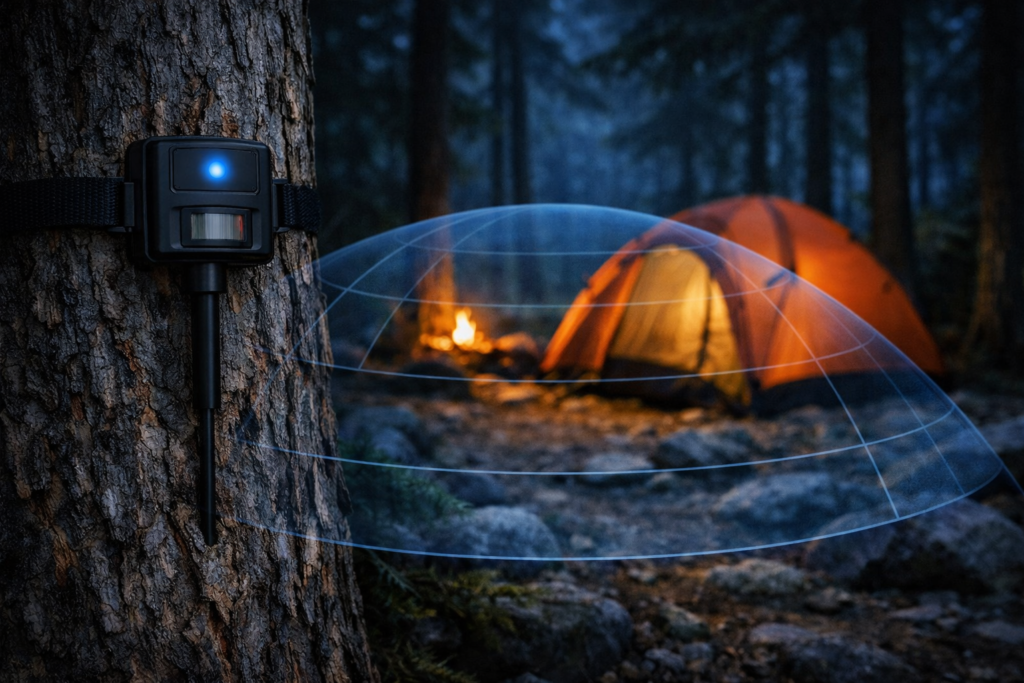
If you have ever had a motion sensor alarm wake you up at 2am because a breeze moved a branch, you will understand why radar technology is such a welcome addition to camping security systems.
Radar alarms work differently from PIR sensors. Instead of detecting heat, they send out millimeter-wave radio signals — the same basic technology behind automatic sliding doors — and pick up movement in their detection zone. Because they are not triggered by temperature changes, they are far less likely to fire on a sudden drop in air temperature, a gust of wind, or rain hitting nearby leaves. In wet, foggy, or cold conditions where PIR sensors constantly false-trigger, radar alarms stay quiet until something actually moves.
They also detect through light cover — movement behind a bush or even through a tent wall registers clearly, which removes a lot of the blind spots that PIR setups can have.
The most well-known product in this category is the LETWESAF radar camping alarm, which creates a 45×20 foot 3D detection zone from a single compact unit, with a receiver range of 800 metres. In plain terms: it knows the difference between a person walking toward your tent and a leaf blowing past it. That distinction is what makes radar worth considering if you camp in wet climates, dense woodland, or anywhere PIR sensors have given you trouble before.
- Best for: solo campers in bear or grizzly country, remote dispersed sites, wet weather camping environments
- Typical detection zone: 30-50 feet adjustable
- False alarm rate: significantly lower than PIR in adverse weather
- Power: rechargeable battery, typically 1-3 months between charges
- Setup time: around one minute — stake in the ground, switch on, done
| HONEST ASSESSMENT | Radar alarms are excellent in wet conditions but typically cost more than PIR alternatives. For fair-weather camping at established sites, a quality PIR sensor or trail camera may be a better value. For remote backcountry camping in bear country or challenging weather — radar is worth every penny. |
Smart Audio Detection: When You Need to Know What Kind of Animal It Is
Smart audio detection systems take a different approach altogether. Instead of detecting heat or movement, they listen. Microphones pick up sounds around your campsite and software analyses what it hears — trying to identify whether that rustle in the dark is a bear or a deer, or whether an animal is moving casually or approaching with intent.
It sounds impressive. And honestly? For most recreational campers, it is more than you need.
Here is the thing: whether your alarm tells you a bear is approaching or just says something large is approaching, you are going to do the same thing. Turn on a light. Make some noise. Assess from inside the tent. The species identification does not really change your response.
Smart audio detection genuinely earns its keep in professional settings — wildlife researchers, backcountry ranger stations, and serious long-term solo expeditions where knowing exactly what species is active in the area actually informs decisions. For a camping trip of a few nights, a good PIR sensor or radar alarm does the job just as well, at a fraction of the cost and complexity.
GPS Wildlife Tracking Alerts: Know Before They Arrive
GPS wildlife tracking systems are an interesting idea. They connect to databases managed by parks and wildlife organisations, pulling in real-time location data from collared animals — bears, wolves, mountain lions — and alerting you when a tagged animal moves within a set distance of your campsite.
In the right place, that is genuinely useful. Several US National Parks and some Canadian wilderness areas actively collar and track predators, and if you are camping in one of those zones, this kind of early warning can be meaningful.
The honest limitation though: the data only exists where animals have actually been collared and tracked. That covers a relatively small slice of the places people actually camp. For most campsites around the world, there simply is no tracking database to connect to — so the system has nothing to work with.
What GPS does offer every camper, everywhere, is something arguably more valuable: the ability to call for help from anywhere on Earth. A satellite communicator like the Garmin inReach does not depend on mobile signal or Wi-Fi. If a wildlife encounter or any other emergency goes beyond what you can handle alone, you press a button and rescue services receive your exact coordinates. That is the GPS tool that genuinely earns a place in every camper’s kit.
Low-Tech and DIY Campsite Alarms: What Forums Swear By
Ask experienced backcountry campers what they actually use for campsite security and the answers are often surprisingly simple. The forums are full of people who have tried expensive motion sensor setups and ended up falling back on methods that cost almost nothing.
The Classic Tripwire Setup: Paracord, Pots, and Pans
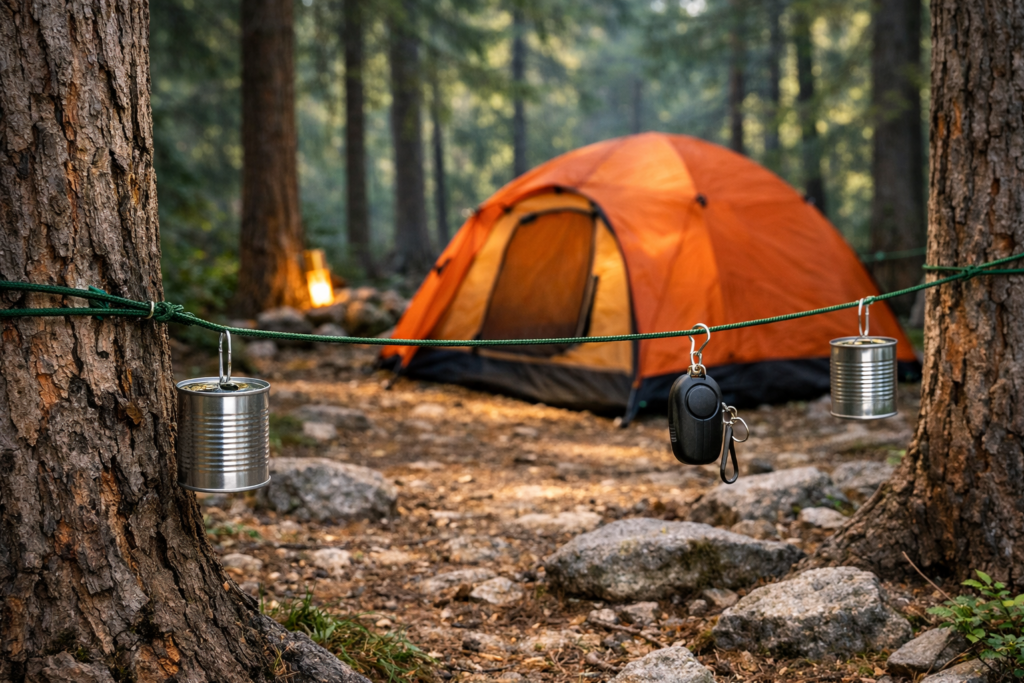
This is the system that experienced campers on forums like Backpacking Light, Rokslide, and r/camping recommend most consistently: a length of paracord or fishing line strung around the campsite at a height of 12-18 inches above the ground, with something noisy attached.
Tie the cord between trees to create a loose perimeter. Attach tin cans with a few pebbles inside, or hang a cluster of metal utensils that will rattle when the cord is disturbed. A bear or large animal walking through the perimeter snags the cord and wakes you up immediately — no batteries, no false alarms from rain or temperature changes, no setup app required.
- Cost: essentially zero if you already carry paracord
- Weight: negligible — the cord you already have plus a few small alarms
- Reliability: works in any weather, does not run out of batteries, cannot be disabled by cold
- Limitation: will not detect something moving slowly and carefully. Designed for casual animal wandering, not deliberate intrusion.
| FORUM WISDOM | The most upvoted advice on camping forums about tripwire alarms: set the cord high enough that rabbits, foxes, and small animals walk under it rather than through it. 12-18 inches clears most small nocturnal animals while catching anything deer-sized or larger. Below that height and you will be up all night. |
Personal Alarm as Campsite Perimeter Alert
Here is a clever little trick that costs almost nothing and works surprisingly well. A personal safety alarm — the small handheld kind with a pull-pin that triggers a piercing siren — can be turned into a simple campsite trip alarm with nothing more than a short length of cord.
Tie the cord across a likely approach path at about 15-18 inches above the ground, and attach one end to the alarm’s pull-pin. Anything walking through the cord — an animal, a person, whatever it may be — pulls the pin and the alarm goes off. Loudly. At 130 decibels, it is genuinely startling at close range, which is usually enough to send wildlife the other way in a hurry.
What makes personal alarms such good value for campers is how many jobs they can do. Trip alarm around the perimeter. Distress signal if you need help. Personal safety device if you feel uneasy about someone nearby. All of that from something that fits in your pocket, weighs almost nothing, and costs very little.
A few things worth knowing before you set yours up:
- Tie the cord 15-18 inches above ground — high enough that small animals walk under it, low enough to catch anything deer-sized or larger
- Test the tension before you go to sleep — the cord should pull the pin cleanly without needing a sharp tug
- Carry two if you can — one for the perimeter and one on your person or in the tent
The False Alarm Problem — and How to Solve It
This is the most commonly raised issue in camping forums about motion sensor alarms, and it is worth addressing honestly: if you position a PIR sensor or motion-activated alarm carelessly, you will be woken up repeatedly all night — by deer, foxes, raccoons, and whatever else wanders through. Several campers in outdoor forums report giving up on sensor alarms entirely after a night of constant false triggers.
The fixes are simple but they require deliberate setup:
- Mount sensors at the right height — 8-12 feet for large animal focus; lower than that and everything triggers
- Adjust sensitivity down in areas with high small-animal activity — most quality sensors have at least two sensitivity settings
- Choose dual-technology sensors where possible — these require both a heat signature AND movement to trigger, dramatically reducing false alarms
- Avoid pointing sensors at tall grass, loose branches, or areas where wind-blown vegetation will move
- Set a 3-5 second delay filter if your sensor has one — brief crossings by small animals will not hold long enough to trigger the alarm
- Test your setup at dusk by walking through the detection zones yourself — adjust before dark
The goal is a system that wakes you up for bears and lets you sleep through deer. With a bit of deliberate positioning, that is entirely achievable.
How to Position Your Camping Security System for Maximum Effect
Camping security systems are only as good as their placement. A technically excellent radar alarm pointed in the wrong direction is less useful than a tin can on a string pointed the right way.
The Layered Zone Approach: Outer, Middle, and Inner Detection
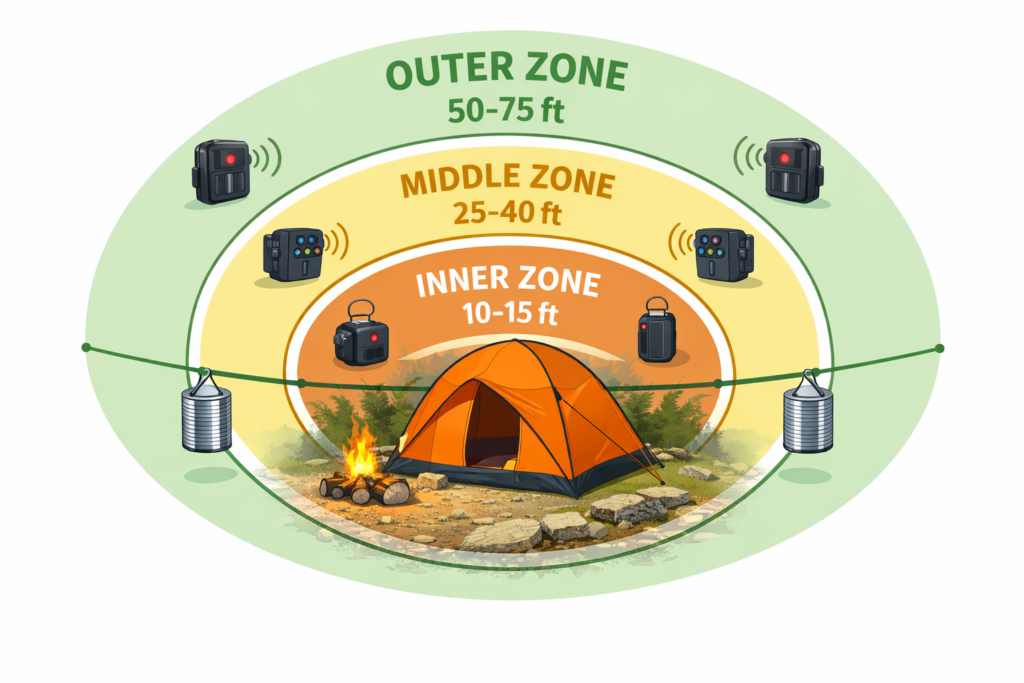
The most effective campsite security setups use multiple layers of detection — each one giving you a different kind of alert at a different distance.
- Outer zone (50-75 feet): Silent vibration alert or quiet chirp only. Early warning — you are made aware something is approaching without waking the whole campsite. Gives you maximum response time.
- Middle zone (25-40 feet): Audible warning — a moderate beep or tone that can deter animals without provoking aggression. Most wildlife will change direction at this range.
- Inner zone (10-15 feet): Loud, clear alarm. Last line of defence. Anything this close needs your immediate attention.
You do not need three separate systems to achieve this. A single quality PIR sensor placed at 50 feet set to vibration mode, backed up by a tripwire or personal alarm at 15 feet, creates a two-layer system that covers both early warning and last-resort alert.
Where Bears and Wildlife Approach From
Positioning your sensors effectively requires understanding how wildlife typically moves. Bears almost always approach campsites from downhill — they follow drainage paths, creek beds, and natural wildlife corridors. Positioning sensors on the downhill and downwind sides of your camp first covers your highest-risk approach.
- Bears: approach from downhill; follow drainage corridors and creek beds
- Mountain lions: stalk from above and behind. Focus uphill if camping on a slope.
- Deer and raccoons: approach from multiple directions; primarily interested in food smells
- Any wildlife: follows the path of least resistance — natural trails, gaps in vegetation, creek edges
Sensors placed at existing wildlife corridors — gaps in vegetation, water sources within 100 yards, natural paths between trees — will trigger on genuine wildlife activity rather than random wandering. This reduces false alarms and ensures your warnings come from the directions that matter.
Reducing False Alarms: Sensitivity Settings and Placement Tips
- Walk through your own detection zones before dark — this calibrates your response and confirms the system is working
- Clear loose vegetation from in front of sensors — swaying grass and loose branches are the single biggest cause of false PIR alarms
- Angle sensors slightly downward — this focuses detection on ground-level movement rather than waving branches
- Avoid pointing sensors at cooking areas or food storage — heat from stoves and lanterns triggers PIR sensors
- Use the sensor’s time-delay filter if available — animals that pass quickly (birds, small rodents) do not hold long enough to trigger the alarm
- In wet or foggy conditions: switch to radar-based detection if available, or rely on the low-tech tripwire which is unaffected by weather
Choosing the Right Campsite Security Alarm for Your Camping Style
The best campsite alarm system is the one that fits your camping style, your budget, and the specific environment you camp in. Wildlife and intruders are not the only campsite security concern — insects are a genuine nuisance too. Our guide to
Wildlife and intruders are not the only campsite security concern — insects are a genuine nuisance too. Our guide to keeping mosquitoes away while camping covers that side of the equation. For everything else, here is how to match your security setup to your camping situation.
Solo Backpackers: Lightweight and Reliable
Weight is everything for backpackers. A compact PIR sensor with a vibration receiver clipped to your sleeping bag weighs very little, runs on AA batteries for months, and gives you silent personal alerts without waking the surrounding area. Pair it with a length of paracord tripwire for the inner zone and you have a two-layer system that adds under 200 grams to your pack.
- Recommended: portable PIR sensor + vibrating receiver + paracord tripwire
- Power: AA batteries for months of standby; no recharging needed in the field
- Budget: starting from around £30-50 for a quality PIR + receiver set
Family Car Campers: Coverage and Ease of Use
Car camping is where you can really build out a proper security setup — you are not counting grams or worrying about pack space, so there is no reason to compromise on coverage.
A solid family setup is a trail camera covering the most likely animal approach, backed by two or three PIR sensors spread around the perimeter. That combination gives you both passive recording and active alerts from multiple directions.
One practical tip if you are camping with kids: set the outer sensors to vibration-only on the receiver. You get a quiet personal alert when something enters the outer zone, without a siren going off at 2am and waking everyone up. The loud alarm can wait for the inner zone — where you actually need it.
- Recommended: 1-2 trail cameras + 2-3 PIR sensors covering perimeter
- Power: rechargeable via car USB or portable power bank
- Consider solar-powered sensors for multi-day sites without vehicle access
Solo Female Campers: The Extra Layer of Awareness
Security is a top priority for solo female campers — and a dedicated section of our solo camping for women safety guide covers campsite selection, digital safety, and how to handle uncomfortable situations.
For solo female campers specifically, a campsite security system serves an additional purpose beyond wildlife detection: it is an awareness tool for the rare but real possibility of an unwanted human approaching your campsite at night. A sensor that gives you 30-60 seconds of advance notice before someone reaches your tent is time to decide on a response rather than react in surprise.
- Prioritise systems with a silent vibration mode — alerts you personally without announcing your awareness to whoever triggered it
- A personal safety alarm on your person at all times is as important as the perimeter setup
- Campsite selection matters as much as alarms — a well-chosen site with good sightlines reduces risk before any technology is involved
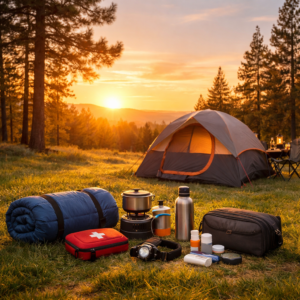
Alongside your security setup, make sure your essential camping first aid kit is fully stocked — security is about total preparedness, not just alarms.
Power and Battery Options: What Lasts Longest Outdoors
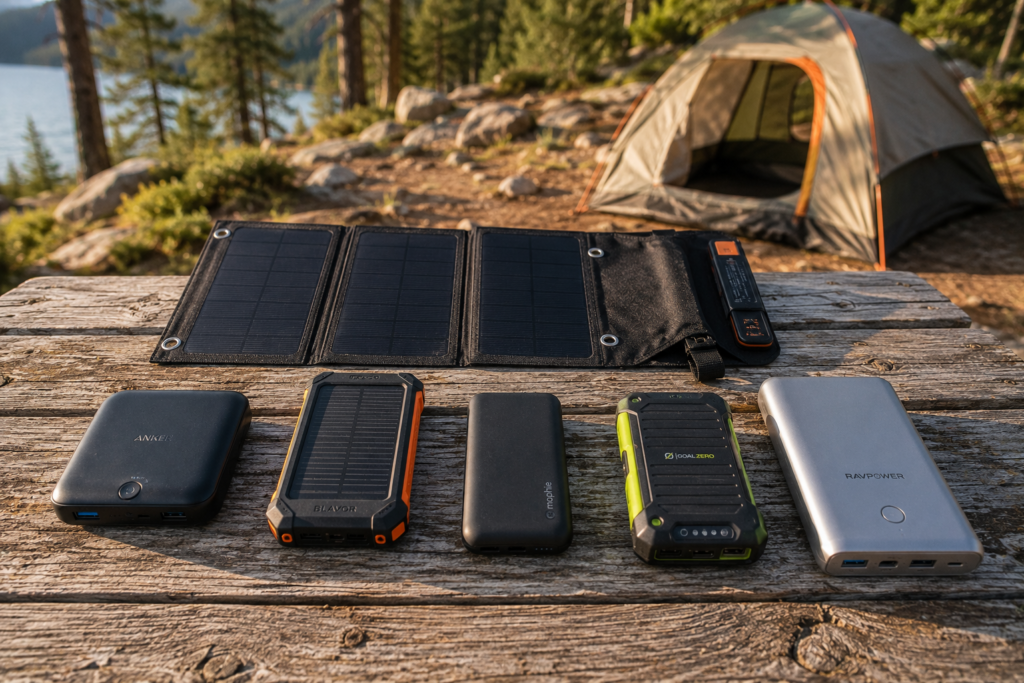
- AA battery-powered sensors: Most reliable in cold weather. Batteries are universally available. Long life on standby mode (weeks to months). The practical choice for most camping situations.
- Rechargeable USB sensors: Convenient if you have a power bank or vehicle USB. Check the runtime between charges — cheaper models may only last 2-3 days on a charge, which is not enough for a week-long trip.
- Solar-powered sensors: Excellent for extended or static setups. Less reliable in dense forest or heavily overcast conditions. Best as a supplement rather than a sole power source.
- Propane or liquid fuel-powered sensors: Rare in camping security but used in professional wildlife monitoring. Not practical for recreational camping.
A security system at camp is only as useful as its power source — our best camping power banks guide covers the rugged, weatherproof picks that keep devices running overnight in all conditions.
| COLD WEATHER TIP | In very cold conditions, keep spare AA batteries in an inner jacket pocket close to your body overnight. Cold dramatically reduces battery capacity. Warm batteries put back into your sensor in the morning will perform significantly better than batteries left in the device overnight. |
Frequently Asked Questions About Camping Security Systems
Do camping security alarms actually keep bears away?
Alarms deter bears only when they trigger loudly enough to startle the animal at a point where it still has room to retreat. A loud alarm at 50 feet gives a bear the chance to move away. A loud alarm at 5 feet is just loud and upsetting for everyone involved. The deterrence value comes from early detection — which is why the outer detection zone matters most. Properly stored food and scent management remain more important than any alarm system. An alarm supplements good camping practice; it does not replace it.
What is the best campsite perimeter alarm for solo camping?
For solo camping, a compact PIR motion sensor with a vibrating receiver that clips to your sleeping bag is the most practical option. You get silent personal alerts that wake you without alerting whatever triggered the sensor. Paired with a paracord tripwire with a tin can rattle for the inner zone, this two-layer setup covers most situations and adds minimal weight to your pack. The LETWESAF radar alarm is the better choice if you camp in wet or foggy conditions where PIR sensors struggle with false alarms.
How do I stop my camping alarm from triggering all night on deer?
This is the most common frustration with motion sensor camping alarms. The fix is placement and sensitivity calibration. Mount PIR sensors at 8-12 feet above ground to focus on large animal body-heat signatures rather than small animal ground traffic. Adjust sensitivity to the lower setting if available. Clear swaying vegetation from in front of the sensor. Use a dual-technology sensor that requires both heat and movement to trigger. Set a 3-5 second delay filter to ignore brief crossings. Test by walking through the detection zones yourself before dark and adjust from there.
What should I do when my campsite alarm goes off at night?
Stay calm and stay inside the tent. Turn on a bright torch or headlamp pointed outward through the tent mesh — sudden bright light startles most wildlife. Make noise calmly — talk in a firm, clear voice: ‘Hey bear, go on.’ Do not open the tent until you have some idea of what triggered the alarm. If you have a bear spray, have it accessible but do not open the tent to use it unless an animal is attempting to enter. If you have a satellite communicator, have it within reach. Once the noise has stopped and a minute or two has passed without further alerts, assess whether to investigate.
Our emergency signaling tips for lost campers guide covers how to signal for help if a wildlife encounter or other emergency escalates beyond what your alarm system can handle.
Do I need a camping security system at an established campground?
At a busy established campground with a host, neighbors, and regular ranger patrols, a security system is optional. The social environment itself provides a level of deterrence and awareness. Where camping security systems add the most value is at dispersed wilderness campsites, remote backcountry locations, solo camping situations, and any campsite with documented regular wildlife activity. If you are camping in bear country regardless of the site type, a perimeter alarm combined with proper food storage is always worth the minimal weight and setup time.
Sleep Soundly Out There: Building the Campsite Security System That Works for You
The best camping security system is not necessarily the most expensive or the most technically advanced. It is the one you will actually set up consistently, position deliberately, and trust enough to sleep through.
For most campers, that means a quality PIR sensor or radar alarm for early warning, backed up by something as simple as a paracord tripwire for the inner zone. Understand where wildlife approaches from, position your sensors with intention, calibrate them to reduce false alarms, and combine the whole thing with sound food storage and scent management.
Technology gives you information. What you do with that information — the calm, prepared response — is what actually keeps you safe out there.
A campsite security system is one more item that belongs on every camper’s pre-trip list — add it to your complete camping checklist for new campers alongside your first aid kit and navigation tools. The peace of mind is worth the small weight in your pack.
Security systems help you stay safe at camp — but if something goes wrong in the wider wilderness, our emergency signaling tips for lost campers guide covers how to get found faster once you need rescue.