Best Camping Backpacks: Remarkable Picks for Every Camper and Trip
-
| Founder & Content Creator

Latest Posts
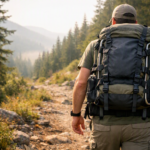
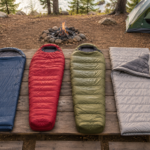
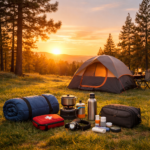
A camping backpack is the one piece of gear that touches everything else you own. It carries your shelter, your sleep system, your food, your water, your layers — and if it doesn’t fit properly, it makes every mile harder than it needs to be. The right pack doesn’t make itself noticed. It just works, mile after mile, while everything else gets your attention.
The confusing part isn’t the price or the brand. It’s that nobody tells you the things that actually matter before you buy: measure your torso before you look at any spec sheet. Load the pack with real weight before you trust how it feels. And decide whether you actually need a backpacking pack at all, or whether a simpler option would serve you better.
This guide works through all of that before the product recommendations — because a great pack chosen for the wrong body and the wrong trip is still a bad purchase.
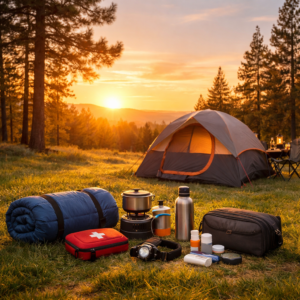
Building your full camping kit? Our complete camping checklist for new campers covers everything that goes alongside a good pack on your first trip.
Before You Buy: Two Things You Must Do First
Most people start by browsing packs online. Here’s what to do first instead.
Step 1: Measure Your Torso Length (Not Your Height)
Backpack sizing is based on torso length, not height. Two people of the same height can have torso lengths that differ by several inches — and if you put the wrong torso length in a pack, it won’t fit properly regardless of how much you adjust the straps.
How to measure: Tilt your chin down to your chest and feel for the bony bump at the base of your neck — this is your C7 vertebra, and it’s the top measurement point. Then place your hands on your hip bones and trace an imaginary line across to your spine — this is the bottom point. Measure between these two points. Most adults fall between 15 and 22 inches. This number, not your height, is what determines your pack size.
If you’re between sizes, most experienced hikers and gear experts recommend sizing down for a more secure, controlled carry. A pack that fits snug generally performs better than one that’s slightly too long.
Step 2: Try It On With Real Weight Before You Commit
An empty backpack tells you almost nothing about how it will feel with 25 or 35 pounds of gear. Hip belts that feel fine empty can slide around or pinch under load. Shoulder straps that seem comfortable can dig in when the frame is carrying real weight.
If you’re buying in-store, ask to load the pack with real weight before you decide — most reputable outdoor shops have sandbags for exactly this purpose. If you’re buying online, plan to test the pack fully loaded on a short walk before the return window closes. A good pack with a correctly measured torso fit and a well-adjusted hip belt should transfer most of the weight to your hips immediately, with your shoulders just stabilizing the load rather than carrying it.
The one-sentence test: If your shoulders are taking most of the weight, your hip belt isn’t doing its job — and either the torso length is wrong, or the belt isn’t tightened correctly around your hip bones.
How Much Pack Do You Actually Need — Litres Explained Simply
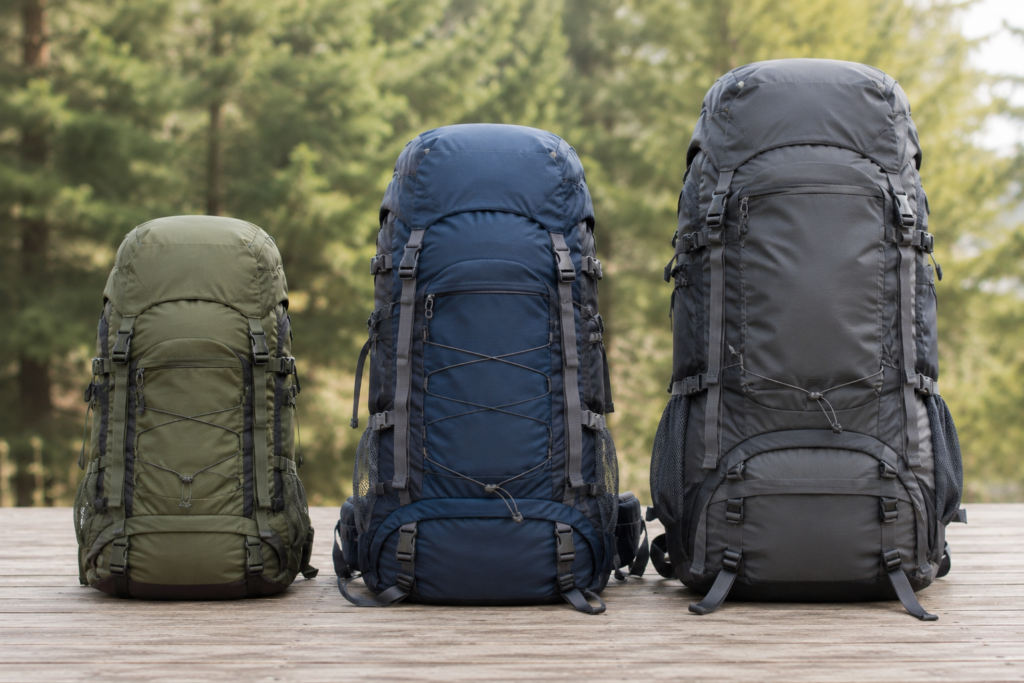
Litre capacity is what most buyers focus on first. It’s actually one of the last things to worry about, once you know your torso length and how you camp. Here’s the straightforward version.
A Better Way to Think About Pack Volume
| Trip Length | Typical Gear Weight | Suggested Volume | Why |
| 1-2 nights | Under 25 lbs | 35-45 litres | Weekend kit: tent, sleeping bag, pad, food, water — everything fits in a nimble pack |
| 2-4 nights | 25-35 lbs | 50-60 litres | The sweet spot for most recreational campers — enough room for comfort items without going overboard |
| 5-7 nights | 35-45 lbs | 60-70 litres | Extended trips or camping in colder weather where gear is bulkier |
| 7+ nights / family carry | 45-60 lbs | 70L+ | Expedition or family trips where one adult is carrying gear for multiple people |
The 20% rule: As a safety guideline, your fully loaded pack shouldn’t regularly exceed 20% of your body weight. A 70kg (154 lb) person should aim to keep their pack under 14kg (30 lbs) for day-to-day hiking comfort. Heavier than this and the load starts causing real strain on hips, knees, and back over time.
Heading somewhere with serious elevation? Our mountain camping for beginners guide covers how altitude affects gear choices and packing decisions specifically.
Do You Actually Need a Backpacking Pack — or Something Simpler
This is the question no commercial pack review ever asks, because the answer for some readers is ‘no.’
A technical backpacking pack — with an internal frame, load lifters, hip belt, and suspension system — is designed to carry 25-50 pounds comfortably over multiple miles on uneven terrain. If your camping involves driving to a campsite, setting up within 50 metres of your car, and only walking the camp itself, you don’t need one.
- Car camping without long walks: a large duffel bag, a soft-sided tote, or a basic pack without a technical suspension system is completely fine. You’re carrying gear from your car to a tent, not hiking miles with it on your back.
- Hike-in camping (short trails, 1-3 miles): a daypack with some extra volume (20-35L) handles this for a weekend trip with a light kit. A technical backpacking pack is still overkill.
- Overnight or multi-day backpacking: (3+ miles on trail, camping away from the car): this is where a proper backpacking pack earns its price. The suspension system, load lifters, and hip belt design all do real work at 25-45 pounds over a full day of hiking.
Honest money-saving note: If you’re a car camper who occasionally does a short hike-in trip, buy a pack that suits your most common use, not your most aspirational one. Spending $300 on a technical backpacking pack that lives in your car boot 90% of the time is a genuine waste of money, however good the pack is.
Best Camping Backpacks — Honest Picks for Every Camper
These picks are chosen based on who actually benefits most from each one — not just a generic ranked list. Find your situation in the category labels before looking at the specs.
Best Overall — Osprey Atmos AG LT 65 (Men’s) / Aura AG LT 65 (Women’s)
The Osprey Atmos AG LT 65 is the most consistently comfortable pack in its class — and ‘comfortable’ is doing real work in that sentence. The suspended mesh back panel creates an air channel between the pack and your spine, which means your back actually breathes on long hiking days instead of becoming a heat and sweat trap. More importantly, the trampoline-style mesh wraps around onto the hip belt itself, creating a uniquely hugging, contouring fit that the pack is genuinely known for.
That hip belt design is what separates this from packs with similar specs on paper. Where other packs have foam hip belts that compress under load, the Atmos AG LT’s mesh belt molds to the exact curve of your hips — which means the weight sits where it should sit, from the first mile to the last.
- Weight: approximately 4.2 lbs — not ultralight, but reasonable for the comfort delivered
- Volume: 65L — plenty of room for 4-7 night trips with a full kit
- Back panel: suspended AirSpeed mesh — keeps the pack off your spine with a ventilation channel
- Hip belt: mesh-wrapped, contours to your hip shape and holds position under heavy loads
- Max comfortable load: 40 lbs — above this, the trampoline suspension’s centre of gravity can shift slightly
- Best for: campers who want the most comfortable all-day carry available in a 60-65L pack
- Who it is NOT for: weight minimalists, anyone who regularly hauls 45+ lbs (a stiffer foam-framed pack handles very heavy loads more efficiently)
Where to buy: https://www.amazon.com/Osprey-Atmos-Backpack-Mens-Medium/dp/B0BKQK88PL/
Women’s version: https://www.amazon.com/Osprey-Womens-Hiking-Backpack-Antidote/dp/B0BKQHGN8W/
Best All-Rounder for Most Campers — Gregory Paragon 60 (Men’s) / Maven 58 (Women’s)
The Gregory Paragon 60 is what most campers and backpackers actually need — a well-balanced pack that’s comfortable enough for all-day carrying, organized enough for multi-day trips, and priced at a point that doesn’t require a long justification conversation. It’s been the consensus overall pick across multiple independent gear publications for its combination of a pivoting hip belt, a side-access zipper for getting into the pack without fully unpacking it, and a mesh back panel that ventilates without going full trampoline.
The pivoting hip belt is worth calling out specifically: it moves with your hips as you walk across uneven terrain, which prevents the hip belt from grinding against your hip bone on descents — a small detail that matters a great deal by mile ten.
- Weight: approximately 3.5 lbs — noticeably lighter than the Atmos at similar volume
- Volume: 60L / 58L (women’s) — ideal 3-5 night range
- Max comfortable load: 50 lbs — the steel frame handles heavier loads well
- Side zipper access: one of the best features for camp organization — no full unpack required
- Shoulder strap has a clip-in pocket sized for a Garmin inReach or similar GPS messenger
- Best for: most recreational backpackers and campers who want a reliable, well-organized pack they can grow into
- Who it is NOT for: weight minimalists who need every ounce counted; anyone who prioritizes back ventilation above all else (the Atmos or Exos win there)
Where to buy (Men’s): https://www.rei.com/product/238071/gregory-paragon-60-pack-mens
Where to buy (Women’s): https://www.rei.com/product/238072/gregory-maven-58-pack-womens
Best Budget Backpacking Pack — REI Co-op Flash 55
The REI Flash 55 is the pack that keeps coming up as the best value in backpacking — and it earns that consistently because it’s actually comfortable, not just cheap. At under three pounds and with a roll-top closure that compresses unused space as you consume food over a multi-day trip, it’s built with the thinking of someone who’s actually hiked with it.
The modular design deserves mention: external pockets and straps can be removed to reduce weight further, or left on for organization. The forward-facing side water bottle pockets — angled outward so you can grab a bottle one-handed without stopping or twisting — are one of those small design details that only becomes obvious once you’ve struggled with a backwards-facing pocket on a lesser pack.
- Weight: approximately 2.8 lbs — one of the lightest sub-$250 framed packs available
- Volume: 55L — enough for weekend to 4-night trips with a reasonably light kit
- Max comfortable load: 30-35 lbs — above this, lighter-duty frame and fabric starts to show
- Roll-top closure: compresses the pack as food weight decreases — no dead air space on day three
- Packmod system: pockets and straps are removable to save weight or reconfigure storage
- Best for: budget-conscious campers who want a quality pack without spending $300; backpackers with a dialled light kit under 30 lbs
- Who it is NOT for: anyone planning to carry more than 35 lbs regularly; car campers who don’t need lightweight construction
Where to buy (Men’s): https://www.rei.com/product/236975/rei-co-op-flash-55-pack-mens
Where to buy (Women’s): https://www.rei.com/product/236976/rei-co-op-flash-55-pack-womens
Best Pack Under $200 — REI Co-op Trailmade 60
The REI Trailmade 60 is the pick for people who want a genuinely complete, well-made backpacking pack without spending much money. It stands out from the budget tier because it’s built with durable recycled nylon rather than thin cost-cutting materials, has a torso adjustment that fits a wide range of body sizes, and comes with more inclusive sizing than almost any other pack — accommodating waist sizes up to 52 inches.
What it gives up for the price is mostly refinement — the fixed lid can’t be removed or expanded over a large load, the foam back panel is more basic than the premium picks, and there’s no trampoline suspension. For a beginner’s first proper pack, none of that matters anywhere near as much as the fact that it fits a wide range of people, holds up to trail use, and doesn’t cost as much as a weekend camping trip.
- Weight: approximately 3.3 lbs — solid for the price tier
- Volume: 60L — good range for 3-5 night trips
- Sizing: most inclusive in this guide — two widths, torso adjustment to 21 inches
- U-shaped front zipper: opens the entire face of the main compartment — rare at this price point
- Best for: beginners buying their first proper backpacking pack; anyone who needs wide-fit sizing; budget-conscious campers who still want something that will last
- Who it is NOT for: experienced backpackers who want ventilation or a floating lid; weight-conscious hikers
Where to buy: https://www.rei.com/product/C01915/rei-co-op-trailmade-60-pack-mens
Best Ventilated Back Panel — Osprey Exos 58 (Men’s) / Eja 58 (Women’s)
If your camping happens in warm weather and you tend to run hot, or you’re heading somewhere humid where a sweaty back is a misery rather than just an inconvenience, the Osprey Exos is the right choice. The AirSpeed suspension keeps the pack completely away from your spine with a tensioned mesh trampoline back panel — at low and moderate loads, this genuinely transforms how comfortable sustained hiking feels on a warm day.
The trade-off is load capacity: above about 35 lbs, the centre of gravity shifts slightly away from your body and the pack starts to feel less controlled on steep terrain. Under that weight, the Exos is one of the best-carrying packs available at any price.
- Weight: approximately 2.8 lbs — near the Flash 55 in weight, with a better suspension
- Volume: 58L — 3-5 night range at moderate weights
- Max comfortable load: 35 lbs — the key limitation of this design
- AirSpeed suspension: tensioned mesh trampoline keeps the pack off your spine entirely
- Torso adjustment: can be adjusted while wearing the pack — useful on longer trips where load changes affect ideal fit
- Stow-on-the-Go: trekking poles slot into front strap without stopping — a trail-specific detail that matters on technical terrain
- Best for: warm-weather campers, humid-climate hikers, anyone who prioritizes back ventilation and carries under 35 lbs
- Who it is NOT for: cold-weather camping (the ventilation that keeps you cool in summer can work against you in cold); anyone carrying 40+ lbs regularly
Where to buy (Men’s): https://www.amazon.com/Osprey-Exos-Mens-Backpacking-Backpack/dp/B09NRR5BVJ/
Where to buy (Women’s): https://www.amazon.com/Osprey-Eja-Womens-Backpacking-Backpack/dp/B09NRQRJXN/
Best Lightweight Versatile Pack — Granite Gear Blaze 60
The Granite Gear Blaze 60 earns a spot here for one reason: it’s the lightest pack on this list that can still comfortably handle 45-50 lbs, which puts it in a category of one. Most packs that weigh under 3 lbs either compromise heavily on load carrying above 30 lbs, or on features, or on durability. The Blaze manages all three because its ROBIC nylon fabric is genuinely tougher than it has any right to be at this weight, and the internal frame transfers load to the hips more efficiently than most ultralight designs.
A hidden front zipper lets you access the main compartment from the outside without rolling down the rolltop — a detail that makes a real difference at camp when you want your stove at the bottom of your pack and don’t want to unpack everything to find it.
- Weight: approximately 3 lbs — lighter than the Gregory Paragon at a similar capacity
- Volume: 60L — flexible for 3-7 night trips depending on how light your kit is
- Max comfortable load: 50 lbs — the highest load limit for a sub-3-lb pack on this list
- Hidden front zipper: accesses the main compartment from the front without opening the rolltop
- ROBIC nylon: abrasion-resistant for its weight — takes scraping against rocks without tearing
- Best for: campers who want to carry a lighter pack but haven’t committed to full ultralight gear; anyone who needs a pack that handles heavy loads without being heavy itself
- Who it is NOT for: budget buyers — the Blaze sits at $300; anyone who needs maximum pocket organization
Where to buy: https://www.amazon.com/Granite-Gear-Blaze-Backpack-2019/dp/B07N1Z3DSW/
Best for Beginners on a Tight Budget — Kelty Asher 55
The Kelty Asher is for the camper who wants to try backpacking properly without spending $200+ on a pack before they know whether they’ll stick with it. It delivers the fundamentals well: a supportive foam hip belt, an adjustable torso, and a frame that transfers weight to your hips competently at loads up to 45 lbs. The build quality is more modest than the other picks here, and the hip belt pockets are minimal — but the comfortable carry and budget price make it the right first-pack purchase for a lot of people.
- Weight: approximately 2 lbs 15 oz — respectable for an entry-level framed pack
- Volume: 55L — solid 2-4 night range
- Max comfortable load: 20-40lbs — better than expected for the price
- Best for: first-time backpackers; anyone unsure whether they’ll camp regularly enough to justify a $250+ investment
- Who it is NOT for: experienced hikers who need hip belt pockets, a removable lid, or premium ventilation
Where to buy: https://www.amazon.com/Kelty-Backpack-Multi-Day-Backpacking-Lightweight/dp/B096SZH3MC/
Honest note: If after one or two trips you decide backpacking is something you’ll keep doing, consider this a starter pack rather than a long-term investment. The comfortable carry makes it a good first pack — just know there’s an upgrade path worth considering once you’re committing to the activity.
Camping Backpacks for Family Trips — What Nobody Else Covers
Choosing a backpack for family camping isn’t the same decision as choosing one for a solo or couples trip — the variables are different.
When Kids Should Carry Their Own Pack
Children over about 6-7 years old can comfortably carry a small daypack on their own — sized to their torso, with a proper hip belt, carrying no more than 10-15% of their body weight. Below that age, a child-specific pack exists but is largely unnecessary since they’re being carried or hiking with very little gear of their own.
For school-age children on camping trips, a 15-20L kids’ daypack that carries their sleeping bag and personal items is realistic. What to avoid: adult packs sized down with straps pulled tight — adult pack geometry doesn’t fit a child’s shoulder width or torso proportions, and can cause discomfort or posture issues over a day on the trail.
For the full family camping setup — not just gear — our camping with kids guide covers planning, sleeping arrangements, and how to keep everyone comfortable at camp.
How to Split the Load Across Adults for Family Camping
On a family camping trip with young children, one adult often ends up carrying significantly more than the other — shelter, food, and group cooking gear add up fast when a child isn’t carrying their own weight. A few practical things that help:
- Shelter load balancing: split tent poles and body between two packs rather than one person carrying the whole tent
- Food distribution: day-by-day meal packs across both adults’ packs — the load gets lighter at the same rate as meals are consumed rather than one person finishing with a light pack and the other still carrying day three’s food
- Pack volume selection: if one adult is carrying substantially more load, a 65-70L pack on the heavier carrier and a 50-55L on the lighter carrier is a sensible split rather than matching volumes
- Heavier adult pack choice: choose a pack with a proper load-bearing hip belt rated for 40+ lbs, not a lightweight adventure pack designed for 25-30 lbs
How to Actually Fit a Backpack — the Hip Belt Rule
Knowing the right pack size is only half the job. Knowing how to put it on correctly is the other half — and it’s where most first-time buyers lose comfort unnecessarily.
The 80/20 Rule — Why Your Hips Should Carry Most of the Weight
Approximately 80% of a backpack’s weight should ride on your hips — not your shoulders. Your hips are the strongest, most load-bearing part of your body. Your shoulders are not built to carry sustained weight over miles. If your shoulders hurt at the end of a hiking day, it’s almost always because the hip belt isn’t doing its job.
How to set it correctly: load the pack with your actual camping gear (or something close to it), then put the pack on with the hip belt sitting directly on top of your hip bones — not below them, not at your natural waist. Buckle and tighten the hip belt until it’s snug against your hips. Now loosen your shoulder straps and shake gently. The pack should stay in place on your hips, with only light contact on your shoulders for stability.
Quick diagnostic: Drop your arms straight down beside your body. If your swinging forearms hit the hip belt pockets, the belt has slid too low. If the belt feels loose and the weight is all on your shoulders, tighten the hip belt before adjusting anything else.
Load Lifters, Sternum Straps, and What They Actually Do
- Load lifters: the short straps between the top of the shoulder pad and the pack body. Pulling them angled at roughly 45 degrees brings the top of the pack closer to your body — this shifts the centre of gravity inward and makes heavy loads feel lighter and more controlled. They don’t lift the load; they pull it in.
- Sternum strap: the horizontal strap across your chest connecting the two shoulder straps. Its job is to stop the shoulder straps from sliding outward toward your arms as you move. Pull it snug but not tight enough to restrict breathing — it’s a stabilizer, not a load-carrier.
- Compression straps: the straps running vertically or diagonally across the sides of the pack. These pull the load in closer to the frame when the pack isn’t full — important for stability when you’ve eaten half your food and the pack is only half loaded. A loose, half-full pack sways with every step; compressed properly, it stays controlled.
Frequently Asked Questions About Camping Backpacks
What size backpack do I need for a 3-day camping trip?
For a 3-night trip with average camping gear (sleeping bag, tent, pad, food, water, and layers), a 50-60 litre pack is the right range for most people. If your gear is lightweight and well-dialled, the lower end of that range works. If you’re still building your kit and running heavier synthetic gear, aim for 60L.
What’s the difference between a backpacking pack and a hiking daypack?
A backpacking pack has an internal frame, a full suspension system with load lifters, and a structured hip belt designed to transfer 25-50 lbs to your hips over multiple hours. A hiking daypack is a simpler, smaller bag (15-35L) designed for day trips with lighter loads — water, snacks, a layer, and basic gear. The two aren’t interchangeable: a daypack won’t carry overnight camping loads comfortably, and a backpacking pack is overkill for a day hike.
How do I know if my backpack fits correctly?
Three signs it fits well: the hip belt pads sit over your hip bones (not below them), most of the weight shifts to your hips when you loosen your shoulder straps, and the load lifters angle at roughly 45 degrees from the top of the shoulder straps. If your shoulders take most of the weight, either the torso length is wrong or the hip belt needs to be tightened.
Is an internal frame or frameless backpack better for camping?
For most campers, an internal frame pack is the better choice. The frame transfers weight to the hip belt efficiently and keeps the load organized against your back. Frameless packs are significantly lighter but rely on well-packed, compressible gear to provide any structure — they’re a deliberate choice for experienced ultralight hikers who have specifically dialled their kit, not a good beginner option.
Can I use a regular backpack for camping instead of a hiking pack?
For car camping or short walk-ins: yes, a large regular backpack works fine. For multi-day backpacking trips: a regular backpack without a hip belt and load-bearing suspension will put all the weight on your shoulders, which becomes painful quickly at hiking loads. For anything above 15-20 lbs over more than an hour of walking, a pack with a proper hip belt and internal frame makes a significant difference to comfort and reduces injury risk.
The Right Pack Makes Every Mile Better — Here Is How to Find Yours
A camping backpack is genuinely one of those purchases where getting the right one makes everything else easier — and getting the wrong one makes every trip slightly harder than it needs to be. The spec sheet matters, but less than the torso measurement. The price matters, but less than the fit.
Measure your torso. Load it with real weight before deciding. Match the volume to your actual trip length, not a theoretical one. And if you’re a car camper who only hikes a short trail to a site, buy what you actually need rather than what the most impressive spec sheet recommends.
For the full picture of everything else that goes alongside a good pack, our complete camping checklist for new campers and our seasonal camping gear guide cover the rest of the kit across every season.
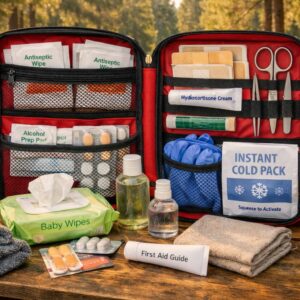
Heading somewhere remote enough that pack choice really matters? Our wilderness emergency evacuation guide and essential camping first aid kit cover the safety side of gear for backcountry camping.