Best Camping Power Banks & Solar Chargers: Tested Picks
-
| Founder & Content Creator

Latest Posts
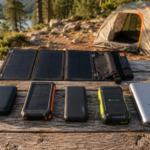


The best camping power banks are the difference between a dead phone at golden hour and a photo you’ll actually keep. Your headlamp, GPS, satellite messenger, and phone all run on batteries that don’t last forever, and the middle of a campground or a switchback three miles from the trailhead is a rough place to discover that the hard way. We’ve spent time digging through what actually holds up in the field, not just what looks good in a listing, so you can pick one and stop thinking about it.
Nothing kills the mood at camp faster than watching someone hold their phone up at a weird angle chasing one bar of signal while the battery ticks down. A good power bank fixes that particular flavor of vacation stress.
Why You Need Backup Power at Camp
Camping has changed. Phones aren’t just for photos anymore — they’re your map, your flashlight backup, your kids’ entertainment on a rainy afternoon, and often your only way to call for help. Add in GPS watches, satellite messengers, and rechargeable headlamps, and a single weekend trip can involve four or five devices that all need juice at some point.
If you’re still working through your gear list, our
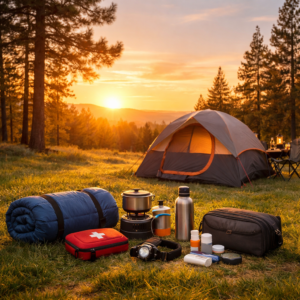
If you’re building out your trip supplies from scratch, our complete camping checklist for new campers is a good place to start before you get into add-ons like power banks.
A dead power source is more than an inconvenience. If you’re relying on a phone for navigation or emergency contact, running out of charge in the backcountry can turn a minor hiccup into something serious — which is exactly why we treat this as gear worth researching properly, not an afterthought you grab at checkout.
How We Chose These Camping Power Banks
Four factors stood out as the ones that actually separate a good power bank from a mediocre one: how much usable capacity it delivers relative to its weight, how it holds up when dropped or rained on, how fast it recharges, and whether it keeps performing when temperatures drop. The picks below are weighted toward products that score well across all four — not just the ones that win on a single spec.
Best Camping Power Banks for Every Trip
Here are the picks we’d actually recommend, organized by the kind of trip you’re taking rather than a single “best of everything” list — because the right power bank for a solo backpacking trip is not the right one for a family car-camping weekend.
Best Overall Camping Power Bank — Nestout 15000mAh
Where to Buy: https://www.amazon.com/ELECOM-NESTOUT-Portable-15000mAh-Charging/dp/B0C6RHFMV8/
This one earns the overall pick because it keeps showing up at the top of independent testing from more than one outdoor gear site, and for good reason. It carries a rugged, waterproof build rated to survive submersion and dust, delivers enough capacity for three to four phone charges, and includes a small tripod that lets you stand it up on uneven ground or hang it inside a tent.
Who it’s for: Anyone who wants one power bank that can handle rain, dust, and the occasional drop without babying it. Compared to slimmer travel-focused banks, it’s a little heavier, but that trade-off buys real peace of mind at a campsite where things get knocked around.
Best Budget Camping Power Bank — Anker 313 (PowerCore 10K)
Where to Buy: https://www.amazon.com/Anker-Portable-PowerCore-High-Speed-Technology/dp/B08TW84CR1/
If you just want something dependable without spending much, this is the one testers kept coming back to. It’s slim enough to disappear into a daypack pocket, delivers two to three full phone charges from its 10,000mAh cell, and Anker’s reputation for reliability held up across multiple rounds of testing.
Who it’s for: Weekend campers and casual hikers who want a reliable backup without paying for features they won’t use. The one trade-off is it only charges one device at a time — fine for a solo camper, less ideal if you’re splitting power across a family.
Best Power Bank for Backpacking — Nitecore NB10000
Where to Buy: https://www.amazon.com/Nitecore-NB10000-Ultra-Slim-Quick-Charge-Flashlights/dp/B0C1Q7R2HS/
Ounce-counters, this is the one. Independent efficiency testing using a multimeter and dummy load found it delivers more usable power per gram than nearly anything else in its capacity class, all while staying under six ounces. It also recharges faster than most 10,000mAh banks.
Who it’s for: Thru-hikers, backpackers, and anyone counting grams. The trade-off is reduced efficiency in cold weather — if you’re winter camping, pack it inside your sleeping bag or jacket overnight rather than leaving it in an outside pocket.
Most Rugged and Waterproof Power Bank — Dark Energy Poseidon Pro
Where to Buy: https://www.amazon.com/Dark-Energy-Poseidon-Pro-Indestructible/dp/B0FB6HPPK8/
Built for people who genuinely abuse their gear. It carries a high waterproof rating that allows full submersion for extended periods, and manufacturer testing claims it can survive a 75-foot drop and weeks of freezing temperatures. Reviewers who tossed it in snow and backpacks without any special care reported it performing like new afterward.
Who it’s for: Anyone heading somewhere genuinely remote or wet — kayaking trips, monsoon-season camping, or basecamp setups where gear gets tossed around. It’s a few ounces heavier than banks with similar capacity, which is the fair price for that level of protection.
Best High-Capacity Power Bank for Families — UGREEN 145W
Where to Buy: https://www.amazon.com/UGREEN-25000mAh-Portable-Charging-Compatible/dp/B0BJQ7F16T/
When you’ve got multiple kids, multiple phones, a tablet for the car ride, and maybe a laptop for remote work at the campsite, capacity matters more than pocket-size. This bank held enough charge in testing to top off two smartphones and a tablet simultaneously with over half its capacity left over.
Who it’s for: Families and group campers who’d rather carry one larger battery than juggle three small ones. It’s heavier and bulkier than the other picks here, so it’s better suited to car camping than a pack you’re carrying miles down a trail.
Best Solar Chargers for Camping
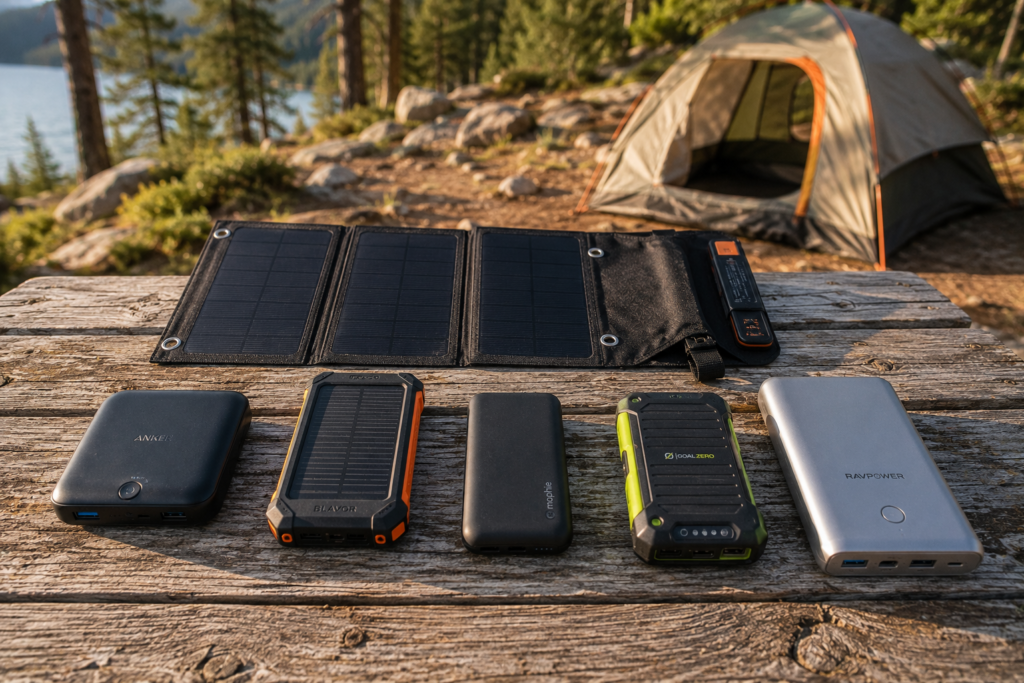
Solar makes the most sense for trips longer than a few days, where you can’t just recharge everything the night before you leave. One thing worth knowing upfront: solar panels work best charging a battery bank at camp, not clipped to a moving backpack — testers who tried the backpack-mounted approach found the sun angle changes too much while walking to produce reliable power. Set it up at your site, angled toward the sun, and let it top off a battery instead.
Best Overall Solar Charger — BigBlue 28W
Where to Buy: https://www.amazon.com/BigBlue-Foldable-Waterproof-SunPower-Cellphones/dp/B01EXWCPLC/
In side-by-side output testing using a digital USB tester, this panel consistently produced more power per hour than similarly priced competitors. It folds down small, includes two USB ports so you can charge two devices at once, and comes with a built-in ammeter that shows you exactly how much power it’s generating in real time — handy for knowing whether you’ve got it angled correctly.
Who it’s for: Anyone on a multi-day trip who wants to top off a power bank during the day. Pair it with one of the battery packs above rather than plugging a phone straight into it — phones tend to lose their charging connection when clouds pass over and won’t reconnect on their own.
Best Solar Power Bank With a Built-In Battery — BioLite SolarPanel 10+
Where to Buy: https://www.amazon.com/BioLite-SolarPanel-Integrated-Power-Bank/dp/B08SHGP6ND/
This is the only panel in independent testing that ships with its own integrated 3,200mAh battery, meaning you can pre-charge it at home and still have backup power on a cloudy day or after dark. It includes a small sundial and rotating kickstand that helps you angle it correctly toward the sun without guessing.
Who it’s for: Campers who want a single, simpler piece of gear rather than a separate panel-and-battery combo. It’s a smaller wattage than dedicated panels, so it’s better suited to keeping one or two devices topped off than powering a whole family’s electronics.
How to Choose the Right Power Bank or Solar Charger
A few things matter more than brand name when you’re comparing options.
Capacity: How Many mAh Do You Actually Need
A 10,000mAh bank typically delivers two to three full phone charges and covers most weekend trips comfortably. Step up to 20,000mAh or higher if you’re charging multiple devices, camping for a week or more, or need to top off a tablet or laptop. Anything under 5,000mAh is really an emergency-only backup, not a primary charging solution.
Weight and Portability
For backpacking, aim for something in the five-to-eight-ounce range — enough capacity without adding noticeable weight to your pack. For car camping, weight matters far less than total capacity, so it’s fine to size up.
Weatherproofing and Durability
Look for an IP rating if you’re camping somewhere wet, dusty, or generally rough on gear. Not every power bank lists one, and plenty of unrated models will still survive a light drizzle, but if you’re rafting, kayaking, or camping through monsoon season, a rated model is worth the extra cost.
Solar vs. Battery-Only Charging
If your trips are three days or shorter, a good battery bank alone is usually all you need — solar adds weight and complexity that doesn’t pay off on a short trip. Once you’re out for five days or longer, or camping somewhere without easy access to an outlet, adding a solar panel to recharge your battery bank during the day starts to make real sense.
Frequently Asked Questions
How long do camping power banks last?
Most quality power banks handle around 500 to 1,000 full charge cycles before their capacity starts noticeably declining, which typically works out to three to five years of regular use. Storing your bank partially charged rather than fully drained or fully topped off between trips helps it last longer.
What size power bank do I need for a weekend camping trip?
For a solo camper or couple heading out for two or three nights, a 10,000mAh bank is usually plenty for keeping a phone and headlamp charged. If you’re bringing a GPS device, camera, or charging for a group, size up to 20,000mAh so you’re not rationing power.
Are solar chargers actually worth it for camping?
For trips under a week, most campers do fine with a battery bank alone. Solar becomes genuinely useful once you’re out for five or more days, camping somewhere remote, or trying to avoid draining a vehicle battery on a longer trip. Just plan to charge a battery pack with the panel rather than a phone directly.
Can I bring a power bank on a camping road trip flight?
Most airlines allow power banks in carry-on luggage but not checked bags, and many cap total battery capacity around 27,000mAh without special approval. Some countries have also introduced tighter in-flight restrictions recently, so it’s worth checking your airline’s current battery policy before you fly with camping gear.
How do I keep a power bank working in cold weather?
Cold noticeably reduces how much usable charge a power bank can deliver, sometimes by ten percent or more. Keep it in an inside jacket pocket, your sleeping bag, or close to your body overnight rather than in an outer pack pocket, and it’ll perform much closer to its rated capacity.
FAQ Schema (paste after FAQ section as Custom HTML block)Keep Your Camp Powered for Whatever’s Next
A reliable power bank is one of those small pieces of gear you barely think about until the moment you really need it. Whether you’re heading out for a quiet weekend or a longer trip off the grid, pair the right pick from this list with the rest of your seasonal camping gear checklist and you won’t be the one hunting for a signal bar with 3% battery left.
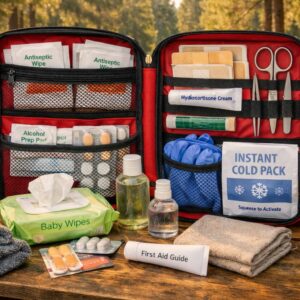
If you’re heading somewhere remote enough that backup power really matters, it’s worth pairing this gear with a broader look at wilderness emergency preparedness and making sure your camping first aid kit is just as dialed in as your electronics.
And if a portable charger has you thinking about the rest of your camp tech setup, our guide to camping security systems and monitoring gear covers the other side of keeping your site safe and powered overnight. Still shopping for the shelter itself? Start with our breakdown of how to choose the right tent for your trip.