Essential Camping First Aid Kit: Stay Prepared in the Wild
-
| Founder & Content Creator

Latest Posts

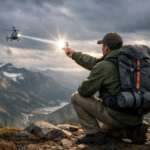
A camping first aid kit is not an optional extra — it is the single most important piece of safety gear you will pack for any outdoor trip. Tents, sleeping bags, camp stoves: all replaceable if forgotten. A first aid kit in a genuine emergency is not. Whether you are heading out for a weekend at an established campground or a week-long backcountry adventure, the right wilderness first aid supplies can be the difference between a minor inconvenience and a situation that gets serious very quickly.
The good news is that building the perfect camping medical kit is not complicated once you know what to include and why. This guide walks you through every essential item, how to pack it, how to use it, and how to customise your kit for different trip types — from family camping with kids to remote solo backcountry adventures. Let’s get into it.
Why Every Camper Needs a First Aid Kit — Even on Short Trips
Here is the thing about outdoor emergencies: they do not check your itinerary before happening. A one-night trip to a campsite 30 minutes from home can produce a deep blister, a twisted ankle on a short trail, an allergic reaction to a plant, or a burn from a camp stove. None of these are dramatic — but all of them are significantly better handled with the right supplies than without them.
In backcountry or remote camping situations, the stakes are higher. You may be hours or even days from the nearest medical facility. In those settings, a well-stocked camping emergency kit is genuinely your first line of medical defence. It buys you time, treats pain, prevents infection from escalating, and in serious cases, keeps someone stable until professional help arrives.
THE RULE OF THE THUMB
Scale your first aid kit to your trip. A weekend car camping trip near facilities needs a basic kit. A week-long backcountry hike in a remote location needs a comprehensive wilderness first aid kit with advanced supplies and ideally a wilderness first aid course behind you. The further from help you go, the more prepared you need to be.
The Most Common Camping Injuries and How to Treat Them
Before building your kit, it helps to understand exactly what you are building it for. These are the injuries and medical situations that come up most frequently on camping trips — in order of how commonly they occur.
Wound Care Emergencies — Cuts, Scrapes and Blisters
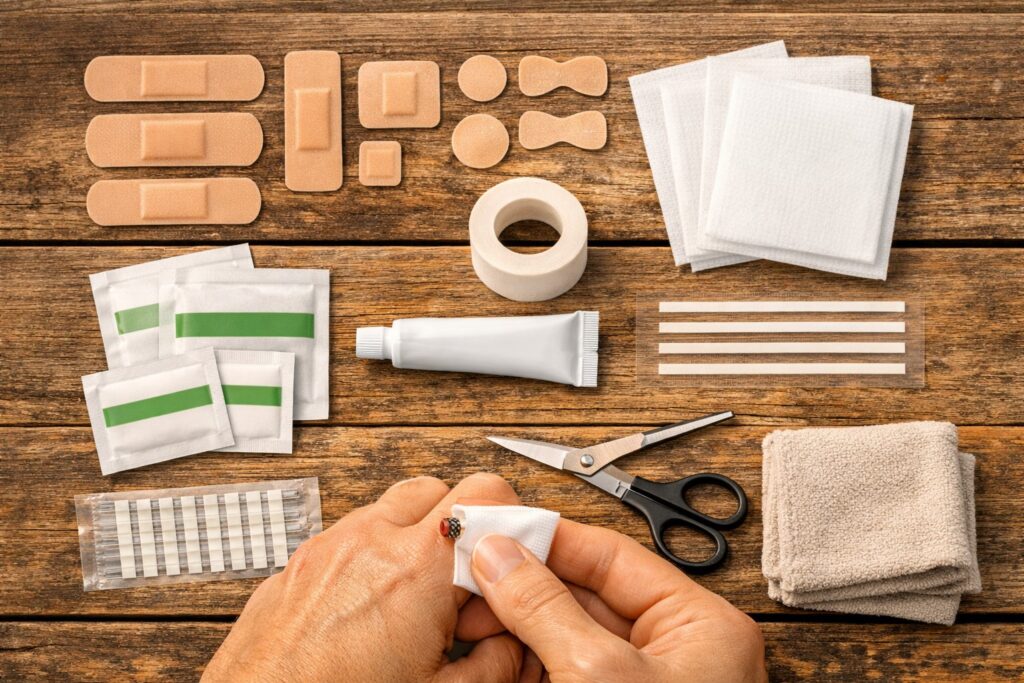
How to Clean and Dress a Wound Outdoors
Cuts and scrapes are the most common camping injury by a wide margin. The key is treating them promptly — outdoor environments are full of bacteria and the risk of infection is higher than at home. Here is the correct sequence
- Step 1: Rinse the wound thoroughly with clean water — remove all visible dirt and debris
- Step 2: Pat dry gently with a sterile gauze pad — never use fabric or clothing which introduces more bacteria
- Step 3: Apply antiseptic wipe or ointment — prevents infection from taking hold
- Step 4: Cover with an appropriately sized adhesive bandage or gauze pad secured with medical tape
- Step 5: Check the wound daily — redness, swelling, or warmth spreading from the wound means infection and needs medical attention
Blisters deserve special mention. They are the most common hiking-related injury and are almost entirely preventable with the right footwear and early treatment. The moment you feel a ‘hot spot’ — a rubbing sensation before a blister forms — apply moleskin or a blister plaster immediately. A hot spot treated takes five seconds. A full blister treated takes five days.
Burns from Campfire and Camp Stoves
Minor burns from campfires and camp stoves are extremely common and very treatable if handled correctly. For minor burns (redness, no blistering): cool the burn immediately with cool running water for at least 10 minutes — never apply ice, butter, or toothpaste (these are myths that cause more damage). Apply burn gel or aloe vera gel once cooled. Cover loosely with a sterile non-stick dressing. For blistered or deep burns — do not burst the blister, cover gently, and seek medical attention as soon as possible.
Insect Bites, Stings and Tick Removal
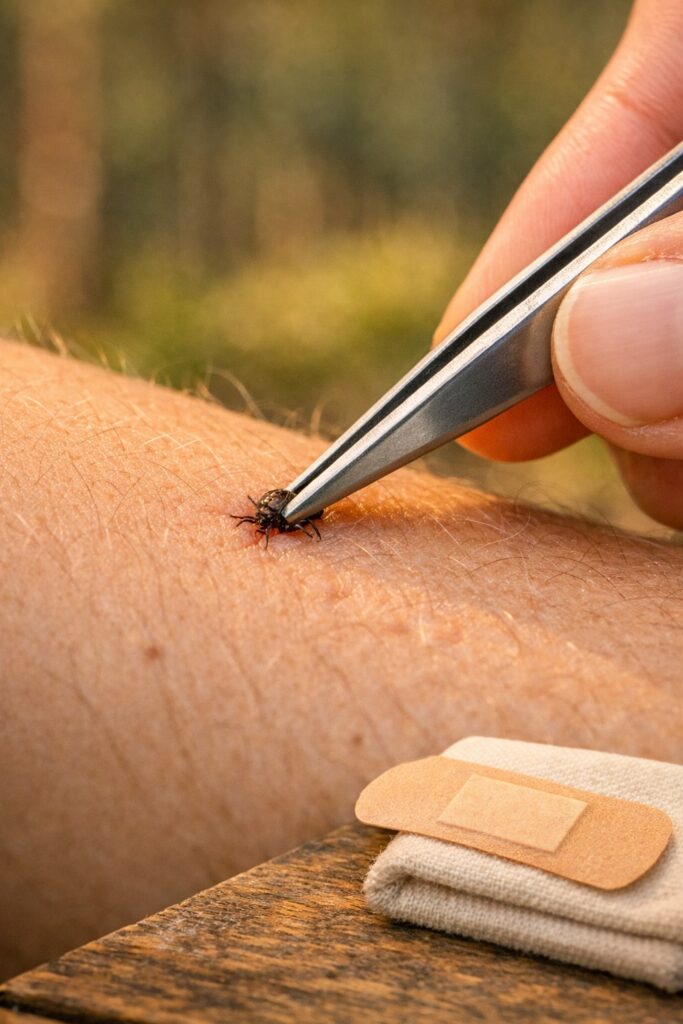
The Correct Way to Remove a Tick
Insect bites and stings are inevitable outdoors. Most are minor — treat with antihistamine cream for itching and hydrocortisone for inflammation. Watch for signs of allergic reaction: swelling beyond the bite area, hives, difficulty breathing. If allergic reaction is suspected, administer oral antihistamine immediately and monitor closely. If anaphylaxis is suspected — see H4 below.
Ticks are the most serious insect concern because of the diseases they can carry. The correct removal technique matters:
- Use fine-tipped tweezers — not fingers, not burning, not petroleum jelly
- Grip the tick as close to the skin surface as possible
- Pull upward with steady, even pressure — do not twist or jerk
- Do not crush the tick’s body — this can push contents back into the skin
- Clean the bite area with antiseptic wipe after removal
- Save the tick in a sealed bag if possible — useful for identification if symptoms develop
- Monitor for a bulls-eye rash (Lyme disease indicator) in the days following removal
Sprains, Strains and Muscle Injuries
Ankle sprains from uneven terrain are one of the leading causes of camping trips being cut short. The treatment protocol is the R.I.C.E method — see the Skills section below for the full breakdown. For your first aid kit, you need elastic bandages for compression, instant cold packs for swelling, and ibuprofen for both pain and inflammation. If weight-bearing is impossible after a sprain, the injury may be a fracture — immobilize, do not attempt to walk on it, and arrange evacuation.
Allergic Reactions and Anaphylaxis
What to Do if Someone Goes Into Anaphylactic Shock
Mild allergic reactions — rash, itching, mild swelling — respond well to oral antihistamines and hydrocortisone cream. Anaphylaxis is a severe, life-threatening allergic reaction that requires immediate action. Signs: throat tightening, difficulty breathing, swelling of face and lips, rapid heartbeat, pale or blotchy skin. If someone in your group has a known severe allergy, they must carry an EpiPen and you must know how to use it. Administer the EpiPen to the outer thigh, call emergency services immediately, and keep the person lying flat with legs raised. Anaphylaxis can progress very rapidly — do not wait to see if it improves.
Essential Camping First Aid Kit Checklist: Item by Item
Here is the complete camping first aid kit checklist, organized by category. Go through each section when packing — do not skip categories even if you think you won’t need them.
If you are building your full gear list from scratch, our [complete camping checklist for new campers] covers every item category beyond just first aid — start there before your first trip.
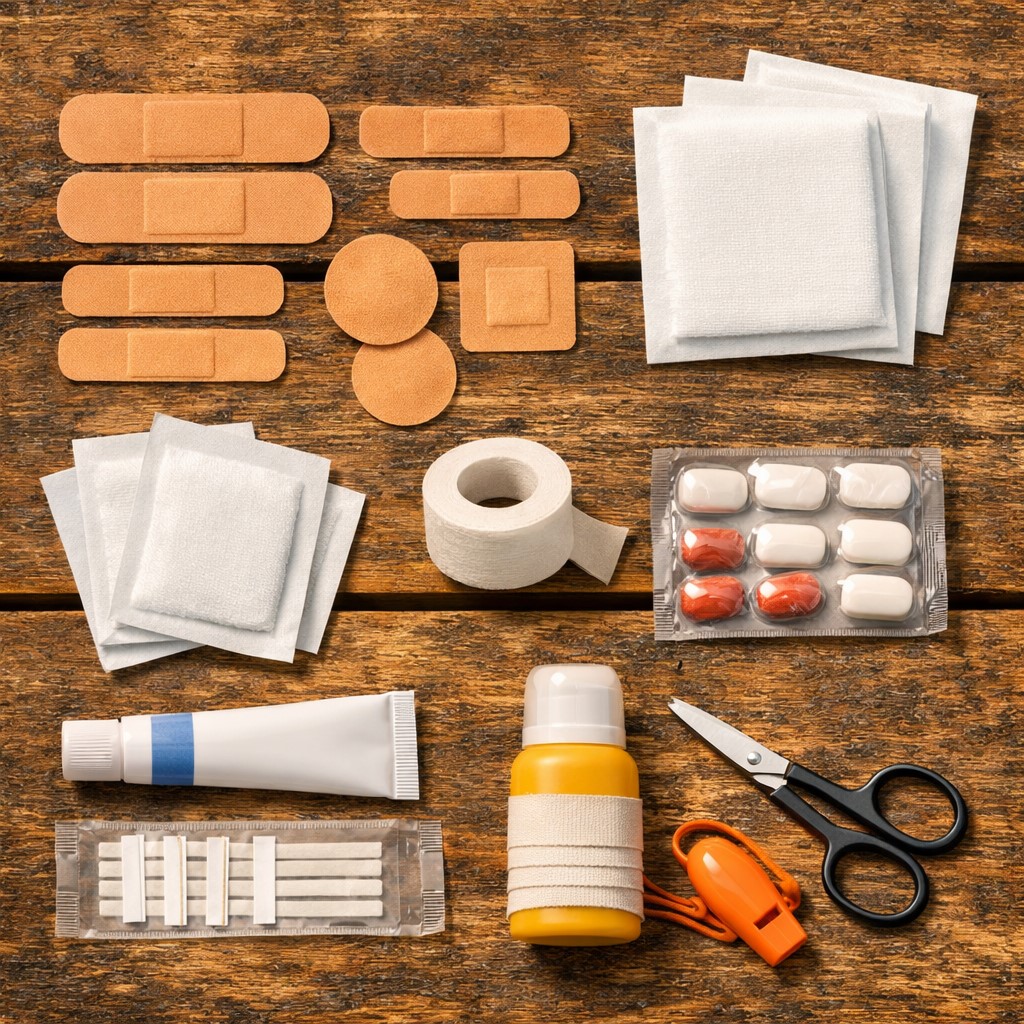
Wound Care Supplies
- Adhesive bandages — multiple sizes: small fingertip, medium rectangular, large knuckle. These cover more scenarios than any other single item in your kit
- Sterile gauze pads — for larger wounds; control bleeding and provide clean coverage
- Medical tape — secures gauze and dressings; holds better than plasters alone on awkward body parts
- Wound closure strips / butterfly closures — for deeper cuts that need edges held together until proper treatment
- Blister plasters and moleskin — non-negotiable for any hiking component of your trip
- Antiseptic wipes — clean wounds before dressing; individually wrapped packets stay sterile in kit
- Antibiotic ointment (Neosporin or equivalent) — prevents infection after cleaning
- Medical scissors — sharp, rust-resistant; cuts bandages, clothing, and tape
- Non-stick dressings — for burns and wounds where standard gauze would stick and damage on removal
Medications and Pain Relief
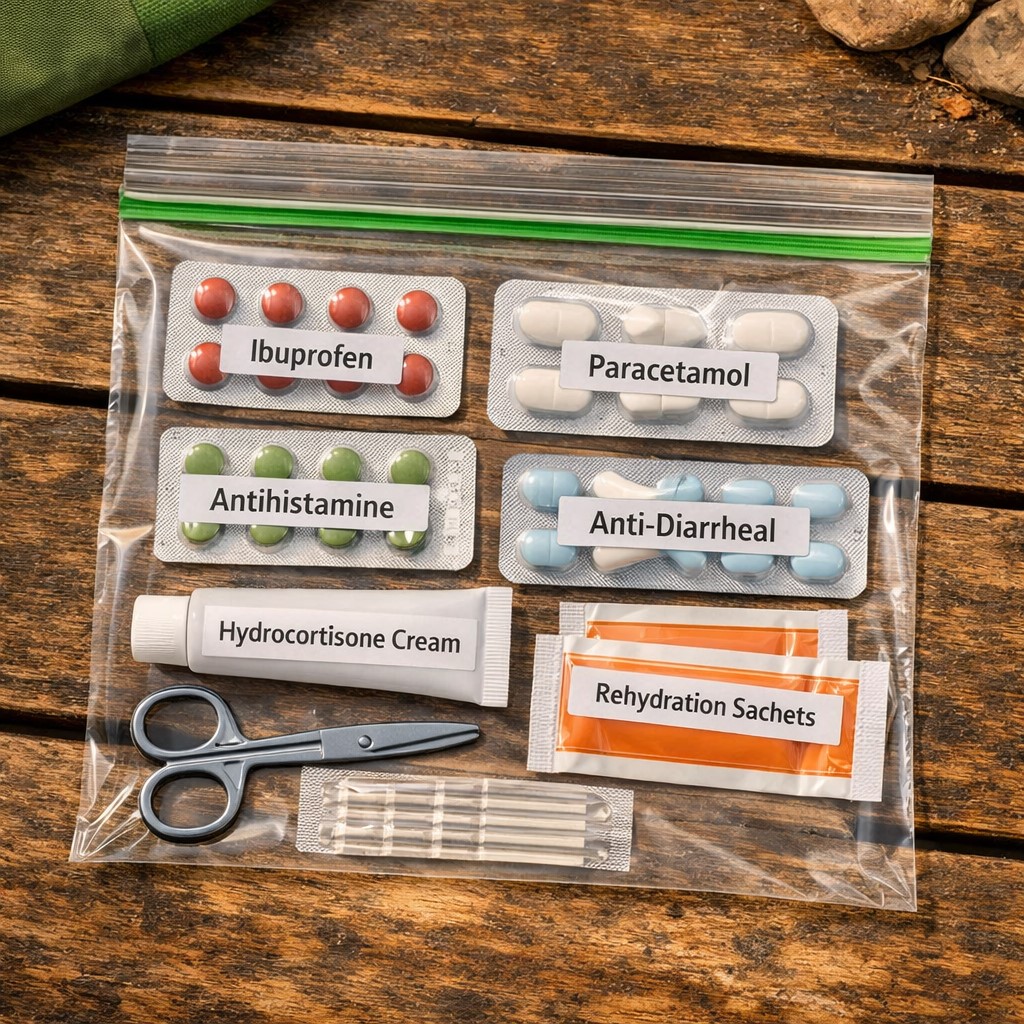
- Ibuprofen — treats pain AND inflammation; essential for sprains, headaches, and fever
- Paracetamol / acetaminophen — alternative or complement to ibuprofen; safer for stomachs
- Antihistamine tablets — oral treatment for allergic reactions; sedating versions help with sleep disrupted by insect bites
- Hydrocortisone cream — immediate relief for insect bites, rashes, and plant-contact irritation
- Anti-diarrheal medication — gastrointestinal issues are common when water sources change or food handling isn’t perfect
- Rehydration sachets / electrolyte tablets — for dehydration from heat, illness, or vomiting
- Burn gel or aloe vera gel — cool and treat minor thermal burns from campfire or stove
- Eye wash solution — remove dust, sand, and irritants safely from eyes
- Personal prescription medications — always pack extras sealed in a waterproof bag
Tools and Instruments
- Fine-tipped tweezers — tick removal, splinters, thorns, foreign objects in wounds
- Medical scissors — separate from your camping knife; sharp and clean
- Digital thermometer — fever detection; compact and accurate
- Safety pins — multiple sizes; used more than you’d expect for slings, securing bandages, and clothing repairs
- Medical gloves — nitrile, minimum 4 pairs; wear for any wound treatment to prevent cross-contamination
- CPR face shield — compact, single-use; should be in every kit when group size is 4+
- Tick removal card — credit-card-sized tool that slides under ticks; compact and effective
Skin and Temperature Treatment
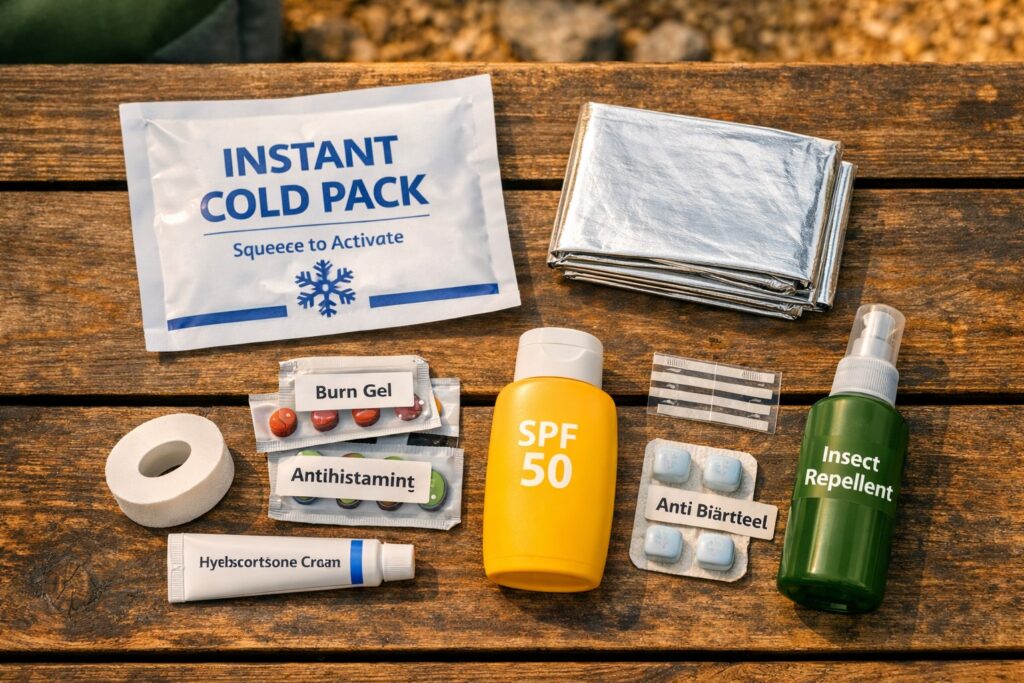
- Instant cold packs — activate on impact; treat sprains, stings, and minor burns without needing ice
- Emergency space blanket / thermal blanket — treats hypothermia; reflects body heat; weighs almost nothing
- Sunscreen SPF 30+ — prevention is treatment; reapply every 90 minutes and after swimming
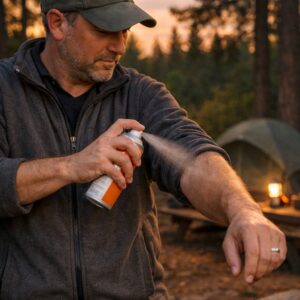
- Insect repellent — DEET-based for maximum protection; prevents bites from becoming a medical issue
- Rechargeable heat pad — comfort for sore muscles and cold-weather pain relief
Hygiene and Infection Prevention
- Hand sanitizer — clean hands before every wound treatment; alcohol-based minimum 60%
- Biodegradable soap — for thorough hand washing when water is available
- Waterproof bag or dry bag — keep medications and dressings completely dry
- Waste disposal bags — for used dressings and medical waste; never leave medical waste at a campsite
Monitoring and Assessment
- Waterproof first aid manual or quick reference card — knowledge is as important as supplies; laminated cards are best
- Emergency contact list — printed, not just on phone; include nearest hospital, emergency services, and a contact at home
- Whistle — three sharp blasts is the universal distress signal; attach to kit bag
How to Build Your Camping First Aid Kit: Step-by-Step
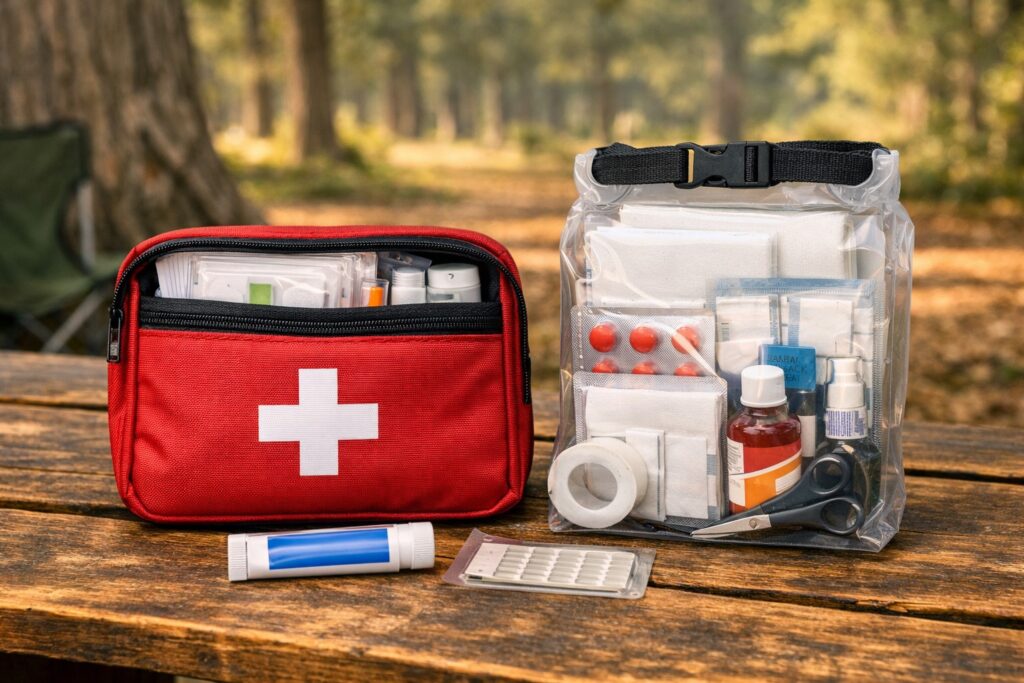
Choosing the Right Container for Your Kit
Pre-Made Kit vs Building Your Own — Which Is Better?
Pre-made camping first aid kits are a great starting point — they give you a solid foundation of basics in a tested, organised container. The limitation is that they are built for a generic camper, not your specific trip. Always supplement a pre-made kit with items specific to your group — children’s medications, EpiPens, personal prescriptions, or advanced wilderness supplies.
Building your own kit from scratch takes more time but gives you complete control over what’s inside and how it’s organised. If you go this route, choose a waterproof hard-shell or dry bag container. Label every section clearly. Organise by injury type — wound care together, medications together, tools together — so you can find what you need under stress without searching through everything.
How to Customize Your Kit for Your Trip Type
- Weekend Car Camping – Basic kit — wound care, OTC medications, tweezers, thermometer, cold pack. 20-30 items.
- Day Hiking – Compact kit — blister supplies, bandages, antiseptic, pain relief, antihistamine, tick remover. Fits in a belt pouch.
- Multi- Day Backpacking – Full kit plus emergency blanket, SAM splint, moleskin, extra medications, irrigation syringe for wound flushing.
- Remote/Backcountry – Comprehensive wilderness kit — above items plus prescription antibiotics (with medical advice), dental kit, SAM splint, EpiPen if appropriate, satellite communicator.
- Camping With Kids – Add children’s ibuprofen and paracetamol liquid, children’s antihistamine, nappy rash cream, thermometer suitable for young children, extra plasters in fun colours (they actually help).
Camping First Aid Kit for Families with Kids
A family camping first aid kit needs everything in the standard checklist above, plus a few child-specific items that make a real difference. Children’s bodies respond differently to medications and injuries — never give adult-strength tablets to children without checking dosages carefully.
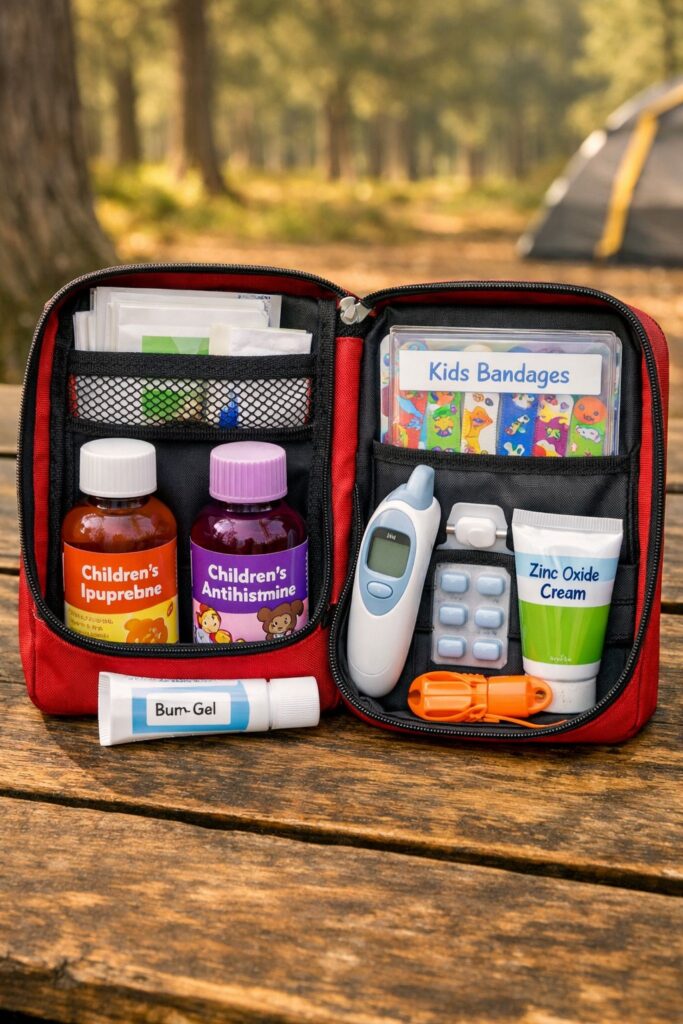
Special Items to Add When Camping with Children
- Children’s ibuprofen and paracetamol — liquid suspensions are easier to dose accurately for young children
- Children’s antihistamine — oral liquid or dissolvable tablets for younger children
- Child-appropriate thermometer — ear or forehead thermometers are easier for young children than oral ones
- Nappy rash cream and zinc oxide — for rash and skin irritation from increased outdoor moisture exposure
- Fun plasters — dinosaurs, stars, superheroes — sounds trivial but genuinely reduces distress in young children during wound treatment
- Children’s insect repellent — lower DEET concentration or DEET-free formulas for young children
- Emergency contact card — child-specific with allergies, medications, blood type, and parent contact details
Going with the whole family? Our [camping with kids guide] is the complete parents’ playbook — safety, gear, activities, sleep, and more.
Knowing how to treat bites is only half the job — our guide to keeping mosquitoes away while camping covers prevention from the ground up
Backcountry and Wilderness First Aid Kit: Going Further Off-Grid
Standard camping first aid kits are designed for situations where professional medical help is reachable within an hour or two. Backcountry and remote camping changes that calculation entirely. When you are hours from the nearest trailhead and days from a hospital, your wilderness first aid kit needs to be more comprehensive and your knowledge of how to use it needs to be stronger.
Advanced Items for Remote and Backcountry Camping
- SAM splint — flexible, lightweight splint for suspected fractures and sprains; moulds to any body part
- Irrigation syringe — high-pressure wound flushing removes bacteria and debris far more effectively than simply pouring water
- Dental kit — tooth pain and lost fillings are surprisingly common multi-day camping emergencies; temporary filling material is a genuine relief
- Prescription antibiotics — discuss with your doctor before a remote trip; a broad-spectrum antibiotic for wound infections can be critical when days from help
- EpiPen or equivalent — if anyone in the group has a known severe allergy, this is non-negotiable in remote settings
- SAM splint and triangular bandage sling — for immobilising upper limb injuries until evacuation
- Satellite communicator (e.g. Garmin inReach) — not a first aid item but the most important safety device for backcountry camping; sends SOS with GPS coordinates
If you’re camping in bear or snake country, your first aid kit needs to be tailored accordingly — our complete guide to wildlife safety while camping covers exactly what encounters to prepare for and how to respond.
In a genuine backcountry emergency, knowing how to signal for rescue is as important as your first aid kit — our [emergency signaling tips for lost campers] guide covers exactly this.
How to Store, Maintain and Restock Your Camping Medical Kit
A first aid kit that has expired medications, used supplies that were never replaced, and equipment stored in a damp bag is worse than useless in an emergency — because you reach for it expecting it to work and it doesn’t. Kit maintenance is not exciting but it is essential.
- Check expiry dates every six months — medications and antiseptic wipes degrade; mark replacement dates on the packaging
- Restock after every trip — replace anything used immediately, not before the next trip
- Store in a waterproof container — moisture destroys medications and contaminates dressings
- Keep it in the same place every time — you should be able to grab it in the dark without thinking
- Review and update before every trip — add or remove items based on the specific activity, terrain, and group composition
- Take a refresher — wilderness first aid knowledge fades; an annual review of basic techniques keeps skills sharp
QUICK RESTOCK CHECKLIST – DO THIS AFTER EVERY TRIP
- Check what was used and replace it immediately.
- Check expiry dates on all medications.
- Check that all dressings and gauze are still sealed and sterile.
- Restock hand sanitizer and gloves — these go quickly.
- Update the emergency contact card if any details have changed.
- Wipe down the container and dry completely before storing.
Basic Wilderness First Aid Skills Every Camper Should Know
The best-stocked first aid kit in the world is only as useful as the person using it. You do not need a full wilderness first aid certification to handle the most common camping medical situations — but you do need to know the basics before you’re in the field. Here are the five skills that matter most.
How to Treat the Five Most Common Camping Injuries
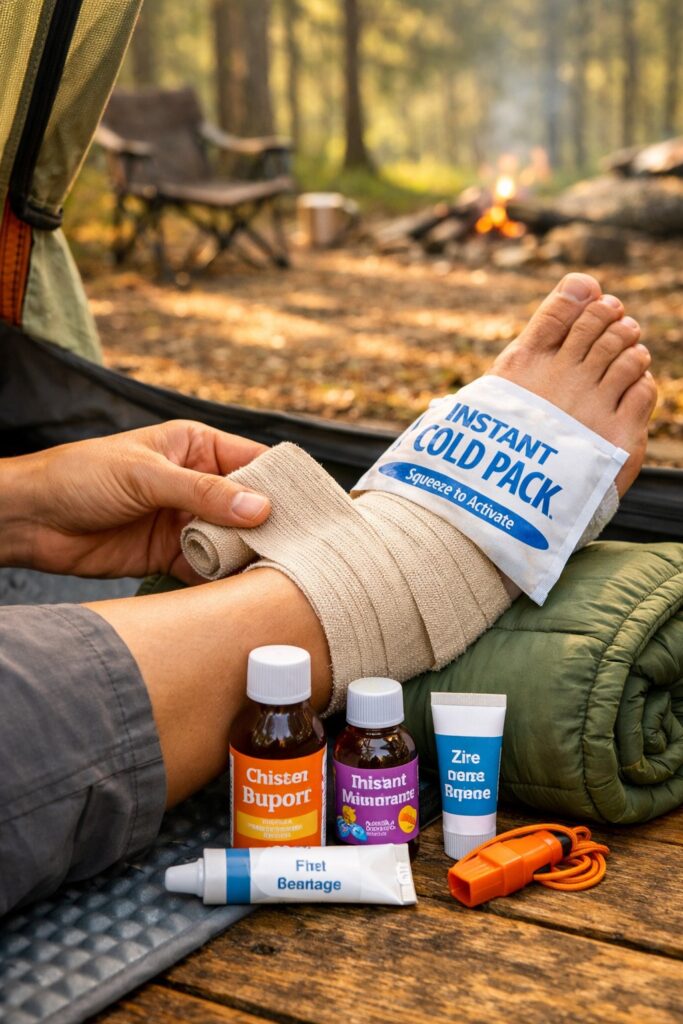
The R.I.C.E Method for Sprains and Strains
- The R.I.C.E method is the correct immediate treatment for any sprain, strain, or soft tissue injury:
- R — REST: Stop the activity immediately. Weight-bearing on a sprained joint causes further damage.
- I — ICE: Apply an instant cold pack for 20 minutes on, 20 minutes off. Never apply ice directly to skin — wrap in cloth first.
- C — COMPRESS: Apply an elastic bandage from below the injury upward. Firm but not tight enough to cut circulation — you should be able to slip a finger under the bandage.
- E — ELEVATE: Keep the injured limb raised above heart level as much as possible to reduce swelling.
Beyond R.I.C.E, the five skills every camper should practice before their trip:
- How to clean and dress a wound — irrigate, antiseptic, cover, monitor (see wound care section above)
- Tick removal — correct technique with fine-tipped tweezers (see above)
- Recognising heat exhaustion vs heat stroke — heat exhaustion: heavy sweating, weakness, cool skin; heat stroke: no sweating, hot dry skin, confusion — a medical emergency requiring immediate cooling and evacuation
- Hypothermia recognition and management — shivering, confusion, slurred speech; get them dry and warm immediately; use the emergency space blanket
- Allergic reaction vs anaphylaxis — knowing the difference and when to use an EpiPen (see above)
CONSIDER A WILDERNESS FIRST AID COURSE
A one or two-day wilderness first aid course teaches practical hands-on skills for managing medical emergencies in remote settings. Organizations like NOLS, Red Cross, and Wilderness Medical Associates run courses worldwide. If you camp regularly — especially in backcountry settings — this is one of the most valuable things you can do.
Frequently Asked Questions About Camping First Aid Kits
These are the questions campers ask most often about first aid kits — answered directly and honestly.
What should I put in a camping first aid kit?
The core essentials are: adhesive bandages in multiple sizes, sterile gauze pads, antiseptic wipes, antibiotic ointment, blister plasters, tweezers, medical scissors, pain relief (ibuprofen and paracetamol), antihistamine, hydrocortisone cream, instant cold pack, emergency blanket, medical gloves, thermometer, and a first aid manual. See the full checklist above for the complete item-by-item breakdown.
How big should a camping first aid kit be?
Scale your kit to your trip. A weekend car camping trip near a town needs a basic 20-30 item kit that fits in a small pouch. A multi-day backcountry hike needs a comprehensive kit in a waterproof bag covering wound care, medications, tools, and emergency equipment. A family camping kit should be larger than a solo kit to account for more potential injuries and children-specific needs.
Can I buy a ready-made camping first aid kit or should I build my own?
Both work — it depends on your confidence and specific needs. Pre-made kits from reputable brands give you a solid foundation quickly. The downside is they are built for a generic camper, not your trip. Always check what’s included and add anything specific to your group — personal medications, EpiPen, children’s supplies, or advanced backcountry items. Building your own from scratch takes more effort but gives you complete control and typically better quality individual items.
How often should I replace items in my camping first aid kit?
Check after every trip and restock anything used. Check expiry dates every six months — medications and antiseptic wipes degrade and lose effectiveness. Store the kit in a cool, dry place between trips. A damp or heat-exposed first aid kit degrades much faster than one stored correctly.
Do I need a wilderness first aid kit for a day hike?
A full wilderness kit is not necessary for a day hike close to civilisation — but a compact personal kit absolutely is. At minimum: a few bandages, antiseptic wipes, blister plasters, pain relief, antihistamine, and a tick removal tool. This fits in a belt pouch and weighs almost nothing. The question is not whether you will need it — it is whether you will be glad you had it.
Pack Your Kit, Hit the Trail
A camping first aid kit is not something you pack out of fear — it is something you pack out of respect for the outdoors and everyone you are sharing the trip with. The wild is genuinely wonderful. It is also genuinely unpredictable. The campers who enjoy it most are the ones who go prepared, so they can spend every moment focused on the adventure rather than the what-ifs.
Build your kit carefully, customise it to your trip, check it before you leave, and know how to use it. Then stop thinking about it — and go camping.