How to Keep a Tent Cool : 12 Tips for Summer Camping
-
| Founder & Content Creator

Latest Posts
If you have ever wondered how to keep a tent cool on a sweltering summer night, you are not alone — and you are in exactly the right place. It starts around 7pm when you unzip the tent door and a wall of trapped heat greets you like you have just opened an oven. By midnight you are lying there, flat on your back, wondering why you did not just book a hotel. We have all been there.
The great news is that keeping a tent cool in summer is genuinely achievable — no electricity required, no expensive equipment, and no compromising on the outdoor experience. A few smart choices before you leave home, the right campsite selection, and some basic ventilation know-how mean you can actually sleep comfortably even when it is baking outside.
In this guide we cover all 12 of the most effective tent cooling tips — tried, tested, and endorsed by experienced summer campers. Let’s cool things down.
HOW HOT DOES A TENT ACTUALLY GET?
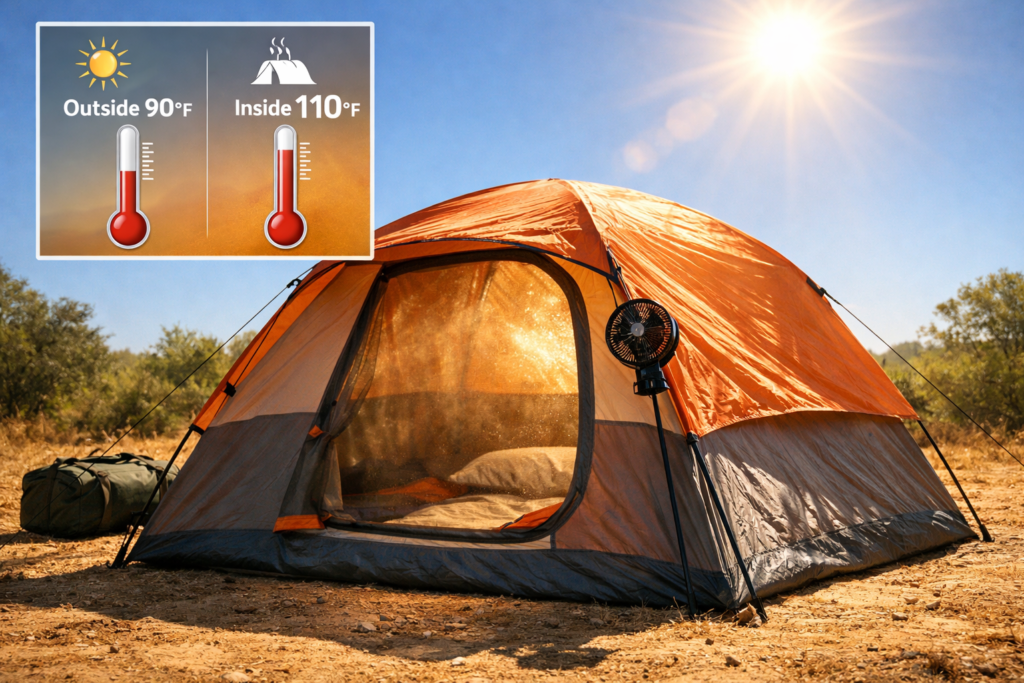
Research and campsite thermometer tests show that a tent left in direct sunlight on a hot day can reach internal temperatures of 20-30°F (10-15°C) higher than the outside air temperature. On a 90°F day, your tent interior can hit 110-120°F. That is not uncomfortable — that is genuinely unsafe. Understanding this is the first reason why tent cooling is not optional on summer camping trips.
Why Your Tent Gets So Hot (And Why It’s Not Just the Weather)
The Greenhouse Effect — Why Tents Heat Up Faster Than You Expect
Why Dark-Coloured Tents Heat Up Faster
Your tent acts like a greenhouse. Sunlight passes through the tent fabric, heats the air and surfaces inside, and then cannot easily escape. The heat gets trapped — and because tent fabric is a relatively poor heat conductor, it keeps accumulating throughout the day. By the time you climb in at night, you are essentially climbing into a room that has been preheating for eight hours.
Dark-colored tents make this significantly worse. Dark fabrics absorb more solar radiation than lighter colors — the same reason you wear a white shirt rather than a black one on a hot day. If you are buying a new tent specifically for summer camping, a lighter colored or silver-coated fabric tent makes a measurable difference in internal temperature, sometimes keeping the interior up to 15°F cooler than a comparable dark tent in the same conditions.
Your own body heat contributes too. In a small enclosed tent, a sleeping person generates significant heat — and that warmth has nowhere to go in a poorly ventilated space. Understanding both sources of heat — solar gain from outside and body heat from inside — is what makes the solutions in this guide so effective. You tackle both, and the result is a genuinely cool tent.
How to Keep a Tent Cool Before You Even Arrive
Choosing the Right Tent for Hot Weather
The tent you choose is your most powerful tool for keeping cool — and the decision is made long before the camping trip begins. If you camp regularly in summer, these are the features worth prioritizing when buying or hiring a tent:
- Light-coloured or silver-coated rainfly — reflects solar radiation rather than absorbing it. One of the most impactful passive cooling features available
- Maximum mesh panels — a tent with large mesh inner walls allows airflow on all sides. This is the single most important ventilation feature for summer camping
- Double-door design — when doors at both ends of the tent can be opened simultaneously, you create cross-ventilation that moves hot air out and pulls cool air in
- Mesh roof or gear loft — hot air rises. A mesh ceiling allows it to escape rather than accumulate
- Larger tent than you think you need — more volume means more air, which means slower heat build-up. A tent that is one size larger than your group keeps you significantly cooler
Timing Your Setup for a Cooler Night
Here is a genuinely effective tip that most camping guides skip entirely: if you arrive at camp in the morning and the day is going to be hot, consider not pitching your tent until late afternoon or evening. A tent that has been sitting in the sun all day has absorbed hours of solar heat. A tent pitched at 5pm, in the shade of early evening, starts the night significantly cooler.
Taking down your tent during the day and re-pitching it in the evening sounds tedious — and on a long trip it may not be practical. But on a one or two night summer camp, it genuinely makes a noticeable difference to overnight comfort. Alternatively, pitch early but in the shadiest possible spot so the tent gains as little solar heat as possible during the day.
The Best Campsite Location to Keep Your Tent Cool in Summer
Where you pitch your tent is one of the most powerful decisions you can make when it comes to how to keep a tent cool — and it costs absolutely nothing.
Using Trees and Natural Shade to Cool Your Tent
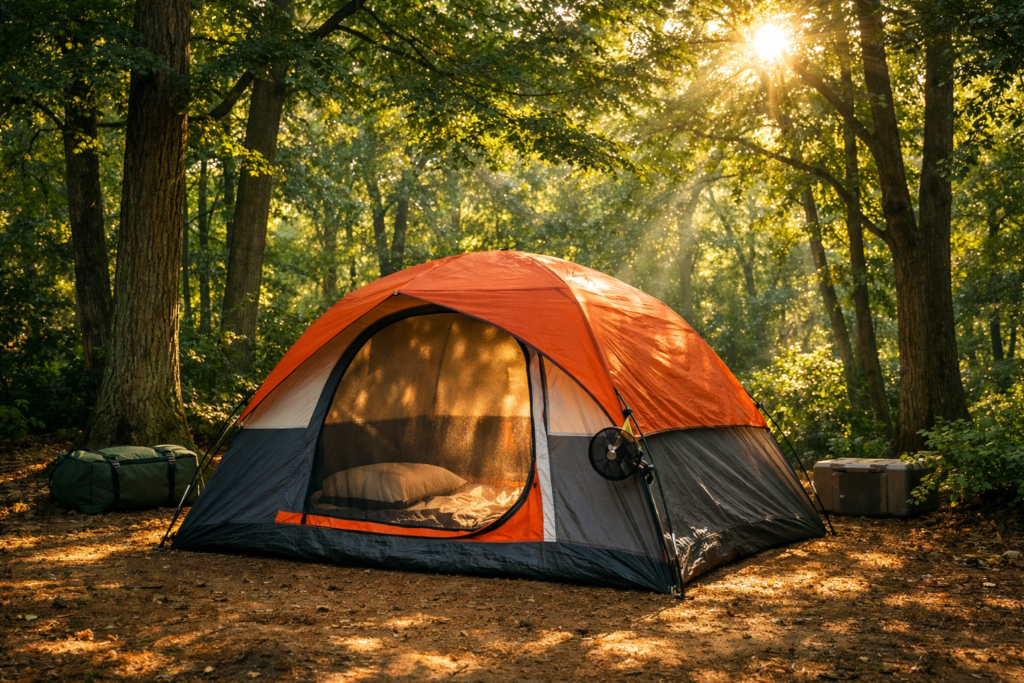
Shade is the most effective free tent cooling tool available. A tent in deep shade can be up to 20°F cooler than an identical tent in direct sunlight — and that difference is felt immediately when you climb in. When choosing your spot, do not just look at where the shade is when you arrive. Think about where it will be during the hottest part of the day (10am–4pm) and position your tent accordingly. The sun moves; your tent doesn’t.
Use a compass or a simple weather app to track the sun’s trajectory across your specific site. Orient the narrowest end of your tent toward the sun’s path rather than the broadest face — this minimises the surface area absorbing direct heat throughout the day. And always pitch on grass rather than asphalt, concrete, or bare rock. Hard surfaces absorb heat during the day and radiate it upward into your tent floor throughout the night.
Camping Near Water for Natural Cooling
Setting up camp near a lake, river, or stream provides natural cooling through a combination of evaporation and gentle water-cooled breezes. The air close to natural water is measurably cooler than air further inland on hot days. Use a weather app to check the wind direction before you set up, then position your tent door or mesh panels facing into that breeze to maximize the cooling airflow through your tent interior.
One caveat: pitching directly at the water’s edge increases mosquito and insect activity significantly — particularly at dawn and dusk. A position 50-100 meters from the waterline usually gives you most of the cooling benefit with considerably fewer uninvited guests.
Reflective Tarps and Sun Shields — Your Tent’s Best Defence Against Heat
A reflective tarp or emergency space blanket rigged above your tent is one of the most effective ways to keep a tent cool in summer — capable of reducing the interior temperature by up to 40% by blocking solar radiation before it reaches the tent fabric. The tent fabric never heats up if the sun never hits it directly. Simple physics. Outstanding results.
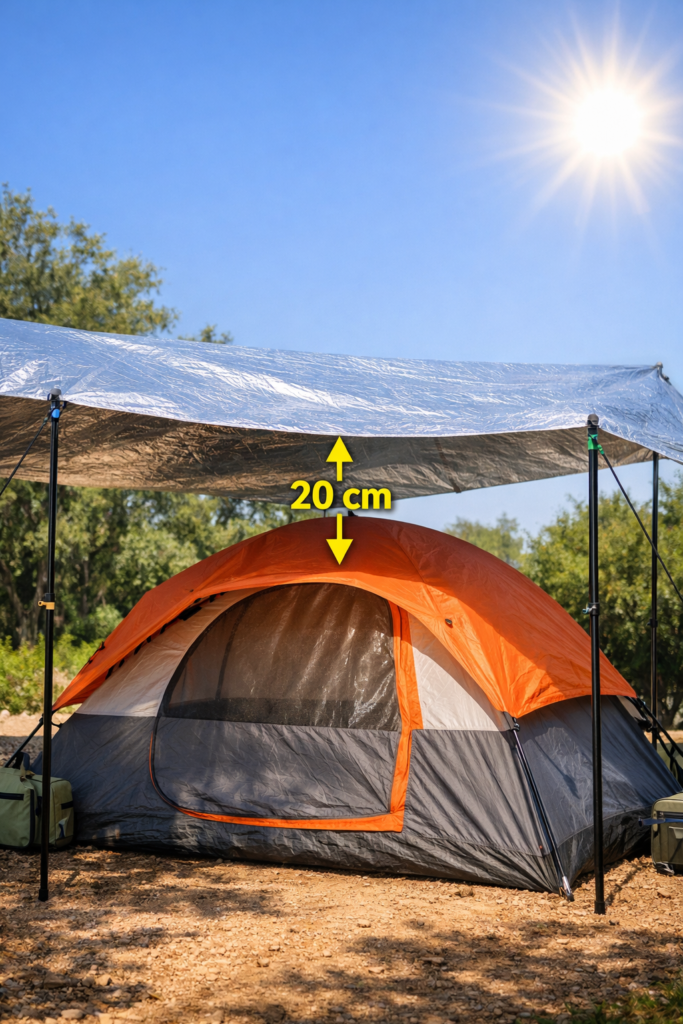
The critical detail that most people get wrong: you must leave a gap between the tarp and the tent roof. Without that gap, you simply create an insulating layer that traps heat against the tent rather than deflecting it. Here is the correct setup:
- Step 1: Choose a reflective tarp or silver-coated sun shade — silver and white surfaces reflect the most solar radiation
- Step 2: Rig it above your tent using paracord, guy lines, or a set of trekking poles — height of 30-50cm above the tent roof is ideal
- Step 3: Leave the gap open on all sides — air must be able to circulate between the tarp and the tent roof
- Step 4: Angle the tarp slightly so that any rain runs off rather than pooling
- Step 5: If you do not have a reflective tarp, remove the rainfly entirely in clear weather — this alone dramatically improves airflow through the mesh tent body
RAINFLY ON OR OFF?
In clear hot weather with no rain forecast, removing the rainfly and sleeping under just the mesh tent body is the single most effective ventilation upgrade possible. You lose weather protection but gain maximum airflow. Check the weather carefully before doing this — a surprise 3am rainstorm is considerably less fun than a hot tent.
Tent Ventilation Tips That Make a Bigger Difference Than You Think
Proper ventilation is the foundation of how to keep a tent cool — and it is where most campers significantly underperform. Experienced summer campers report that the number one mistake beginners make is not opening enough vents. Most tents have more ventilation options than their owners ever use — and using all of them is one of the easiest ways to keep a tent cool without spending a single penny.
Creating the Chimney Effect for Maximum Airflow
Hot air rises. If you open vents at both the bottom and top of your tent simultaneously, hot air escapes upward through the top vents while cool air is drawn in from the lower openings. This is called the chimney effect and it is physics working entirely in your favor, for free, all night long.
- Open every vent, mesh panel, and window your tent has — all of them, at the same time
- Unzip all mesh doors and windows — screens keep the insects out while allowing full airflow
- If your tent has a gear loft or ceiling vent, ensure it is fully open — this is where hot air escapes
- Create cross-ventilation by opening both ends of the tent simultaneously — air enters one end and exits the other
- In canvas or wall tents, roll up the walls during daylight hours for maximum through-ventilation
When to Remove the Rainfly
In warm, clear summer conditions without rain forecast, removing the rainfly entirely transforms your tent from a heat trap into something almost breathable. Sleeping under just the mesh tent body with stars visible above you is one of the genuinely pleasant surprises of summer camping. You get maximum ventilation, natural light at dawn, and an experience that feels genuinely connected to the outdoors.
However, only do this when you are completely confident in the forecast. Check weather apps the evening before AND set an alert for overnight conditions. A tent without a rainfly during unexpected rain is not a tent — it is a shower.
Portable Fans — The Simplest Way to Keep Your Tent Cool Overnight
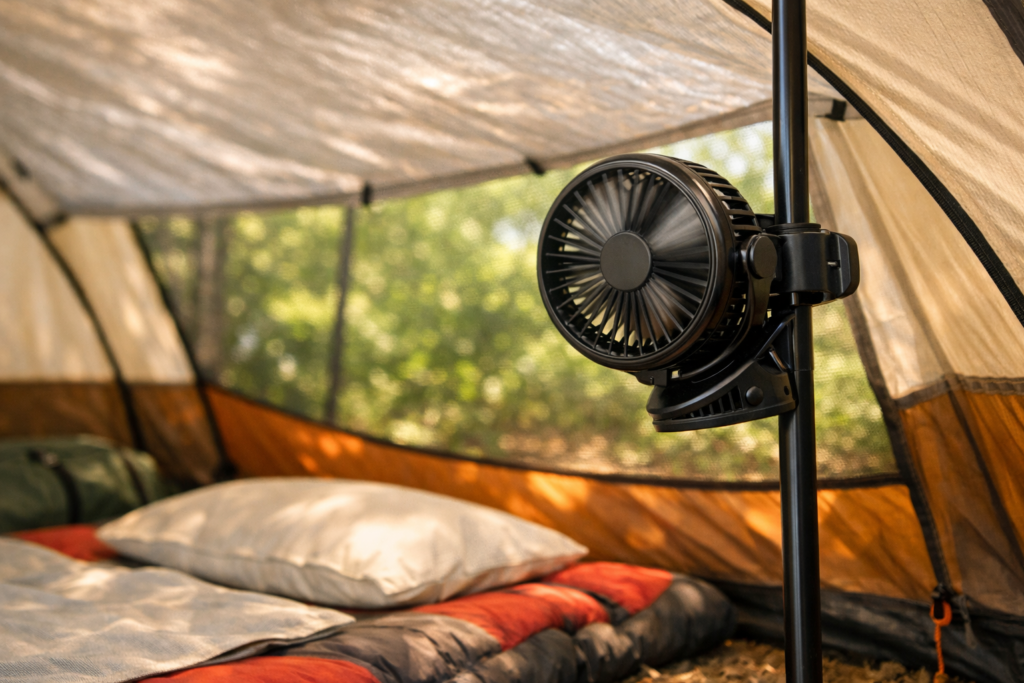
If there is one single purchase that experienced summer campers consistently recommend for keeping a tent cool, it is a portable battery-powered or USB rechargeable fan. Simple, lightweight, genuinely effective, and inexpensive. A quality compact fan running through the night makes a significant and immediate difference to sleep temperature.
Fan Placement for Maximum Cooling Effect
How to Set Up the Wet Towel Fan Trick Step by Step
Fan placement matters almost as much as the fan itself. Here is how to get the most from yours:
- Position the fan near a mesh panel drawing cool air IN rather than blowing warm air around the tent — intake cooling is more effective than circulation
- Clip the fan to a tent pole above sleeping level to direct airflow across your body
- Choose a quiet fan with foam blades if camping with children — the noise of an aggressive fan disrupts sleep and negates the comfort benefit
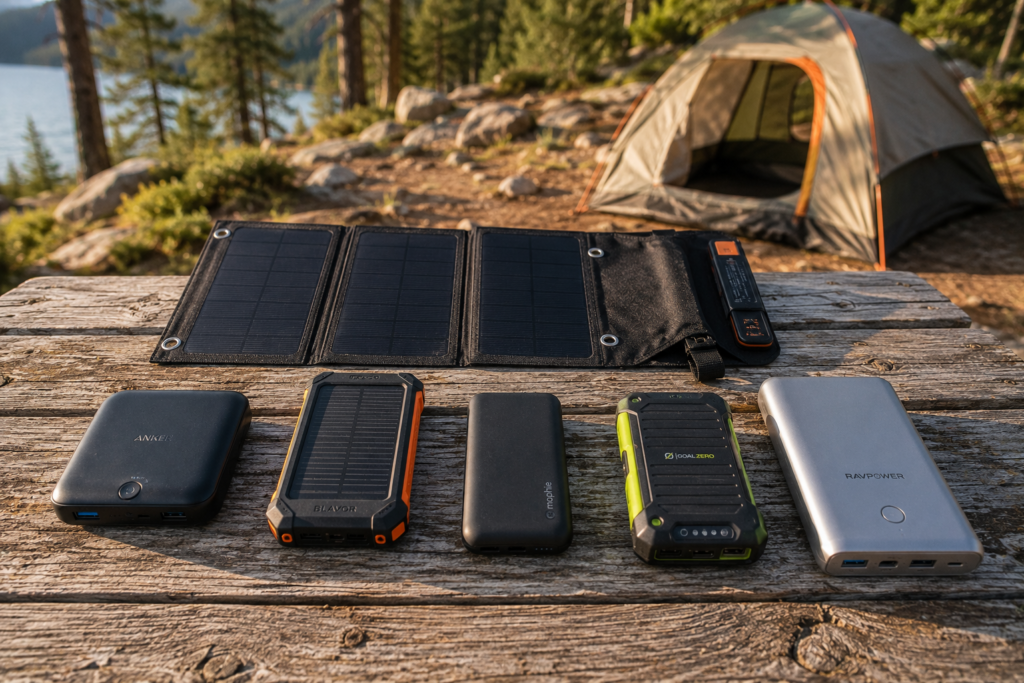
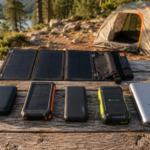
- Use a rechargeable USB fan so you can recharge during the day from a power bank or solar panel
Now for the DIY trick that camping forums consistently rate as one of the most effective low-cost cooling hacks available. The wet towel evaporative cooler:
- Step 1: Soak a towel or cloth completely — it should be wet but not dripping
- Step 2: Hang it near the tent entrance or directly in front of the fan using a cord or tent line
- Step 3: Turn on the fan so air blows through or past the wet cloth
- Step 4: As air passes over the wet surface, evaporation cools it — you feel the difference immediately
- Step 5: Re-wet the cloth every 1-2 hours as it dries out
This evaporative cooling method can lower the perceived temperature in a tent by several degrees. It works best in dry heat — in very humid conditions the air is already so moisture-saturated that evaporation is limited. But in the dry summer heat that most campers face, it is genuinely impressive.
The DIY Tent Air Conditioner That Actually Works
You have already seen the fan and wet towel method above. But there is an upgrade version of this that experienced campers swear by — particularly for very hot, dry climates. This is one of the most effective DIY methods for how to keep a tent cool without any special equipment — just a string, one large wet towel, and a battery-powered fa
- Soak a large towel or sheet completely in cold water — the larger the wet surface area, the more evaporative cooling occurs
- Wring out gently so it is very wet but not dripping water onto the tent floor
- Hang the towel across the tent entrance or across a line stretched between two tent poles
- Position the fan so air blows directly through the hanging wet towel before reaching your sleeping area
- The air passes through the wet fabric, water evaporates, and the air exits several degrees cooler — a genuine air conditioning effect
- For maximum effect, add ice packs or a small bag of ice to the wet towel or a bowl of water the fan blows across
PRO UPGRADE
Freeze several plastic water bottles the night before your trip and use them to keep your cooler cold during travel. Once at camp they can be placed in front of or beside the fan to create an even stronger evaporative cooling effect as they melt. By morning they will have melted into drinking water. Cold air overnight AND cold water in the morning. Win-win.
Summer Sleep System: How to Stay Cool Inside Your Tent All Night
Summer Sleeping Gear — What to Use and What to Ditch
The Cotton Sheet Swap That Changes Everything
Your sleeping system is the part of your camping setup that directly controls your body temperature through the night. In summer, most people bring the wrong gear — specifically, a sleeping bag rated for conditions far colder than they will experience.
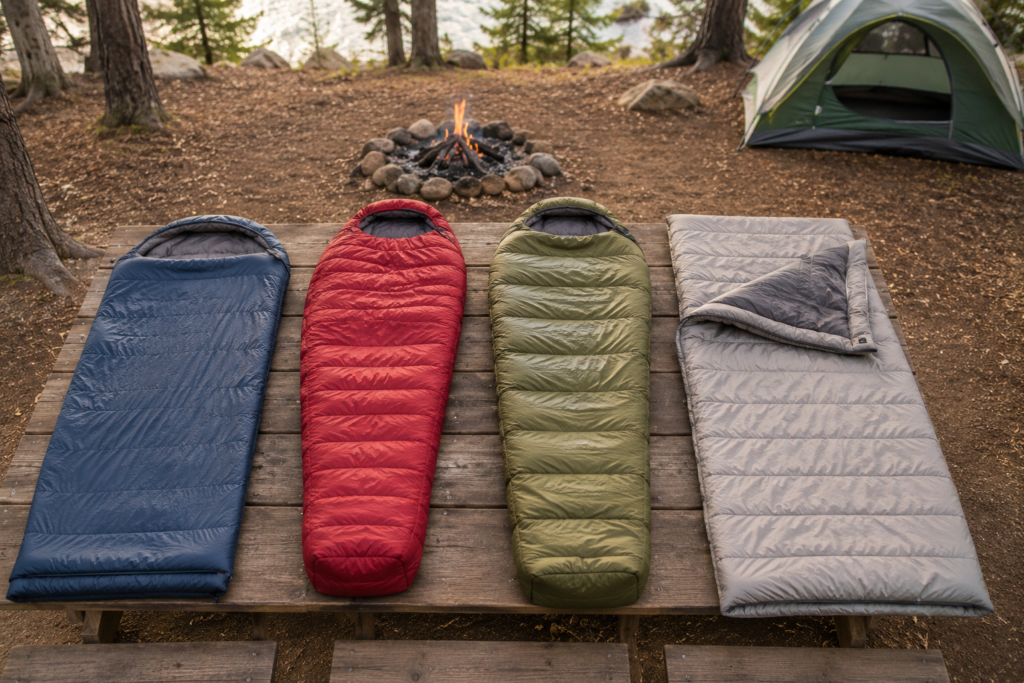
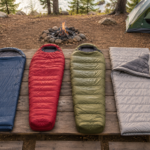
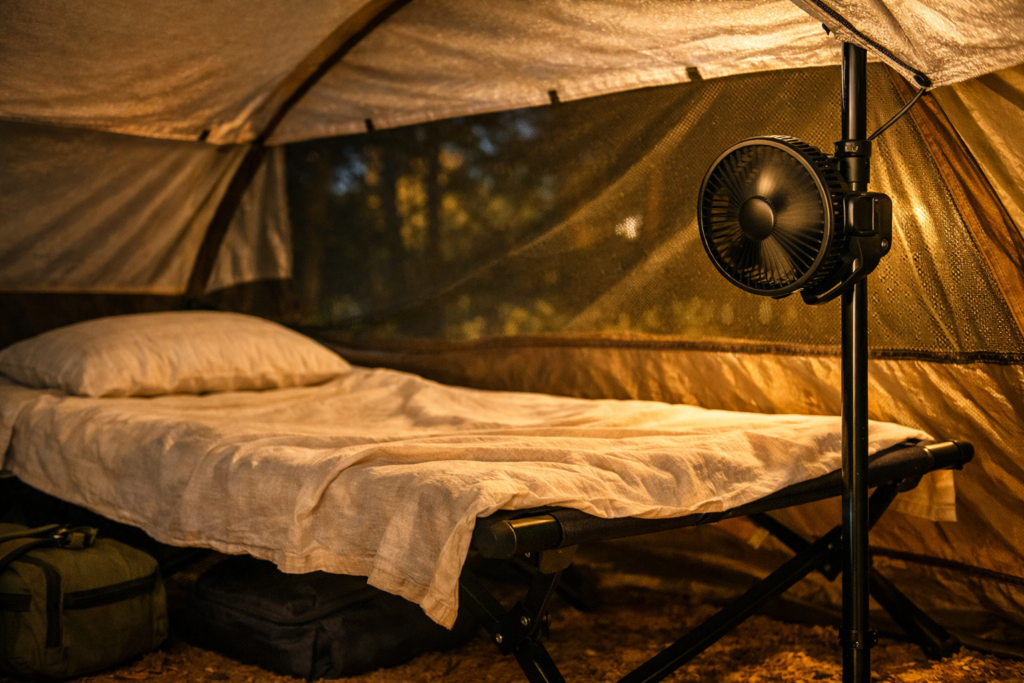
- Ditch the sleeping bag for hot nights — a lightweight cotton sheet is significantly more breathable and comfortable than any sleeping bag on a warm summer night. Cotton also absorbs moisture better than synthetic fabrics
- Use a camping cot rather than a ground mat where possible — cots elevate you off the ground and allow air to circulate freely underneath your body. This alone can reduce the heat you feel throughout the night
- If you do need a sleeping bag, choose one specifically rated for summer temperatures — lightweight, with a mesh or cotton inner and maximum ventilation openings
- Use a sleeping pad with a low R-value for summer camping — you do not want ground insulation in hot weather. A basic thin foam pad or a mesh cot provides airflow without insulating you from the refreshingly cool night air below
- Wear minimal, loose-fitting clothing made from moisture-wicking material — tight or heavy sleepwear traps body heat
Clothing, Hydration and Personal Cooling Strategies
Keeping your tent cool is important. Keeping your body cool inside it matters just as much. These personal strategies work alongside all the tent cooling tips above to ensure you stay genuinely comfortable and safe throughout a hot summer camping trip.
- Wear light-coloured, lightweight, loose-fitting clothing — white and pale colours reflect heat; dark colours absorb it. This applies to your camping wardrobe as much as your tent colour
- Cool your pulse points to cool down fast — wrists, neck, and the inside of your elbows have blood vessels close to the surface. A cool, damp cloth on these areas lowers your perceived temperature remarkably quickly
- Take an evening swim or cool rinse before bed — lowering your body temperature before climbing in means the tent needs to keep you significantly less cool through the night
- Keep wet towels accessible inside the tent — for cooling your forehead, neck, and face during the night when needed
Hydration for Staying Cool in Summer Camping
Electrolytes — The Cooling Hack Most Campers Forget
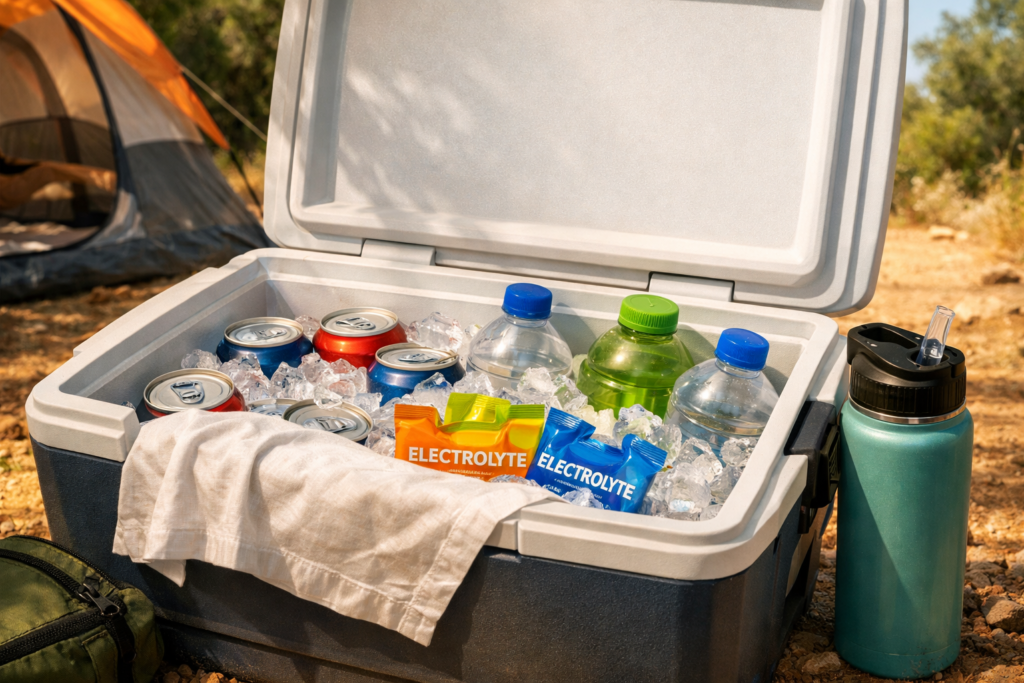
Water is essential but it is not the whole story. When you sweat in summer heat — and on a hot camping trip you will sweat significantly — you lose electrolytes (sodium, potassium, magnesium) alongside the water. Replacing only the water without replacing the electrolytes leaves you feeling fatigued, crampy, and often still uncomfortably hot despite drinking plenty of fluids.
- Drink consistently throughout the day — do not wait until you feel thirsty, which is already a sign of mild dehydration
- Add electrolyte sachets or tablets to your water, particularly after physical activity — available cheaply at most outdoor stores and pharmacies
- Keep a cooler with cold drinks accessible throughout the day and beside your sleeping area at night
- Eat water-rich foods — cucumber, watermelon, oranges — which provide hydration alongside nutrition
- Limit alcohol and caffeine in hot weather — both are diuretics that increase dehydration
When the Tent is Simply Too Hot — Backup Cooling Options
Sometimes, despite your best efforts, the tent is just too hot to sleep in. This happens. It is not a failure. It is August, you are camping in a heat wave, and physics has temporarily won. Here are your backup plans.
- Hammock in the shade — a shaded hammock allows airflow on all four sides simultaneously. No tent can match this for peak afternoon heat. Set one up nearby as a midday rest spot and retreat to it when the tent becomes unbearable
- Outdoor sleeping under the stars — a yoga mat, sleeping pad, or camping cot placed under a tree with a sheet over you is remarkably comfortable on hot nights. Many experienced campers do this routinely in summer rather than sleeping in the tent at all
- Wait out the peak heat — the hottest period is between 10am and 4pm. During this time, find shade, a breeze, or a nearby body of water. Reserve tent time for morning and evening when temperatures are naturally lower
- Open both tent doors and all windows before going to bed — let the tent air out completely for 30 minutes before you get in. The residual heat from a day of sun exposure dissipates faster than you might think
Frequently Asked Questions About How to Keep a Tent Cool
These are the questions summer campers ask most often about tent cooling — answered directly.
How much cooler is a tent in the shade compared to direct sun?
Significantly cooler — research and field testing consistently shows that a tent in deep shade can be 15-20°F cooler than an identical tent in direct sunlight. On a 90°F day, this is the difference between a tent at 95°F and one at 115°F. Shade is the single highest-impact, zero-cost tent cooling strategy available.
Does putting a tarp over a tent keep it cooler?
Yes — but only if you leave a gap. A reflective tarp rigged above your tent with at least 20-30cm of airspace between the tarp and the tent roof can reduce heat absorption by up to 40%. Without the gap, the tarp simply creates an insulating layer that traps heat against the tent rather than deflecting it. The gap is essential.
Can you use a fan to cool a tent?
Absolutely, and it is one of the most effective tent cooling tools available. A battery-powered or USB rechargeable fan positioned near a mesh panel draws cool air in and circulates it through the tent. For maximum effectiveness, combine the fan with the wet towel evaporative cooling method — this creates a DIY air conditioning effect that can reduce perceived temperature by several degrees.
Is it safe to sleep in a hot tent?
It depends on how hot. A tent interior at 80°F is uncomfortable but safe for a healthy adult. Above 95-100°F, the risk of heat exhaustion increases, particularly for children, elderly people, and those with health conditions. If you feel dizzy, nauseous, or stop sweating despite the heat, move to a cooler space immediately, hydrate, and cool your pulse points. Prevention through the cooling strategies in this guide is always the better approach.
What is the best tent for hot weather camping?
For hot weather, prioritize: maximum mesh panels for airflow, a light-colored or reflective rainfly, a double-door design for cross-ventilation, and a size one category larger than your group. Single-layer tents or tents with removable rainflies are significantly more versatile for summer use. A dark, single-door, fully enclosed tent is the worst possible choice for summer camping comfort.
Cool Tent, Great Trip — You Have Got This
Knowing how to keep a tent cool in summer is one of those skills that genuinely separates a good camping trip from a great one. And the good news is that almost none of it costs significant money. Shade is free. Ventilation is free. Timing your setup costs nothing. A wet towel and a fan costs almost nothing. Strategic campsite selection costs exactly nothing.
Start with location and shade — that is where the biggest cooling gains are. Add a reflective tarp and proper ventilation. Bring a fan. Swap the sleeping bag for a cotton sheet on the hottest nights. Stay hydrated with electrolytes, not just water. And remember: if all else fails and the tent is still too warm — hammock. Stars. Breeze. Some camping problems solve themselves beautifully.
For the complete guide to setting up the best possible tent interior across all seasons, our [comfortable tent interior tips] post covers everything from flooring to lighting to sleeping systems.
Make sure all your summer camping gear is sorted before you go — our [complete camping checklist for new campers] is the most thorough packing reference on the site.
Staying cool goes hand in hand with staying fresh outdoors — our [family camping hygiene tips] guide covers everything from biodegradable products to staying clean without a shower.