Best Compact Camping Stoves: Tested Picks for Every Trip
-
| Founder & Content Creator

Latest Posts



The moment you start cooking a proper meal at a campsite — rather than eating something cold and slightly regrettable from a wrapper — something about the whole experience improves. A compact camping stove is the piece of gear that makes this possible, and choosing the right one is considerably more straightforward than the number of options available suggests.
Experience with different stoves in different conditions teaches you things that no spec sheet quite captures. The wind-resistant stove that holds a steady flame on an exposed ridge while everything else flickers and dies. The ultralight backpacking stove that makes serious gram-counters genuinely happy. The integrated boiling system that produces coffee faster than it takes to find your mug.
This guide to the best compact camping stoves covers what the specifications actually mean, which stove type suits which camping style, honest reviews of the stoves that consistently earn the best results, and the things experienced campers consistently wish someone had told them before buying their first one.
A compact camping stove is one of the most useful additions to any camping kit — our complete camping checklist for new campers covers everything else that goes alongside it.
Before You Buy: What Makes a Camping Stove Right for You
The best compact camping stove is the one that matches how you actually camp — not the one with the highest BTU rating, the lowest weight, or the most impressive spec sheet. Five minutes spent thinking about your camping style before choosing a stove saves considerable money and frustration afterward.
The One Question That Narrows Everything Down
Before looking at any specific stove, ask yourself one question: what do I actually need this stove to do?
- If the answer is ‘boil water for coffee and rehydrate freeze-dried meals’: almost any canister stove does this well. Weight and packability should be your primary factors. The MSR PocketRocket 2 or BRS 3000T are ideal.
- If the answer is ‘actually cook meals at camp with simmering and multiple ingredients’: you need a stove with good simmer control, larger pot supports, and more BTU precision. The SOTO WindMaster or MSR PocketRocket Deluxe deliver this.
- If the answer is ‘boil water as fast as possible with no other cooking’: the Jetboil Flash is specifically designed for this and is the best available option for that narrow use case.
- If the answer is ‘cook for two or more people at a car campsite’: you may not need a compact backpacking stove at all — a two-burner propane camp stove like the Coleman Classic gives you significantly more cooking surface for car camping.
Stove Types Explained: Canister, Liquid-Fuel, Alcohol, and Wood
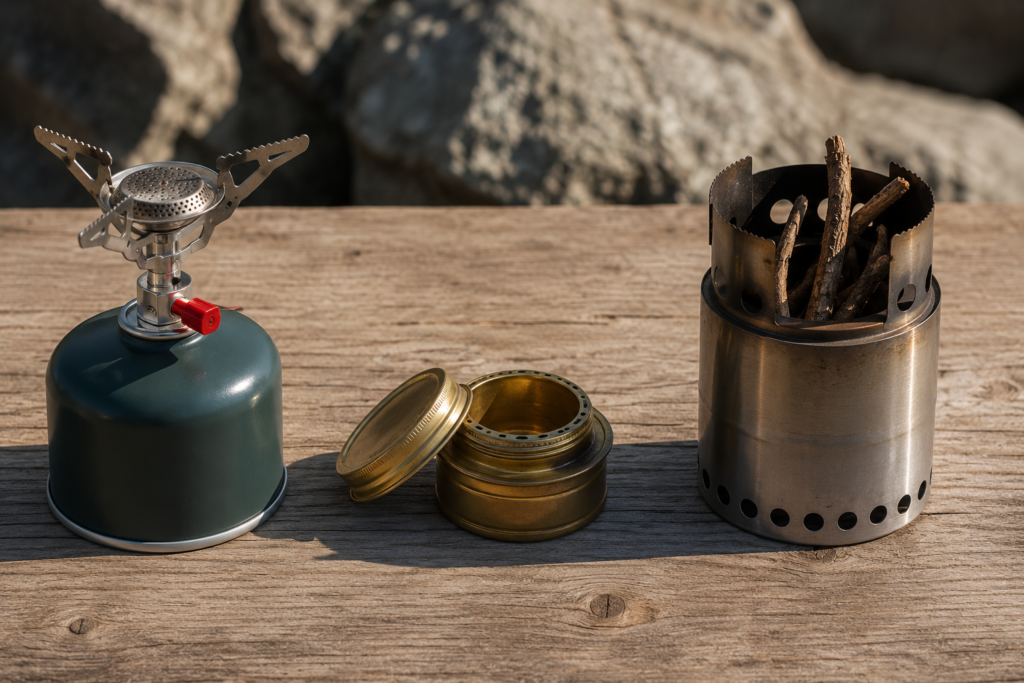
Every stove in this guide is a canister stove — meaning it screws onto a pressurized isobutane-propane fuel canister. This is the right type for the vast majority of campers. But knowing what the other types are helps you understand why canister stoves dominate the market.
- Canister stoves (isobutane-propane): screw onto sealed, pressurized canisters. No priming required, no spills, easy to regulate. The canister self-seals when you unscrew the stove. The type used in every stove reviewed in this guide. Drawback: you cannot tell how much fuel remains in the canister.
- Liquid-fuel stoves (white gas/multifuel): connect to refillable fuel bottles. Work in extreme cold and at high altitude where canister stoves struggle. Heavier, require priming, field-repairable. Best for expedition mountaineering. Not the right choice for most campers.
- Alcohol stoves: burn denatured alcohol from a small open cup. Extremely lightweight, dead simple, no moving parts. Terrible in wind, slow boil times, fuel hard to find in small towns. Favoured by ultralight thru-hikers willing to accept limitations.
- Wood-burning stoves: burn collected twigs and sticks. Zero fuel to carry. Smoky, inconsistent, restricted or banned in many parks and wildfire-risk areas. Useful as an emergency backup option.
For everything except expeditions above the snowline, international travel where isobutane is unavailable, or committed ultralight thru-hiking, a canister stove is the right choice. The rest of this guide focuses entirely on canister stoves.
BTU Output, Boil Time, and Weight — the Three Numbers That Matter
Stove specifications can look overwhelming, but three numbers tell you almost everything you need to know about a canister stove’s real-world performance.
- BTU output (British Thermal Units per hour): how much heat the stove produces. Higher BTU means faster boiling and more cooking power. Most quality canister stoves produce 8,000-11,000 BTU. The SOTO WindMaster produces 11,000 BTU, making it one of the most powerful canister stoves available. For reference, your kitchen hob produces roughly 12,000-18,000 BTU.
- Boil time (typically per litre or 500ml of water): how long to bring cold water to a rolling boil. Most quality canister stoves boil 500ml in 2-4 minutes. The Jetboil Flash boils a full litre in under 4 minutes, making it the speed leader in the integrated system category.
- Weight (stove head only, or complete system): canister stove heads range from 26 grams (BRS 3000T) to about 100 grams (MSR PocketRocket Deluxe). Note that integrated systems like the Jetboil Flash are weighed as complete systems — the pot is included, which explains the higher weight figure.
IMPORTANT NOTE: Always check whether a quoted weight includes the fuel canister and pot or just the stove head. These are not comparable numbers. A 100g stove head plus a 110g canister plus a 100g pot is 310g total. An ‘integrated system weighing 430g’ includes the pot and often the fuel. Compare complete system weights when deciding between options.
Wind Resistance: The Spec Most Buyers Discover Too Late
Wind is the single most damaging factor to canister stove performance — and it is the one that is hardest to appreciate from a spec sheet. In calm conditions, most canister stoves perform similarly. In sustained wind, the differences become dramatic.
A standard canister stove in a 10mph crosswind can lose 30-40% of its effective heat output as wind disperses the flame away from the pot base. At 20mph, some stoves become effectively unusable without a windscreen.
- The SOTO WindMaster’s concave burner head is specifically engineered to shelter the flame — tested at 14,000 feet in Colorado with sustained gusts. GearJunkie testers confirmed it held flame at conditions where competitors failed.
- The MSR WindBurner integrated system takes wind resistance to its logical conclusion — the enclosed burner system is almost entirely wind-immune. At the cost of versatility.
- Budget note: never use a windscreen around a canister stove — it traps heat around the canister and creates an explosion risk. The right answer to wind is a wind-resistant burner design, not a windscreen.
Wind is just one part of the wet-weather camping challenge — our wet weather camping tips guide covers the full picture of staying comfortable when conditions turn.
Cold Weather Performance and the Pressure Regulator Advantage
Standard canister stoves lose performance in cold weather because isobutane-propane fuel depressurises at low temperatures. Below 5°C (40°F), some canister stoves produce noticeably reduced heat — and in freezing conditions, some struggle to light at all.
- Pressure regulator: a built-in component that maintains consistent fuel pressure regardless of canister temperature or fill level. The MSR PocketRocket Deluxe has one. The SOTO WindMaster has a micro-regulator. Budget stoves typically do not.
- Winter camping solution: keep the fuel canister warm — in your sleeping bag overnight, in a jacket pocket while hiking. Warm fuel outperforms cold fuel regardless of the stove’s design.
- Altitude consideration: canister stoves work at altitude but boil times increase as atmospheric pressure drops. The thinner the air, the longer the boil. Budget 20-30% extra fuel for sustained high-elevation camping.
At altitude, stove performance changes significantly — our mountain camping for beginners guide covers high elevation specifics including fuel management strategies.
Best Compact Camping Stoves by Camper Type — Honest Recommendations
The best compact camping stoves vary significantly by how you camp, what you cook, and how much weight you are willing to carry. Here is the honest picture for each category.
Best All-Round Canister Stove — SOTO WindMaster
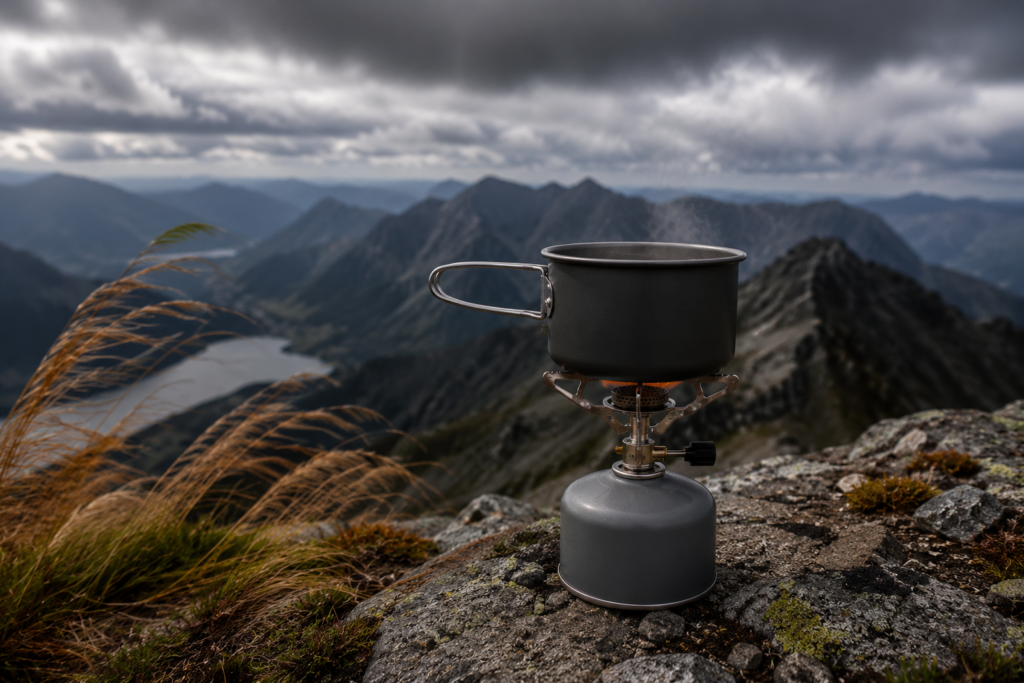
The SOTO WindMaster is our top canister stove pick, and it edges out the perennial favorite MSR PocketRocket for one simple reason: it just handles wind better. The concave burner head tucks the flame in close to the pot base and shields it from gusts instead of letting them scatter the heat sideways.
That design consistently holds a steadier boil in gusty, high-elevation conditions — think sustained 30mph wind at altitude — where flatter burner designs tend to sputter and lose efficiency. It does give up a little ground on raw boil speed, but makes it back up with better fuel efficiency, so you get more hot meals out of the same canister. Combine that with a compact, pack-friendly size, and it’s an easy call for anyone who camps somewhere the wind doesn’t cooperate.
- Weight: approximately 67g — manageable for backpacking, barely noticeable for car camping
- BTU output: 11,000 BTU/h — one of the highest in its class
- Boil time (500ml): approximately 2 minutes 45 seconds in calm conditions
- Pot support: 4-flex interchangeable pot support handles pots up to 3 litres with stability
- Pressure regulator: micro-regulator for consistent performance in cold and at altitude
- Best for: regular backpackers, alpine campers, anyone who frequently camps in exposed or windy conditions, those who want to cook real food not just boil water
- Who it is NOT for: absolute weight minimalists who need sub-30g options, budget buyers — the WindMaster sits at around $70
Where to Buy: https://www.amazon.com/SOTO-WindMaster-Micro-Regulator-4Flex/dp/B07Z3Y3GRQ/
Best Value All-Rounder — MSR PocketRocket 2
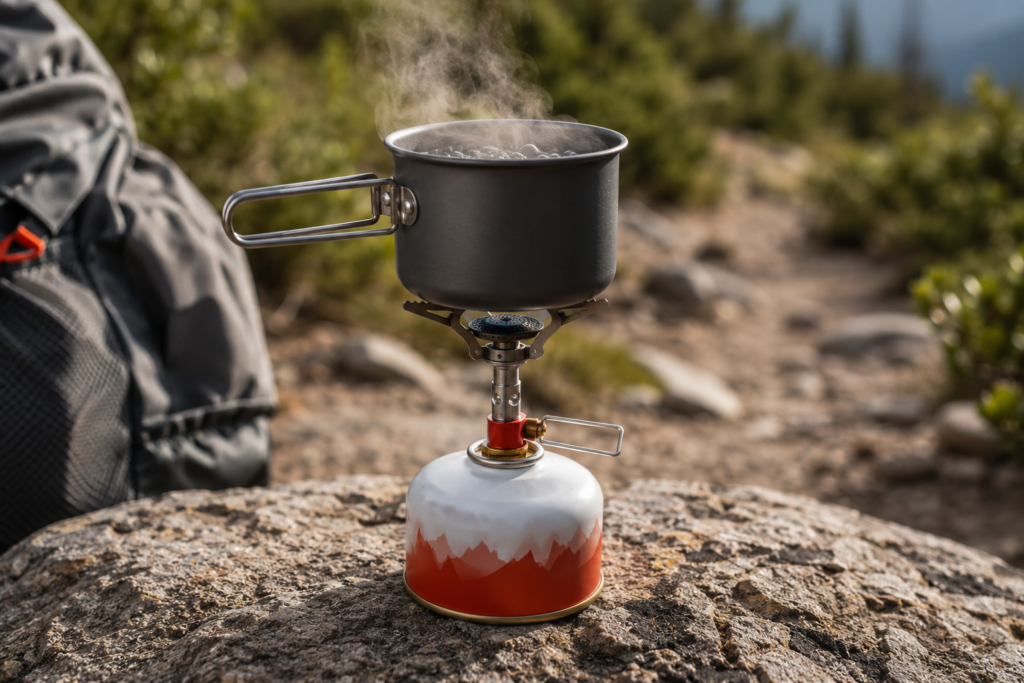
The MSR PocketRocket 2 remains one of the most consistently recommended canister stoves for good reason: it’s simple, reliable, light, compact, fast, and priced accessibly. It doesn’t lead in any single category — it doesn’t have the WindMaster’s wind resistance, the Jetboil’s boil speed, or the LiteMax’s titanium construction — but it excels at being competent at everything, at a price that makes it the obvious first stove purchase for most campers.
- Weight: 73g (2.6 oz) — light enough for backpacking, invisible in a car camping kit
- BTU output: 8,800 BTU/h
- Boil time (1L): 3 minutes 30 seconds in calm conditions
- Pot support: three-leg folding design with serrated edges for grip
- Compatibility: all standard isobutane-propane canisters
- Best for: first-time stove buyers, weekend backpackers, campers who want reliability without premium pricing
- Who it is NOT for: windy alpine conditions where the WindMaster is a meaningful upgrade, cold weather camping where a pressure regulator matters
A little humor with a point: The MSR PocketRocket 2 has a very specific superpower: it makes experienced campers feel slightly defensive when asked why they’re not using something newer or lighter. The answer is almost always some variation of “because this one always works.” There’s no more honest stove endorsement available than that, repeated across thousands of trail miles.
Where to Buy: https://www.amazon.com/MSR-PocketRocket-2-Stove/dp/B07BN143Z5/
Best Integrated System for Speed — Jetboil Flash
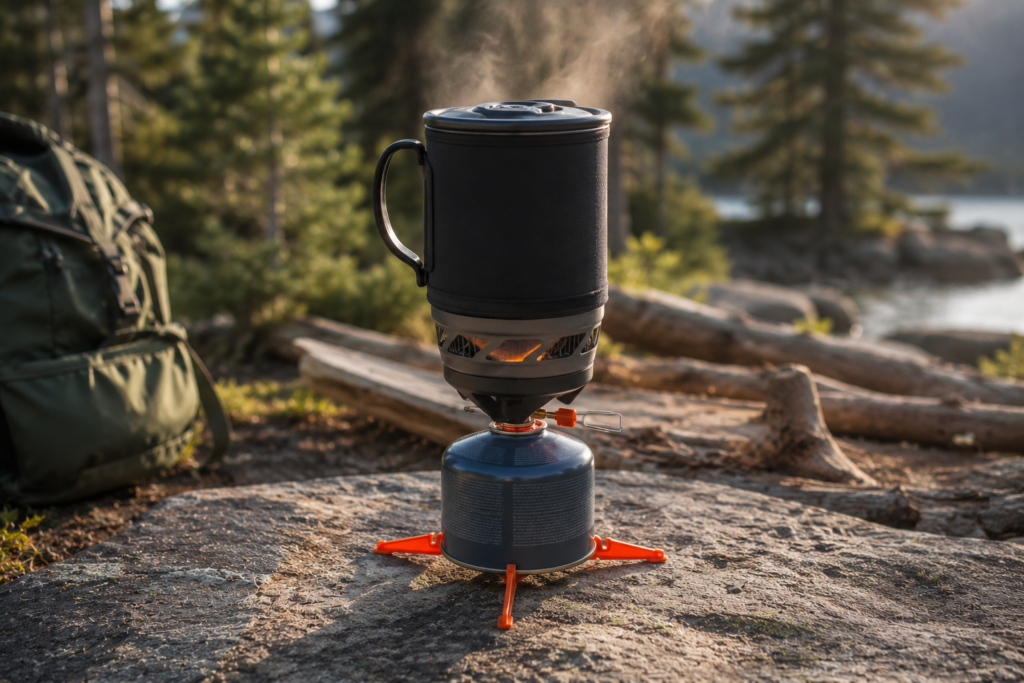
The Jetboil Flash was redesigned in 2025 with meaningful improvements over the previous generation: a new turn-and-click ignition (replacing the more fragile push-button), an improved fuel regulator for better flame control, heat-resistant grips, and a sturdier pot-stove locking mechanism. Recent testing across dramatically different climates — from humid summer heat to blustery Patagonian wind — held up well on both counts.
The Flash is purpose-built for one thing above all others: boiling water as fast as possible. It does this through a heat exchanger built into the base of the insulated cooking vessel and a burner optimized for the specific pot dimensions. The result is a boil time of approximately 4 minutes per liter that holds up better in varied conditions than standard canister stoves of equivalent BTU rating.
- System weight: approximately 15.5 oz (stove + pot, excluding fuel canister)
- Pot capacity: 1 liter — enough for two people’s hot drinks or one freeze-dried meal
- Boil time: approximately 4 minutes per liter
- Fuel efficiency: the heat exchanger makes the Flash significantly more fuel-efficient per boil than standard canister stoves
- New 2025 features: turn-and-click ignition, improved regulator knob, sturdier locking mechanism, heat-indicating color-change sleeve retained
- Best for: solo adventurers who live primarily on boiling water at camp — freeze-dried meals, coffee, hot drinks
- Who it is NOT for: campers who want to cook actual meals with simmering control; groups larger than two; weight-obsessive backpackers
A fast-boiling stove is also one of three reliable methods for purifying water in the wilderness — our complete guide to purifying water in the wilderness covers when boiling is the right choice and when a filter is more practical.
Where to Buy: https://www.amazon.com/Jetboil-Portable-Backpacking-Ignition-Isobutane/dp/B0DZ9GB3Y5/
Best Ultralight Stove for Minimalists — Snow Peak LiteMax
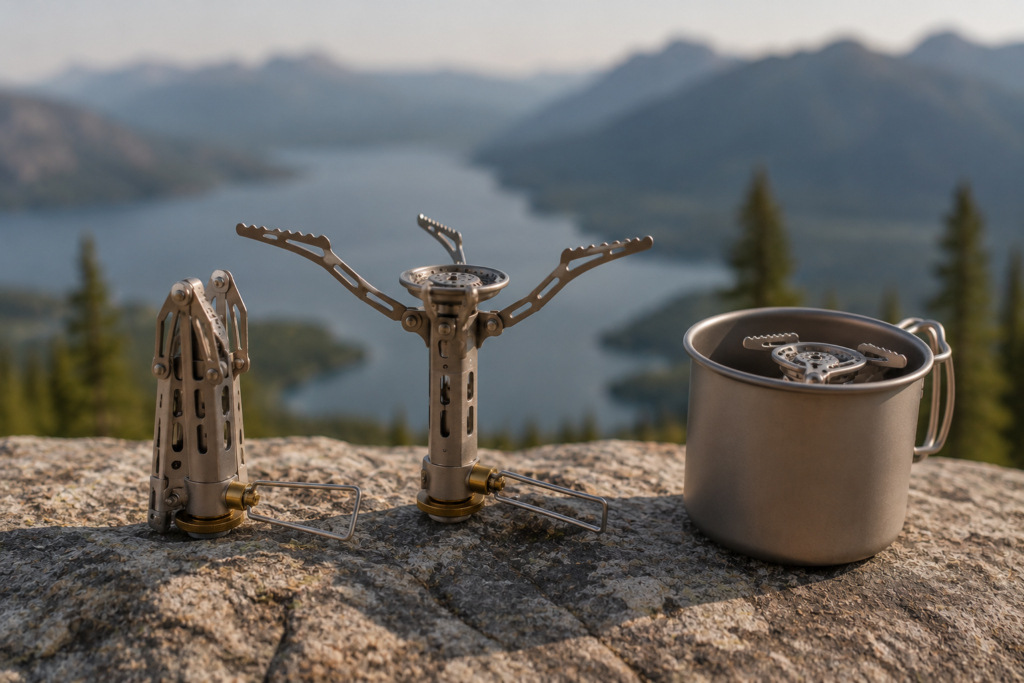
The Snow Peak LiteMax is the stove for campers who have already eliminated every gram they can from their pack and are ready to eliminate a few more. At approximately 27g (0.9oz), it’s one of the lightest quality canister stoves available — and the titanium construction that achieves this weight is genuinely more durable than most ultralight alternatives at this weight range.
- Weight: 27g (0.9 oz) — titanium construction
- Packability: folds down to fit inside 550-750ml titanium pots
- Simmer control: better than most ultralight competitors — capable of simmering noodles and rice without scorching
- Wind performance: limited — use natural terrain windbreaks or position behind your pack. A windscreen cannot safely be used with canister stoves.
- Best for: thru-hikers and ultralight backpackers for whom every gram is a conscious decision
- Who it is NOT for: campers who need wind resistance; those who cook frequently in exposed terrain; beginners who may not need ultralight capability yet
Where to Buy: https://www.amazon.com/Snow-Peak-LiteMax-Stove/dp/B011B6J7U0/
Best Budget Ultralight — BRS 3000T
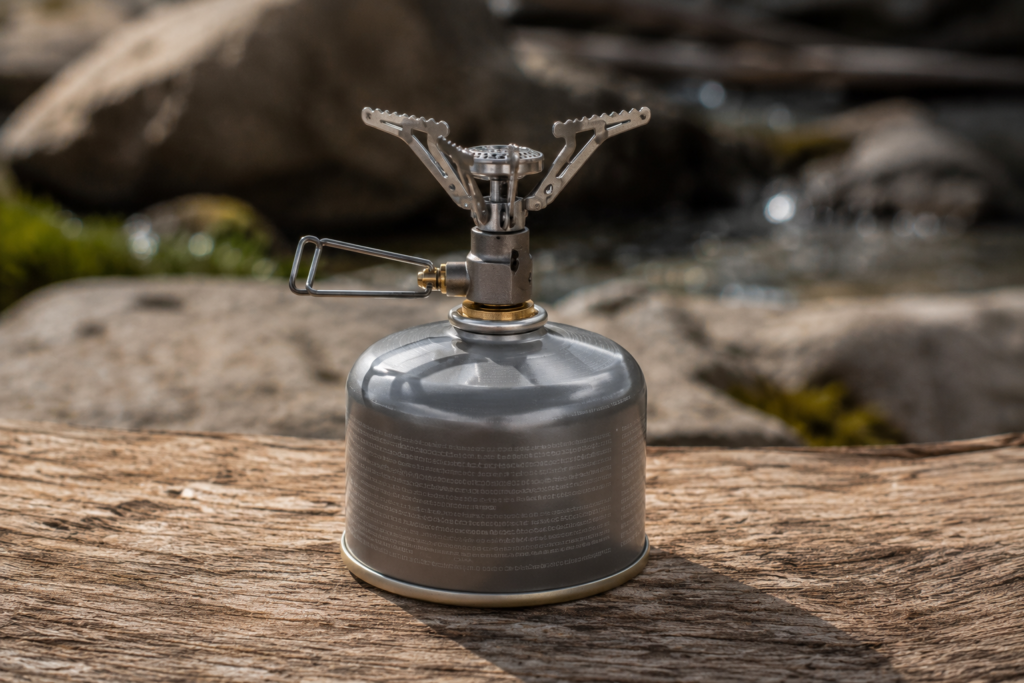
The BRS 3000T is the answer to the question “what is the lightest and cheapest canister stove that actually works?” At 26g and approximately $18, it achieves something that seems physically implausible and is worth taking seriously as both a primary stove for calm-weather backpackers and a backup stove for everyone else.
- Weight: 26g — the lightest canister stove on the market at this price point
- Price: approximately $18 — genuinely exceptional value for titanium alloy construction
- No built-in ignition: you need a lighter or matches every time — carry one regardless
- No simmer control: the flame adjustment is basic — best for boil-only tasks rather than actual cooking
- Wind performance: poor — in any meaningful wind the BRS 3000T loses significant effectiveness
- Best for: ultralight backpackers in fair to calm weather; anyone needing a reliable backup stove; budget-conscious campers trying a canister stove for the first time
- Who it is NOT for: cooking in wind, carrying large pots, anyone who needs simmer control or built-in ignition, winter camping or high altitude use
Honest verdict: The BRS 3000T is a genuine product that works exactly as described in calm conditions and performs poorly in everything else. Many seasoned hikers carry it as a backup stove that weighs nothing and costs nothing relative to the reassurance it provides. Just don’t take it into alpine conditions and expect it to cook dinner in 30mph wind.
Where to Buy: https://www.amazon.com/BRS-Ultralight-Backpacking-Titanium-BRS-3000T/dp/B083CWHB9B/
Best for Car Camping Beginners — MSR PocketRocket Deluxe
The MSR PocketRocket Deluxe is what happens when the PocketRocket 2’s excellent fundamentals gain a piezo igniter (no lighter required), a pressure regulator (consistent performance in cold and at low canister levels), and a larger burner head that distributes heat more evenly for actual cooking. For car camping beginners who want the quality of the MSR family without the limitations of the base PocketRocket 2, the Deluxe is the right step up.
- Weight: 83g (2.9 oz) — the additional features add only 10g over the standard version
- Built-in piezo igniter: push-button spark lighting — no matches or lighter needed
- Pressure regulator: maintains consistent flame output as the canister empties and in cold conditions
- Burner head: enlarged compared to the standard version — distributes heat more evenly for sautéing and simmering
- Best for: car camping beginners who want quality without the complexity of dedicated expedition stoves
- Who it is NOT for: weight-obsessive ultralight backpackers for whom even 10 extra grams matter
Where to Buy: https://www.amazon.com/MSR-PocketRocket-Ultralight-Backpacking-Camping/dp/B07L5S65HR/
Stove Specifications Comparison at a Glance
All specifications as stated by manufacturers or from recent testing. Complete system weights noted where applicable.
| Spec | SOTO WindMaster | MSR PocketRocket 2 | Jetboil Flash | Snow Peak LiteMax | BRS 3000T | PocketRocket Deluxe |
| Weight | ~67g | 73g | 15.5oz (system) | 27g | 26g | 83g |
| BTU | 11,000 | 8,800 | 10,000+ | N/A | N/A | 8,800 |
| Boil (500ml) | ~2:45 | ~1:45 | ~2:00 (0.5L) | ~2:30 | ~3:00 | ~1:45 |
| Wind Resistance | Excellent | Fair | Good | Poor | Poor | Fair |
| Simmer Control | Good | Fair | Basic | Good | Minimal | Good |
| Igniter | No | No | Yes | No | No | Yes |
| Regulator | Yes (micro) | No | No | No | No | Yes |
| Price | ~$70 | ~$50 | ~$145 | ~$70 | ~$18 | ~$60 |
Matching Your Stove to Your Cooking Style — the Decision Made Simple
- You mostly boil water for coffee and rehydrated meals, nothing more: MSR PocketRocket 2 or BRS 3000T (if weight is critical)
- You want to cook actual food — sautéing, simmering, varied techniques: SOTO WindMaster or MSR PocketRocket Deluxe
- Speed is your absolute priority: Jetboil Flash
- You camp in windy or alpine conditions regularly: SOTO WindMaster
- Weight is your primary constraint: Snow Peak LiteMax, or BRS 3000T if you also need to save money
- This is your first camping stove: MSR PocketRocket Deluxe
For what to actually cook once you have your stove, our easy camp cooking for beginners guide covers recipes and techniques that work with a single canister stove and minimal cookware.
Camping Stove Safety: The Basics That Cannot Be Skipped
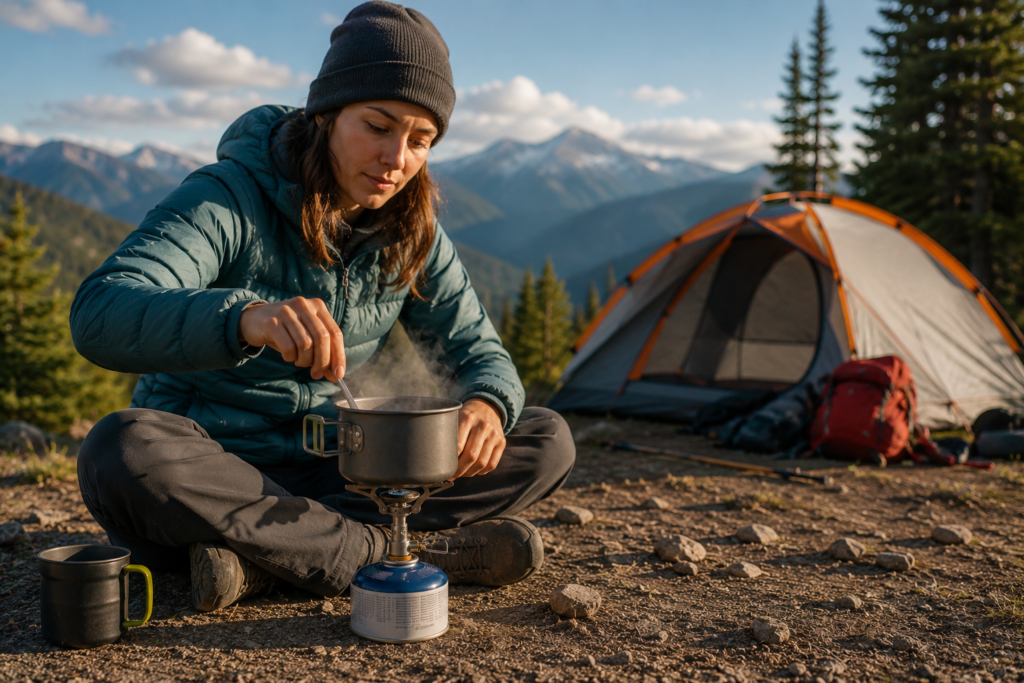
- Never cook inside a tent or enclosed space: carbon monoxide is colorless and odorless and accumulates rapidly in enclosed spaces.
- Never use a windscreen around a canister stove: windscreens trap heat around the canister and create a genuine explosion risk.
- Check all connections before lighting: ensure the stove is fully and securely threaded onto the canister.
- Cook on level ground: a pot of boiling water toppling from an unstable stove is one of the most common backcountry burn injuries.
- Canister disposal: empty canisters need to be punctured before recycling or they go in general waste. Never throw an unpunctured canister into a fire.
- Never light inside a tent porch or vestibule: even tent porches have limited airflow. Cook clear of the tent structure entirely.
What Campers Wish They Had Known Before Buying Their First Stove
- The canister weight matters more than people expect: a 110g isobutane canister becomes part of your system weight. Include it in your total system calculation.
- Fuel efficiency varies more than boil time suggests: a faster boil time doesn’t necessarily mean more fuel-efficient — it may simply use more gas faster.
- Simmer control matters more for real cooking: the difference between a stove that only boils and one that genuinely simmers is the difference between rehydrating meals and actually cooking them.
- The piezo igniter is more convenient than most people initially think: carrying a lighter alongside your stove becomes noticeable after enough trips in wet conditions.
- Wind hits harder than you expect on your first exposed campsite: a stove that performs flawlessly in a sheltered garden test can be frustratingly slow on an exposed hilltop.
- A second small canister as backup is always worth carrying: you can’t tell how much fuel remains in a canister.
Stove mistakes are part of a broader category of avoidable first-camping-trip errors — our common camping mistakes to avoid guide covers the ten most common.
Frequently Asked Questions About Compact Camping Stoves
What is the best compact camping stove for beginners?
The MSR PocketRocket 2 is the most consistent recommendation for first-time buyers: it’s reliable, fast, lightweight, simple to use, and priced accessibly. If you want the additional convenience of a built-in igniter and better cold-weather performance, the MSR PocketRocket Deluxe adds both for a small price premium and weight penalty.
How long does a gas canister last for camping?
A standard 100g isobutane canister provides approximately 1 hour of burn time at maximum output, or roughly 8-12 liters of water boiled. A 230g canister roughly doubles this. Most solo campers find a 100g canister covers 2-3 days of cooking, while couples typically need a 230g canister for the same duration.
Can I use any fuel canister with any camping stove?
All the canister stoves in this guide use standard Lindal valve threading, compatible with canisters from most reputable brands. The one exception to watch for is non-standard valve designs from lesser-known manufacturers sold online without brand recognition. Stick to reputable brands for fuel canisters and you’ll have no compatibility issues.
Is the Jetboil Flash worth the premium price?
For its specific use case — boiling water fast, keeping everything in one compact unit, with no cooking versatility required — yes. For campers who want to cook actual meals with varied techniques, the Flash’s limited simmering ability means you’re paying a premium for a capability you’ll only partially use.
What is the lightest camping stove available?
The BRS 3000T at 26g is the lightest canister stove available at any price point. The Snow Peak LiteMax at 27g is one gram heavier, titanium construction, significantly more durable, and considerably better in variable conditions. The BRS 3000T is the choice when weight is the only consideration; the LiteMax is the choice when weight is primary alongside a minimum standard of durability.
The Right Stove Is the One You Actually Use — Here Is How to Find Yours
The best compact camping stoves are defined by the gap between what they weigh and what they enable — and that gap is genuinely remarkable across every option in this guide. A 73g stove. A 26g stove. A system that boils water in four minutes and fits in the palm of your hand. These aren’t compromises. They’re engineered solutions to a specific problem, and they work.
The choice between them isn’t about which is objectively best. It’s about which matches your camping life. How much cooking do you actually do at camp? How exposed are your usual campsites? How much do the grams matter on your specific trail? How important is it to light your stove in the rain without a lighter?
Answer those questions honestly, match them to the recommendations above, and you’ll choose the right stove. Then go use it. A warm meal after a long day on the trail, cooked on something that weighs less than your phone, is one of the quiet pleasures that camping regularly delivers — and the right stove makes it effortless every time.