Camping with Dogs: The Ultimate Checklist for a Safe Camping Trip
-
| Founder & Content Creator

Latest Posts
Camping with dogs is one of the most rewarding outdoor experiences you can have — for you, for the family, and absolutely for your dog. That tail-wagging enthusiasm the moment they realise they are coming with you is worth every bit of the extra planning. And planning, it turns out, is the key word. A camping trip with your dog that has been thought through properly is brilliant. One that hasn’t? Well, let’s just say you’ll be spending a lot of time apologising to other campers.
The good news is that with the right dog camping gear, a sensible checklist, and a few key habits, camping with your dog is genuinely easy and hugely enjoyable. This guide covers everything — from the pre-trip vet visit and campsite rules to paw care, first aid, trail etiquette, and what to do when you get home. Your four-legged adventure companion deserves the best possible trip. Let’s make sure they get it.
THE ONE THING THAT MAKES EVERYTHING EASIER
Preparation. Not gear — preparation. Knowing the campground’s pet policy in advance, visiting the vet, doing a backyard trial run, and knowing where the nearest veterinary clinic is from your campsite. These four things done before you leave home mean you can relax and enjoy the trip rather than manage problems as they arise.
Is Camping with Dogs Really a Good Idea? (Yes — Here’s Why)
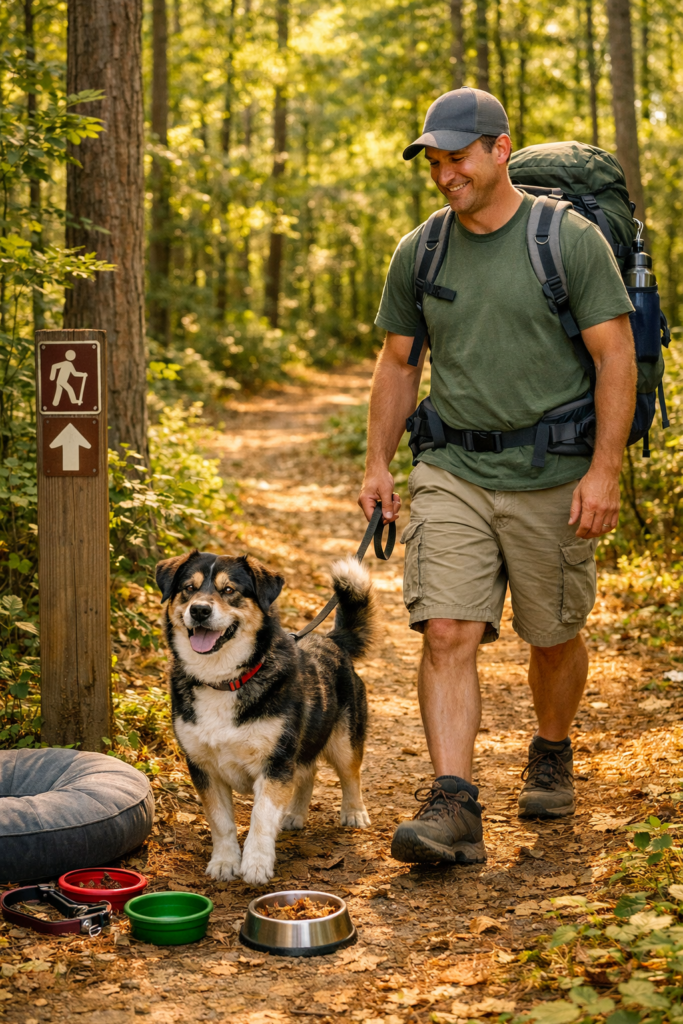
If you have been on the fence about bringing your dog on a camping trip, let us settle it: yes. Dogs are extraordinary camping companions. They love new smells with a passion that is frankly inspirational. They are excellent hiking partners. They are superb at warming up a tent on a cold night. And the bond that forms between a dog and their owner on an outdoor adventure is genuinely different from the one built at home on the sofa.
Dogs thrive on the combination of physical activity, mental stimulation, and time with their people that a camping trip provides. Research consistently shows that dogs who get regular outdoor exercise show fewer anxiety behaviours, better sleep patterns, and improved social confidence. And for you — well, there is no better alarm clock than a dog who has just remembered that there are approximately four thousand new smells outside the tent.
Before You Go: The Pre-Trip Dog Camping Checklist
Everything that happens before you leave the driveway determines how much you enjoy the trip. Get these three things sorted in advance and the rest takes care of itself.
Check Campground Pet Policies in Advance
Before booking any campsite, confirm their pet policy directly. Most established campgrounds welcome dogs, but many come with specific rules — leash length requirements, designated dog areas, dog-free zones near water, or restrictions on certain breeds. Some national parks and wilderness areas have strict limitations on where dogs are permitted at all. A phone call or a quick check of the campsite’s website saves a significant amount of frustration on arrival day.
- Check: Is the campground dog-friendly? (Never assume — always confirm)
- Check: What is the leash policy? (Many require a maximum 6-foot leash at all times)
- Check: Are there dog-free zones? (Often around water, play areas, or certain trails)
- Check: Are there any breed or size restrictions?
- Check: Is there a pet fee? (Some campgrounds charge a small additional fee per dog per night)
Visit the Vet Before Your Trip
Vaccination Records and Tick Prevention
A pre-trip vet visit is one of the most important things you can do before camping with your dog — and one of the most commonly skipped. Your vet can confirm vaccinations are current (some campgrounds require proof), check for any underlying health conditions that might make the trip uncomfortable, and advise on tick, flea, and heartworm prevention specific to your destination.
- Confirm vaccinations are current — rabies, distemper, and leptospirosis are the key ones for outdoor environments
- Ask about tick prevention — topical treatments, oral medications, or tick collars specific to your destination
- Request a printed copy of vaccination records — some parks require proof at entry
- Ask about flea and heartworm prevention for the specific region you are visiting
- Mention any existing health conditions — heat sensitivity, joint issues, or anxiety in new environments
Do a Backyard Trial Run First
If your dog has never camped before, the last thing you want is to discover they are not comfortable in a tent for the first time at an actual campsite, after a long drive, in the dark. Set up your tent in the garden and spend a few hours in it with your dog first. Let them sniff around, settle inside, and get comfortable with the canvas smells and the new sounds. Most dogs adapt quickly once the initial curiosity passes. Some — particularly anxious dogs or those unused to the outdoors — need a little more time. Better to know this at home than to find out at midnight three hours from home.
Essential Dog Camping Gear: Everything Your Dog Needs at Camp
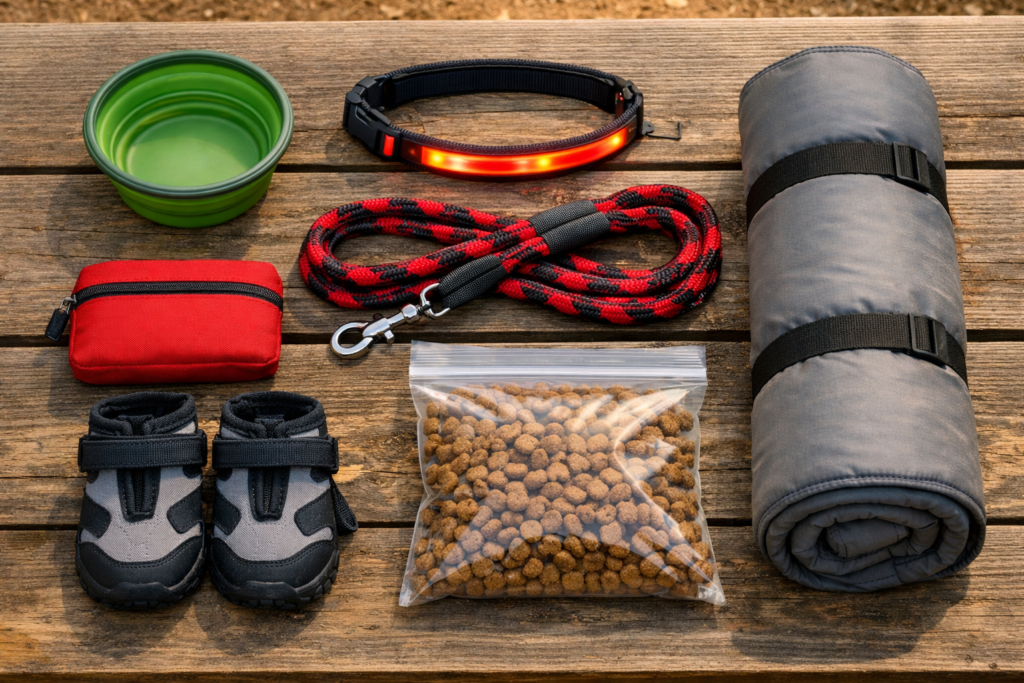
Packing for your dog is a separate checklist from packing for yourself — and it is worth treating it that way. Here is the complete dog camping gear list, organised so nothing gets forgotten.
Dog Sleeping and Comfort Gear
- Dog camping mat or travel bed — a compact, waterproof mat gives your dog a familiar, clean place to sleep at camp
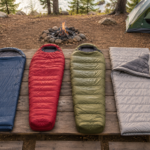
- Dog sleeping bag — for colder nights; dogs get cold too, especially smaller or short-haired breeds
- Extra blanket — a familiar blanket from home provides comfort and warmth and helps anxious dogs settle
- Closed-cell foam pad for tent floor — prevents claw damage to tent floor and provides insulation from cold ground
- Dog-specific tent — if your dog prefers their own space, compact dog tents are available for exactly this purpose
Food, Water, and Feeding Essentials
- Dog food — sealed zip bags for dry food, cooler for wet or raw food. Pack 1-2 extra days’ worth in case you are delayed
- Collapsible dog bowls — lightweight, packable, and far more practical than bringing home bowls
- Portable dog water bottle — with a foldout drinking trough; critical for trail hikes away from the campsite
- Water filter for dogs — if you plan to use stream or lake water, a small filter keeps your dog’s water safe
- Treat pouch — keep training treats accessible for recall training and reward behaviour at camp
- Dog food storage bag — sealed, smell-proof container prevents wildlife being attracted to your site
Dog Safety and Identification Gear
GPS Tracker vs AirTag — Which Is Better for Dogs at Camp?
Identification and tracking gear is the most important category in your dog’s camping kit — and the one most commonly treated as optional. It is not optional. Dogs can bolt at camp when startled by wildlife, other dogs, or unfamiliar sounds. Even well-trained dogs can chase a scent beyond earshot in an unfamiliar environment.
- ID tag on collar — name, your phone number, and ideally the campsite address for the duration of the trip
- LED light-up collar — USB rechargeable, essential for night visibility at camp when you step outside the tent
- GPS dog tracker (e.g. Tractive, Fi) — real-time location tracking via an app on your phone. Far more reliable than an AirTag for moving animals; AirTags only update location when near an Apple device, which may be infrequent in wilderness areas
- Microchip details — confirm your dog’s microchip is registered and your contact details are current before any trip
- Printed photos of your dog — physical copies to show other campers or park officials if your dog goes missing. Phones run out of battery at the worst times
- Long tie-out cable — 20-30 feet of durable cable tied to a tree gives your dog freedom to move around camp safely while keeping them contained
- Standard 6-foot leash — for walking, hiking, and any movement through the campground
Campsite Setup Tips When Camping with Your Dog
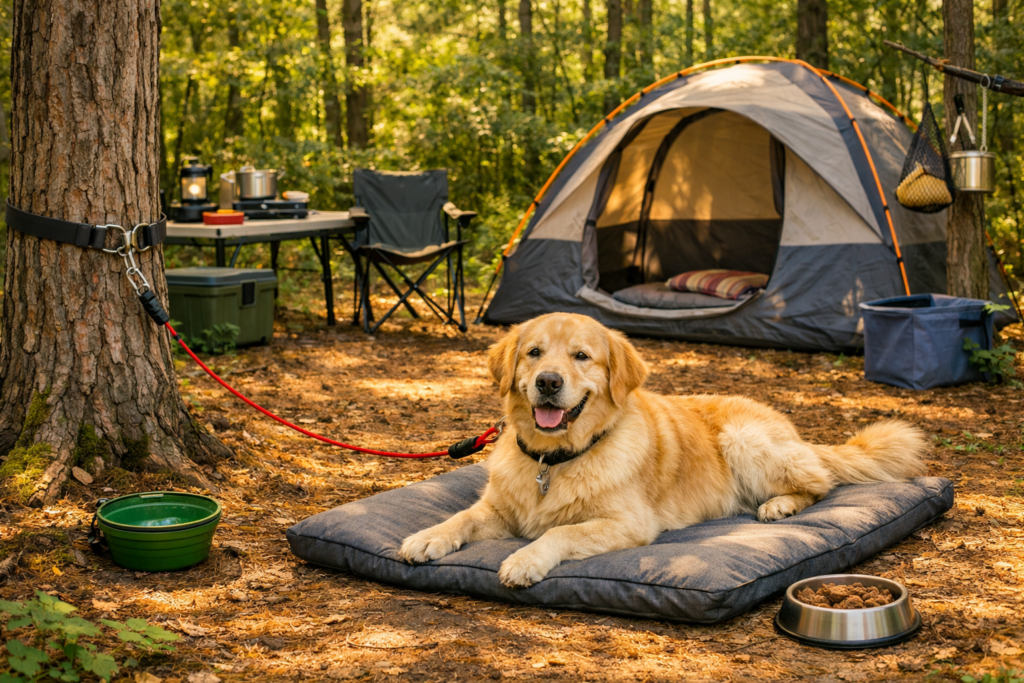
How you set up your campsite directly affects how comfortable and calm your dog is throughout the trip. A few minutes of thoughtful setup saves hours of managing an anxious or unsettled dog.
- Choose a quiet pitch — avoid high-traffic areas near facilities or main paths. A dog that sees people passing constantly will bark constantly
- Set up in shade where possible — shade is critical for your dog’s temperature comfort throughout the day
- Establish the tie-out before letting your dog explore — give them a safe radius from the start, not as an afterthought
- Set up your dog’s sleeping space inside the tent first — a familiar mat or blanket signals ‘this is your safe place’ in a new environment
- Position fresh water within your dog’s reach at all times — dogs in new, stimulating environments drink more than usual
- Never leave your dog in a closed vehicle at camp — on a 70°F day, car interior temperature can exceed 100°F within minutes. This is a genuine emergency risk
- Never leave your dog alone at the campsite unattended — fabric tents are not a secure barrier for a determined or anxious dog
Keeping Your Dog Safe While Camping
Campfire and Heat Safety for Dogs
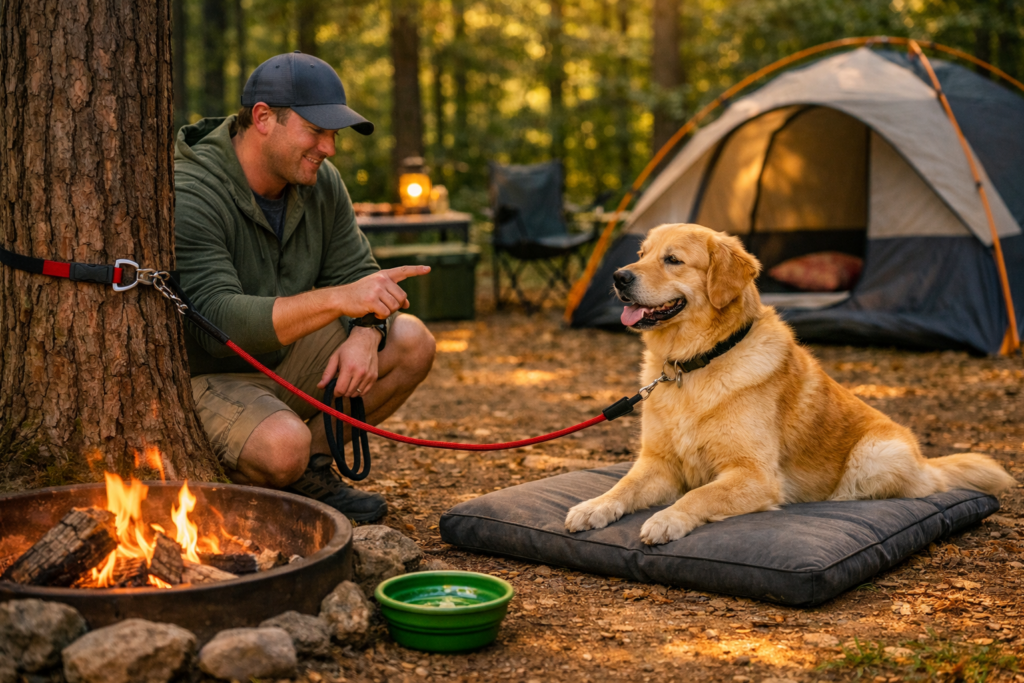
- Keep dogs at least 3 feet from fire rings and camp stoves — curious noses and open flames are a predictable problem
- Never leave your dog unattended near an open fire
- Secure loose food near cooking areas — dogs attracted to the smell of cooking will burn a nose or paw getting too close to a stove
- Provide shade throughout the day — direct sun exposure is a genuine heat risk for dogs
- Offer fresh water constantly, especially after any physical activity
- Avoid exercising your dog during peak sun hours — early morning and late afternoon are the safest times for activity
- Test the ground temperature with your bare hand before letting your dog walk on it — if it is too hot for your palm for 5 seconds, it is too hot for their paws
Wildlife Awareness and Dog Safety
- Keep your dog leashed on all trails — in many national parks and wilderness areas this is a legal requirement, not a suggestion
- Do not let your dog approach or investigate wildlife, no matter how small — porcupines, skunks, and snakes are the most common campsite wildlife hazards
- Keep your dog away from tall grass and dense undergrowth where possible — prime tick habitat
- Do a full tick check every evening — nose to tail, including behind ears, between toes, in the groin area, and around the neck where the collar sits
- Be alert for snake activity — keep your dog close and on leash in areas with known snake populations
- Avoid areas with heavy insect activity at dawn and dusk
For a comprehensive guide to animal encounters at camp — from insects to large predators — our [wildlife safety while camping] handbook is essential reading before any wilderness trip.
Dog Health and First Aid on Camping Trips
A pet first aid kit is non-negotiable for any camping trip with a dog. It is not a substitute for veterinary care — but it gives you the tools to manage minor injuries and stabilise more serious ones until you can get professional help. Know where the nearest veterinary clinic is before you leave home. Save the number in your phone.
Building a Dog-Specific First Aid Kit
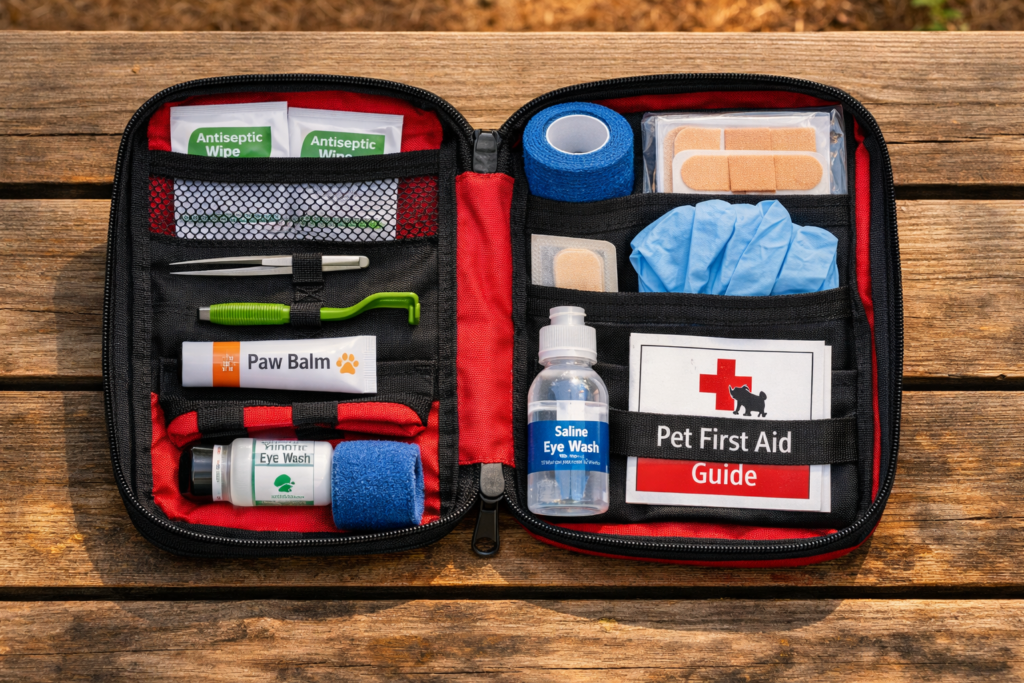
What to Include in a Dog First Aid Kit
- Fine-tipped tweezers — for tick removal, thorns, and splinters. Grip as close to skin as possible, pull straight out
- Co-flex self-adhesive bandage wrap — sticks to itself, not to fur. The single most useful wound management item for dogs
- Antiseptic wipes and spray — clean wounds promptly before dressing
- Paw balm — for cracked, sore, or cut paw pads. Works preventatively on longer hikes too
- Dog-specific eye wash / saline solution — flush out debris, seeds, or irritants from eyes
- Antihistamine (Benadryl / diphenhydramine) — for insect stings and mild allergic reactions. Always confirm correct dog dosage with your vet before the trip
- Digital thermometer — a dog’s normal temperature is 38-39.2°C (100.5-102.5°F). Above 39.5°C is a warning sign
- Printed vaccination records and vet contact details
- Pet First Aid app by American Red Cross — download it offline before you leave home
Signs of Heat Stroke and Hypothermia in Dogs
How to Spot and Treat Heat Stroke in Dogs Outdoors
Dogs cannot regulate their temperature as effectively as humans. They rely almost entirely on panting — and panting has limits. Heat stroke can develop quickly in warm weather, particularly in short-nosed breeds (bulldogs, pugs, boxers), overweight dogs, and older dogs.
HEAT STROKE WARNING SIGNS
- Excessive panting that does not slow down with rest
- Drooling heavily — thick, ropy saliva
- Bright red gums or tongue
- Glazed eyes or disorientation
- Vomiting, stumbling, or collapse
TREATMENT: Move to shade immediately. Apply cool (not cold) water to paw pads, groin, and neck. Offer small amounts of water to drink. Get to a vet as fast as possible.
HYPOTHERMIA WARNING SIGNS
- Shivering or trembling that does not stop
- Lethargy, weakness, or stumbling
- Pale gums
- Shallow, slow breathing
TREATMENT: Move inside a warm shelter. Wrap in dry blankets. Place warm water bottles wrapped in cloth against the body. Get to a vet.
Trail and Hiking Etiquette When Camping with Dogs
Camping with dogs means sharing trails, facilities, and campsite space with other visitors — some of whom love dogs, some of whom are afraid of them, and some of whom simply prefer their outdoor space without someone else’s enthusiastic Labrador in their face. Respecting everyone’s experience is part of being a responsible dog owner outdoors.
- Always keep your dog on a leash on trails unless in a designated off-leash area — regardless of how well-trained they are
- Yield the trail — step to the side and ask your dog to sit when other hikers, cyclists, or horses pass
- Do not allow your dog to approach other dogs or people without explicit permission — not everyone wants to be greeted, however enthusiastically
- Keep your dog from investigating other campers’ food, gear, or campsite — this is campsite etiquette as basic as keeping noise down
- Barking management — if your dog is barking persistently, redirect with toys, a short walk, or a calm reorientation. Persistent barking disturbs other campers and is the fastest way to make your trip unwelcome
- Respect wildlife corridors — keep your dog from chasing wildlife. Apart from the ecological damage, it is also dangerous for your dog
Camping with Dogs in Hot and Cold Weather
Hot Weather Camping with Your Dog
- Pack a cooling vest or bandana — soak in cold water and place on your dog’s neck and shoulders during active periods
- Bring a portable battery-powered fan for the tent interior on very warm nights
- Always check ground temperature before walks — tarmac, sand, and rock surfaces absorb heat and can burn paw pads severely
- Limit exercise to early morning and evening — the coolest parts of the day
- Pack paw wax or boots — these protect pads from hot surfaces and rough terrain
- Increase water provision by at least 50% in hot weather — dogs dehydrate faster than humans during activity
Cold Weather Camping with Your Dog
- Pack a dog sleeping bag or thermal dog jacket for cold nights — small, short-haired, elderly, or young dogs feel cold significantly faster than large breeds
- Use a closed-cell foam pad under your dog’s sleeping area — cold ground conducts heat away from their body quickly
- Dry your dog thoroughly after rain or water exposure — a wet dog in cold air loses body heat rapidly
- Check paws regularly for ice balls forming between toes — common in below-freezing conditions and very uncomfortable
- Watch for shivering starting — it is an early warning signal, not something to wait and see with
Leave No Trace: Being a Responsible Dog Camping Owner
Your dog is your responsibility at camp — and that extends to their impact on the environment and on other campers. These are non-negotiable habits for any responsible dog owner in the outdoors.
- Always pick up your dog’s waste — immediately and completely. Bag it, seal it, and dispose of it in a proper waste bin. Never bury dog waste
- Use biodegradable poop bags — they reduce long-term environmental impact while fulfilling the same function
- Keep your dog off fragile vegetation — dogs can cause significant soil compaction and plant damage off established trails
- Prevent your dog from digging at campsites — this damages ground cover and leaves the site in worse condition for the next visitors
- Wash your dog’s bowls and paws away from natural water sources — soap and food residue in streams and lakes affects aquatic ecosystems
- Do not let your dog approach or disturb other wildlife — observe from a distance, always
For the complete guide to Leave No Trace principles for all campers, our [sustainable camping Leave No Trace guide] covers responsible outdoor practices in full detail.
After the Trip: Post-Camping Care for Your Dog
The trip is not officially over until you have done a proper post-camping check on your dog. Outdoor environments expose dogs to parasites, irritants, and small injuries that are easily missed in the excitement of the trip but become problems if left unaddressed.
- Full body tick check — within 24 hours of returning home, go through the entire coat including ears, paws, between toes, and around the collar line
- Bath or thorough brush-out — removes seeds, burrs, pollen, and any residual dirt. Wash bedding, bowls, toys, and leashes too — fleas hitch a ride on fabric
- Check paws carefully — for cuts, swelling, cracked pads, or foreign objects between the toes
- Note any changes in behaviour — excessive tiredness, loss of appetite, or unusual scratching are early signals worth monitoring for 24-48 hours after return
- Restock your dog first aid kit immediately — replace anything used, check expiry dates on medications
- Air out gear before packing away — prevents mildew on damp items and keeps gear fresh for the next trip
- Write brief notes — what worked, what was missing, what your dog loved and what stressed them. A five-minute review makes every subsequent trip smoother
Frequently Asked Questions About Camping with Dogs
Here are the questions dog owners ask most often about camping with their pets — answered directly.
What do I need to bring camping for my dog?
The essentials: food and water for the full trip plus 1-2 extra days, collapsible bowls, a 6-foot leash and long tie-out cable, LED collar, ID tag with current contact details, dog camping mat or bed, a dog-specific first aid kit, poop bags, and any medications. In cold weather add a dog sleeping bag or jacket. In hot weather add a cooling vest and extra water.
Is camping safe for dogs?
Yes — with proper preparation. The main risks are wildlife encounters, heat stroke, cold exposure, tick-borne illness, and injury to paws. All of these are manageable with the right gear, a vet visit before the trip, a proper tick prevention plan, and basic campsite safety habits. The vast majority of dogs genuinely love camping and thrive with the exercise and stimulation.
Should my dog sleep in the tent with me while camping?
Yes — this is the recommended approach. Many campgrounds require it for security reasons. Dogs left outside tents at night are exposed to wildlife, temperature changes, and the anxiety of separation. Inside the tent, your dog is safer, warmer, and more settled. Line the tent floor with a closed-cell foam pad and their familiar mat to protect the tent floor from claws.
How do I keep my dog calm while camping?
Start with a backyard trial run before the real trip. At camp, maintain feeding and sleep routines as closely as possible — predictability reduces anxiety. Give your dog enough exercise to be pleasantly tired by evening. Bring familiar items from home — their mat, a favourite toy, a worn t-shirt with your scent. For dogs prone to anxiety in new places, ask your vet about calming aids or pheromone sprays before the trip.
Can I take my dog camping if they have never been before?
Absolutely — with a gradual introduction. Do a backyard tent trial first. Then a short day hike. Then a one-night local campsite trip before any longer adventure. This gradual approach gives your dog time to get comfortable with the smells, sounds, and routines of camping without being overwhelmed. Most dogs take to it immediately. Some need a trip or two to fully relax. Either is completely normal.
Pack the Leash, Hit the Trail — Your Dog Is Ready
Camping with dogs is not just a good idea — it is one of the genuinely great experiences you can share with your pet. A dog who has spent a night in a tent, hiked a trail at sunrise, and fallen asleep to the sound of the forest is a happy dog. And a happy dog makes for a happy camping trip.
The planning takes an hour. The checklist takes 20 minutes to pack from. The trip itself — the nose prints on the car window, the tail wagging at the campfire, the way they fall asleep immediately because they have had the best day of their lives — that part stays with you. So does it. Pack the leash, run through the checklist, and go.
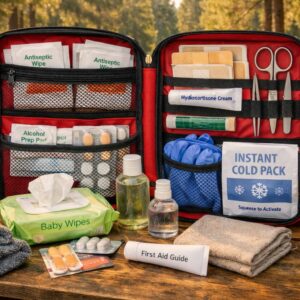
Your dog needs their own first aid supplies — but make sure your own [essential camping first aid kit] is fully stocked too before any trip outdoors.
Make sure your own kit is as sorted as your dog’s — our [complete camping checklist for new campers] is the most thorough packing guide on the site.