Camping with Toddlers: The Complete Stress-Free Guide for Parents of Little Ones
-
| Founder & Content Creator

Latest Posts
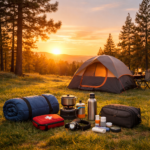
Here is what nobody tells you before your first time camping with toddlers: the chaos is part of it, and the chaos is also, somehow, the best part. The child who announces they need the toilet thirty seconds after you have fully zipped up the tent for the night. The snack that went missing and is now a matter of great emotional importance. The marshmallow that fell in the fire and prompted a grief response worthy of a theatre production.
And also: the child who saw their first shooting star and went completely silent. The morning walk where they spotted a deer and grabbed your hand without thinking. The campfire evening when they stayed up a little later than usual and fell asleep mid-sentence on the walk back to the tent.
This guide covers everything that makes family camping work — from choosing the right site and getting young children to sleep outdoors, to keeping them engaged, fed, and safe. It is written for parents who want a realistic, practical guide, not a highlight reel.
What Age Can You Start Camping with Toddlers? Earlier Than You Think
One of the most common questions on parenting forums about family camping is this one — and the answer tends to surprise people. You can take a baby camping from the very early months. Many families do. The baby, it turns out, is not the difficult part. The baby will sleep in a carrier during the day and a warm sleeping bag at night and will be largely indifferent to the fact that they are in a field rather than a bedroom.
The genuinely useful age guidance:
- Babies (0-12 months): Entirely possible with the right sleeping setup and a campsite with accessible facilities. Choose warm weather, a modern campground, and keep the first trip to one or two nights.
- Toddlers (1-3 years): The most challenging age for camping because mobility and curiosity are high but impulse control is low. The campfire, the water, the interesting-looking berries — all require consistent supervision. Also the age where great camping memories start to form.
- Pre-schoolers (3-5 years): Start to become genuine camping companions. Engaged by nature activities, capable of short hikes, able to follow simple safety rules.
- Primary school age (5+): Excellent camping companions. Old enough to have jobs at camp, to help with cooking, to read a map with you, and to remember the trip for the rest of their lives.
HONEST TRUTH: The question is never really whether the child is old enough. It is whether you have done enough preparation. A well-prepared family camping trip with a two-year-old is more relaxed than an unprepared one with a ten-year-old. Age matters less than planning.
Why Camping with Toddlers Is Worth Every Moment of the Chaos
Nature does something specific to children that screens, soft play, and organised activities simply do not replicate. The unstructured quality of it — the open-endedness, the fact that the afternoon does not have a plan and nobody is in charge of making it entertaining — produces something in children that looks a lot like genuine freedom. They find things. They invent games. They get completely absorbed in a stick or a beetle or a puddle for twenty minutes and emerge from it calm and satisfied in a way that rarely happens indoors.
The research supports this too — children who spend regular time in nature show improved concentration, reduced anxiety, and better emotional regulation. But you do not need research to know it. One camping trip is usually enough to see it yourself.
Family camping is also one of the few travel formats where the age gap between adults and children nearly disappears. A campfire evening is as good for a forty-year-old as it is for a seven-year-old. A morning walk that finds tracks in the mud is exciting for everyone. You are all, genuinely, in the same experience together.
Choosing the Right Campsite — This Decision Makes Everything Easier
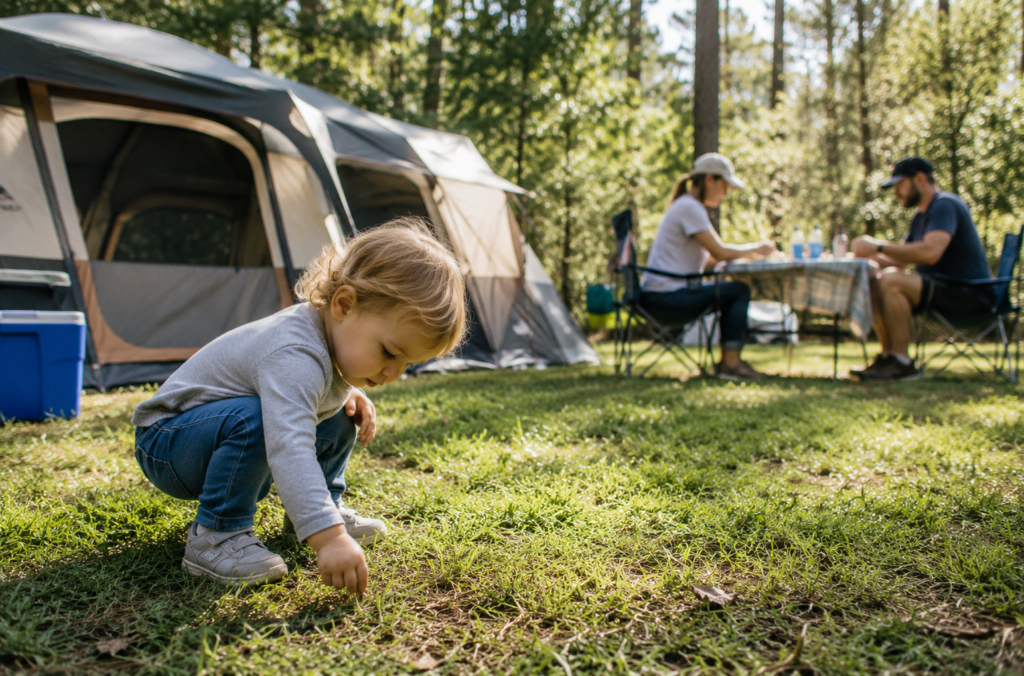
Nothing shapes a camping with toddlers experience more than where you camp. A well-chosen site makes almost everything easier. A poorly chosen one creates problems that preparation alone cannot solve.
Start With a Modern Campground, Not the Backcountry
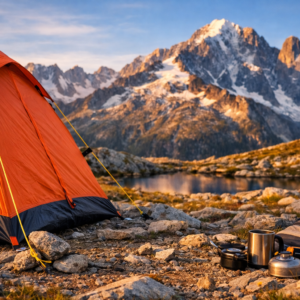
If this is your first family camping trip, or your first with a toddler or baby, start at a modern campground rather than a remote backcountry site. Modern campgrounds — national park sites, KOA-style facilities, state park campgrounds — have flush toilets, hot showers, flat pitching areas, and often a camp host on site.
This matters more than it sounds. The midnight toddler toilet run is considerably less stressful when the facilities are fifty meters away and have lights. The early morning baby change is easier when there is running water. The rainy afternoon is more manageable when there is a covered communal area to retreat to.
Save the remote wilderness trip for when the children are older and everyone has more experience. Start where success is most likely, then build from there.
What to Look for in a Family-Friendly Campsite
- Clean toilet and shower facilities within reasonable walking distance from your pitch
- A flat, well-drained pitch — uneven ground plus a tent full of children is harder than it sounds
- Open grassy space near your pitch where children can play safely within your sightline
- Distance from water features — lakes, rivers, and streams are magical but require constant supervision with toddlers. Choose a pitch that is not directly adjacent to open water.
- Proximity to other families — a campsite with other children nearby is significantly easier than one where yours are the only small people
- Speed of access from the car — packing and unpacking with young children is easier when you are not carrying everything 400 metres
Try the Tent at Home First
This is one of the most consistently recommended tips in family camping guides and forums, and one of the most consistently ignored: pitch your tent in the garden or living room before your first camping trip and let the children sleep in it overnight.
This does three useful things. The children get familiar with the tent before it is associated with a strange dark field away from home. You discover whether the sleeping arrangement actually works before you are two hours from home. And any kit that is missing or broken is discovered in a context where you can fix it rather than improvise.
Even one night in the tent at home dramatically reduces the adjustment required at the actual campsite. Children who have already slept in the tent settle faster and sleep better on night one.
[Pitching a tent with toddlers underfoot adds a layer of complexity — our guide to how to pitch a tent covers every step clearly so you can do it efficiently with small helpers nearby.]
What to Pack When Camping with Toddlers: Gear That Actually Makes a Difference
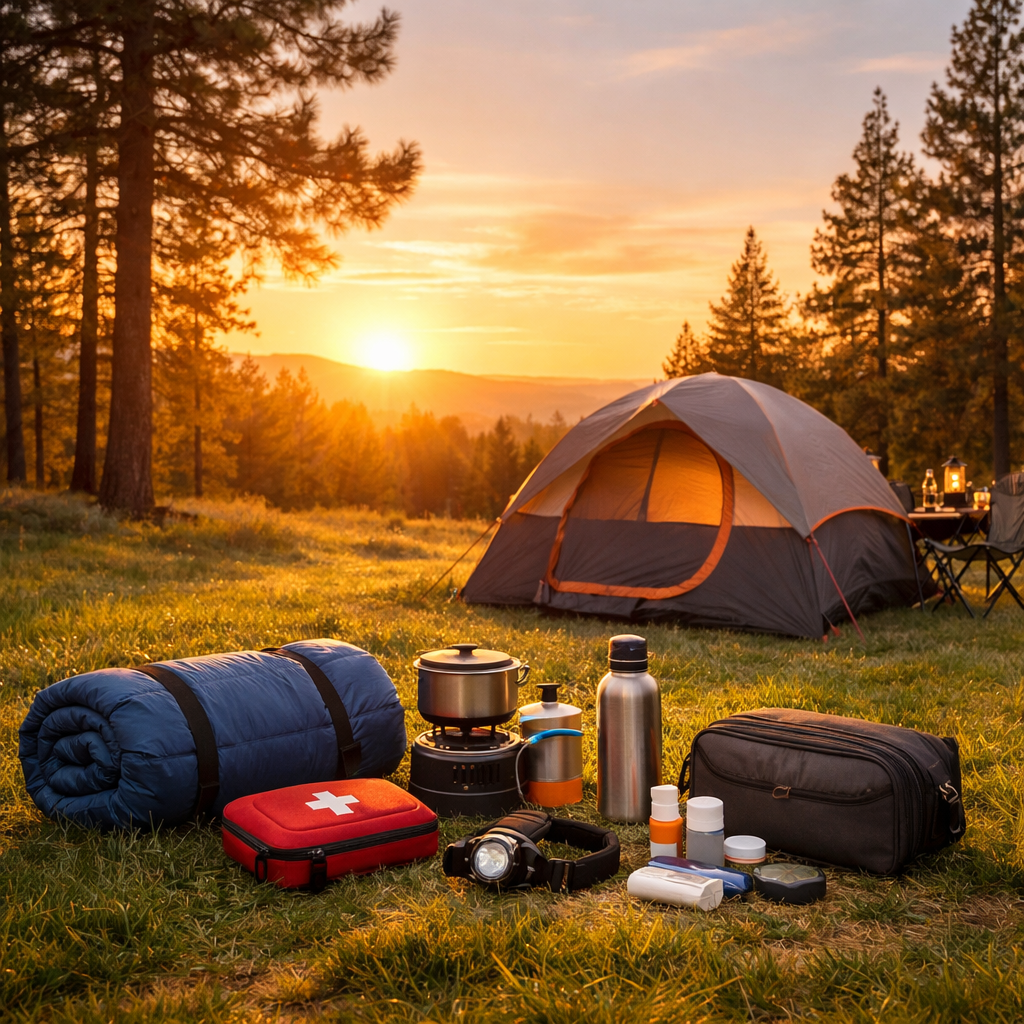
Packing for a family camping with toddlers trip follows one principle: bring what you need, not everything you might need. Overpacking is the most common family camping mistake and one of the most tiring — you spend half the first day moving bags around.
Before adding kid-specific items, make sure your baseline camping kit is covered — our complete camping checklist for new campers covers all the fundamentals before you add the child-specific extras below.
Choosing the Right Family Tent
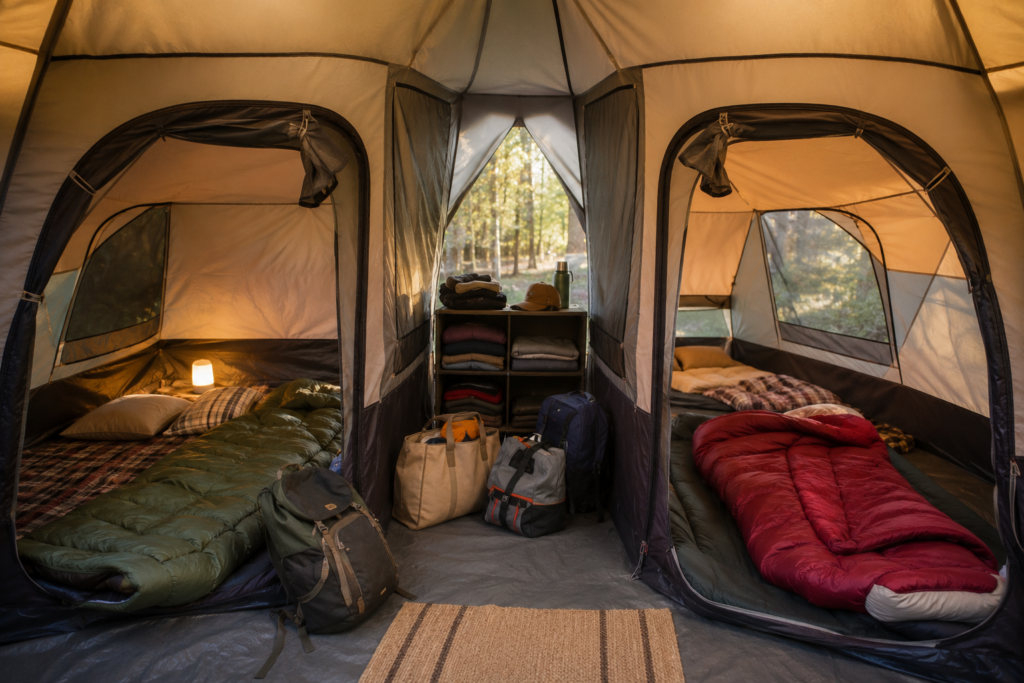
The family tent is the most important gear purchase you will make for camping with toddlers, and the most useful advice is simple: go bigger than you think you need. A tent that gives every person their own sleeping space — plus a small area for bags and boots — prevents the low-level friction of cramped sleeping that exhausts parents more than anything else on a camping trip.
- Size: For a family of four with children under 10, a 6-person tent gives you breathing room without being unmanageable to pitch. Do not buy a tent that is technically the right person-count — buy one size up.
- Rooms: Two-room or three-room tents with divider walls give older children a sense of space and allow adults to stay up later without disturbing sleeping children.
- Height: A tent you can stand up in is genuinely more comfortable for dressing small children than one you have to crouch in. Worth paying more for.
- Ventilation: Mesh inner panels are important when camping with children — stuffy tents make everyone sleep worse.
- Weather rating: Choose a tent with a hydrostatic head rating of at least 2000mm — you will camp in rain at some point, and discovering your tent leaks at midnight with sleeping children inside is an avoidable experience.
Sleeping Bags, Pads, and Staying Warm at Night
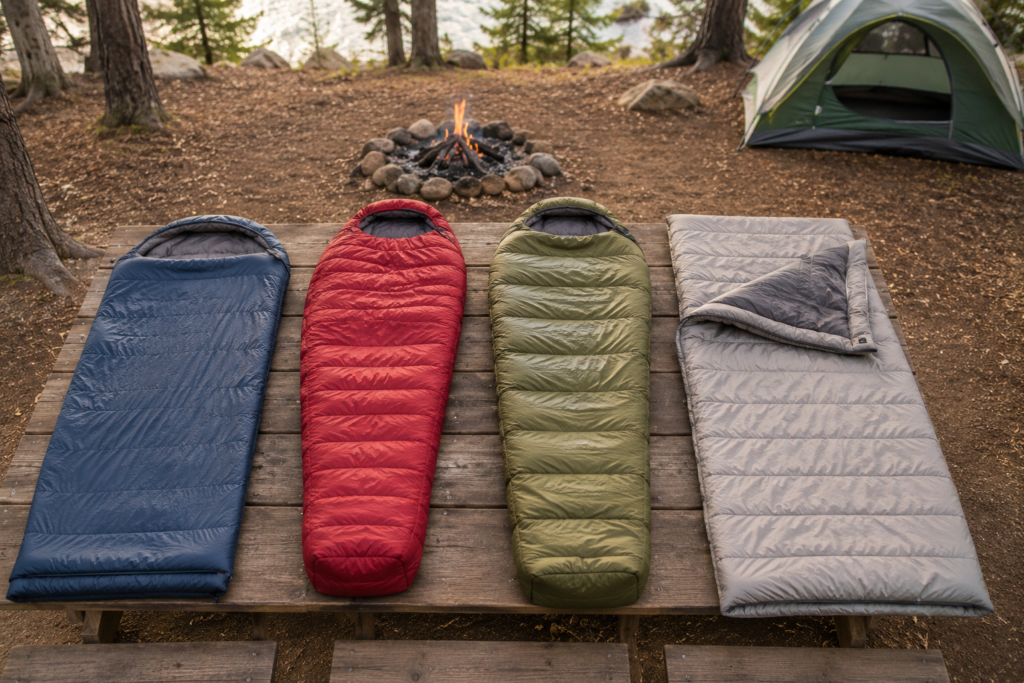
Cold children do not sleep well. Cold children who do not sleep well wake up early, are difficult in the morning, and create a loop of bad camping days. A quality sleeping bag is genuinely one of the most important investments in family camping.
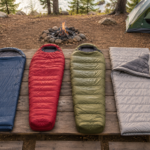
- Choose sleeping bags rated at least 5°C below the lowest temperature you expect — children lose body heat faster than adults
- A sleeping pad provides crucial insulation from the cold ground — the sleeping bag keeps heat in, but cold rises from the ground faster than it falls from the air
- For toddlers: many parents use a folded-over adult sleeping bag or a dedicated toddler bag. Zip two adult bags together and have the child sleep between parents if they are unsettled in a new environment.
- Merino wool or synthetic base layers for sleeping — never cotton for children in cold conditions
- A warm hat for sleeping — children lose significant body heat through their head at night
Carriers and Strollers for Young Children
If you are camping with a baby or young toddler, a carrier or hiking backpack is more useful than a stroller in most camping environments. Campsite terrain — grass, gravel, uneven paths — does not always work well with standard pushchair wheels.
- Baby carrier (soft structured): For babies under about 12kg. Keeps baby close and warm, leaves hands free for cooking, setting up, and managing older children.
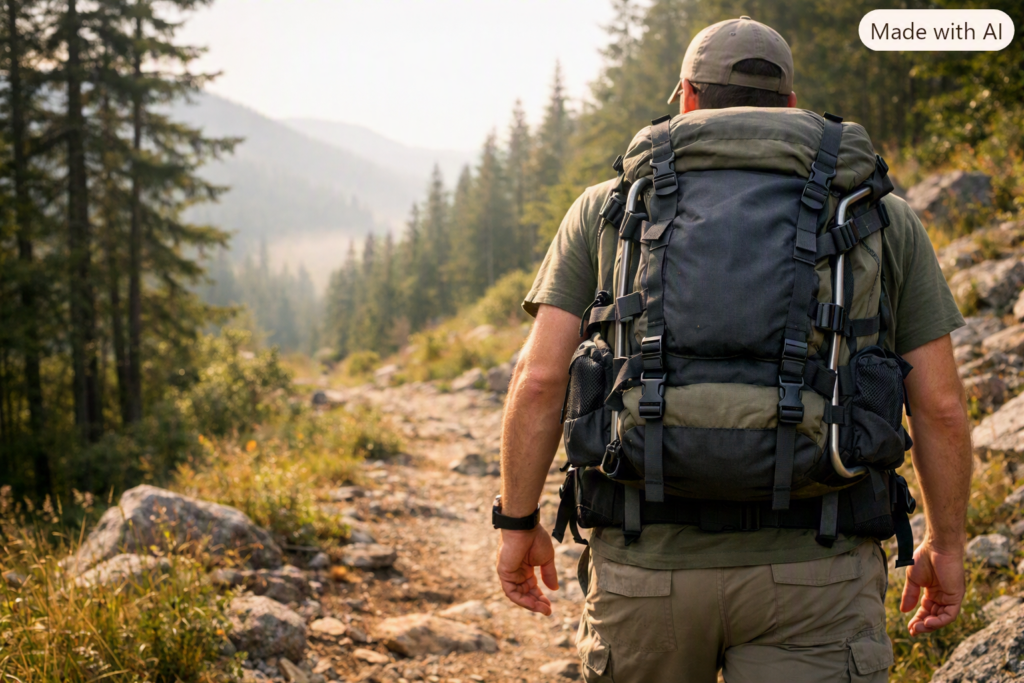
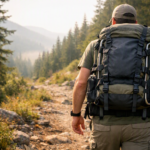
- Hiking backpack carrier: For toddlers up to around 20kg. The child faces forward and sees everything — much more engaging than a pushchair view. Look for models with a sunshade and rain cover.
- All-terrain stroller: Useful if your campsite has good paths. Not worth bringing if your pitch involves any rough ground.
Kid-Friendly Cooking Gear and Simple Camping Food
Camping food with young children works best when it is familiar, fast, and involves minimal washing up. Children who are tired from a day outdoors do not want to wait for complicated cooking.
- Hobo pie makers (sandwich toasters for campfires): a genuine favourite — toasted sandwiches, pizza pockets, and apple turnovers that children can help assemble
- Hot dog sticks: the classic. Roasting hot dogs and marshmallows on a stick is both dinner and entertainment.
- One-pot pasta or rice — fast, filling, something virtually all children eat
- Portable insulated lunch boxes: snacks on demand are one of the most effective morale management tools when camping with young children
- Familiar foods from home: camping is not the time to introduce new foods to a picky eater. Bring what they already love.
The Non-Negotiable: First Aid Kit for Families
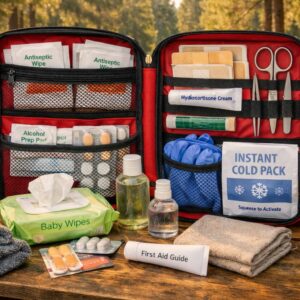
Children are more likely to need a first aid kit at camp than adults — more falls, more insect bites, more unexpected reactions to sun or plants. Do not pack a basic kit. Pack a proper one.
- Plasters and wound care: multiple sizes, including large enough for active-child-sized scrapes
- Antiseptic spray or wipes
- Children’s pain relief: paracetamol and ibuprofen in children’s doses
- Antihistamine: for insect bites, allergic reactions to plants, and hay fever that intensifies in nature
- Sunscreen SPF50+ for children
- Tweezers for splinters and ticks
- Any prescription medications your children take, with copies of prescriptions in your go-bag
For a complete family first aid kit list, our essential camping first aid kit guide covers everything — build your family kit from that list and add any child-specific medications your children need.
Getting Kids to Sleep at Camp: The Thing Nobody Warns You About
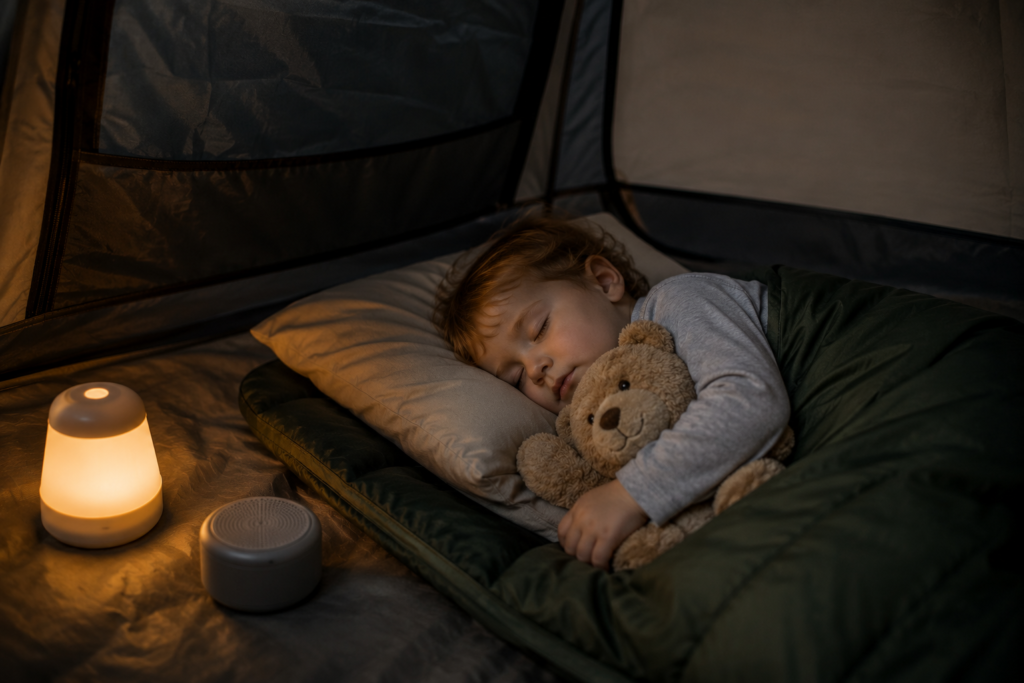
If you ask a parent who has camped with toddlers what they wish someone had warned them about, the answer is rarely the hiking or the packing or the food. It is almost always sleep. Getting a small child to sleep in a tent — in a new place, with unfamiliar sounds, when the sun is still up and the campfire is still crackling — is the part that no amount of gear research prepares you for.
Most family camping guides skip this entirely. They cover tents and cooking and activities, and then cheerfully move on as if bedtime sorts itself out. It does not always sort itself out. Here is what actually helps.
The Light Problem: Summer Evenings and Small Children
Summer camping means long evenings — and young children’s brains are not sophisticated enough to go to sleep when the sun is still high in the sky. Light is the primary trigger for wakefulness, and a tent without blackout is essentially a well-lit room.
- Portable blackout blinds or travel blackout fabric: One of the most underrated family camping investments available. Clip or peg darkening fabric over the tent’s mesh windows and door. The difference in toddler sleep time is significant.
- Dark-coloured tent inner: Some family tent models have darker inner fabric specifically designed to reduce light penetration. Worth checking when buying.
- Earlier bedtime: If the light makes 8pm feel like daytime, aim for a bedtime that coincides with natural light drop rather than fighting it. In midsummer this might mean 9pm for younger children.
Summer camping with a toddler at 8pm is a genuine test of adult reasoning. You are trying to explain to a two-year-old that it is bedtime while sunlight streams through the tent and birds are having the time of their lives outside. The child is not wrong to be confused. Bring blackout fabric. It is the most important camping purchase you did not know you needed.
Maintaining Bedtime Routines in a New Environment
Young children — especially toddlers — rely on routines to signal that sleep is coming. The environment has changed but the routine can stay largely the same, and this continuity is what helps them settle in an unfamiliar tent.
- Do the same bedtime sequence you use at home: wash, brush teeth, change into sleep clothes, story or song, lights out — in that order
- Bring the same pyjamas they wear at home, the same story book, the same nightlight if they use one
- Bring a comforter, favourite stuffed animal, or security item — whatever is part of sleep at home
- A battery-powered nightlight or headtorch inside the tent at a low setting helps children feel less alarmed if they wake in the dark
- A travel white noise machine or a white noise app set to low volume is genuinely effective at masking campsite sounds (other campers, animals, crackling fire) that can wake light sleepers
White Noise, Comfort Items, and Other Sleep Saviours
- Travel white noise machine: Small, lightweight, USB-rechargeable. Masks ambient campsite noise that wakes young children. Consistently one of the most recommended items in family camping forums.
- Sleep sacks for toddlers: Safer than loose blankets in a sleeping bag, stays attached to the child if they wriggle. Look for one with a temperature rating appropriate for camping temperatures.
- The co-sleeping option: Many families find young toddlers sleep better beside a parent in the first night or two at camp, and then settle into their own space. This is a practical choice, not a failure.
- First night realism: The first night camping with young children is usually the hardest. The second night is almost always significantly better as children adjust to the sounds and space. Know this before you go, and plan not to make major decisions about whether camping is working based on night one.
Campsite Safety for Young Children: The Checks That Give You Peace of Mind
Campsite safety with young children is mostly about awareness and setup — identifying the risks in advance so you are not reacting to them in the moment. A quick walk around your pitch on arrival takes five minutes and removes most of the anxiety.
Water Safety at Camp
If your campsite is near any water — a lake, a river, a stream, even a drainage ditch — water safety is your highest priority with young children. Children can move fast, and bodies of water are compelling to them.
- On arrival: identify all water features within sight or walking distance of your pitch
- Establish a clear rule immediately: no approaching water without a parent
- Consider a campsite pitch that is not adjacent to open water — slightly inland gives you more margin
- Life jackets for any paddling or boat activity involving children who cannot swim confidently
- Never leave toddlers unsupervised near water, regardless of how shallow it appears
Understanding wildlife that may also be near water sources is an important part of campsite awareness — our wildlife safety while camping guide covers how to read your environment and respond if an animal encounter happens near camp.
Campfire Safety With Little Ones Around
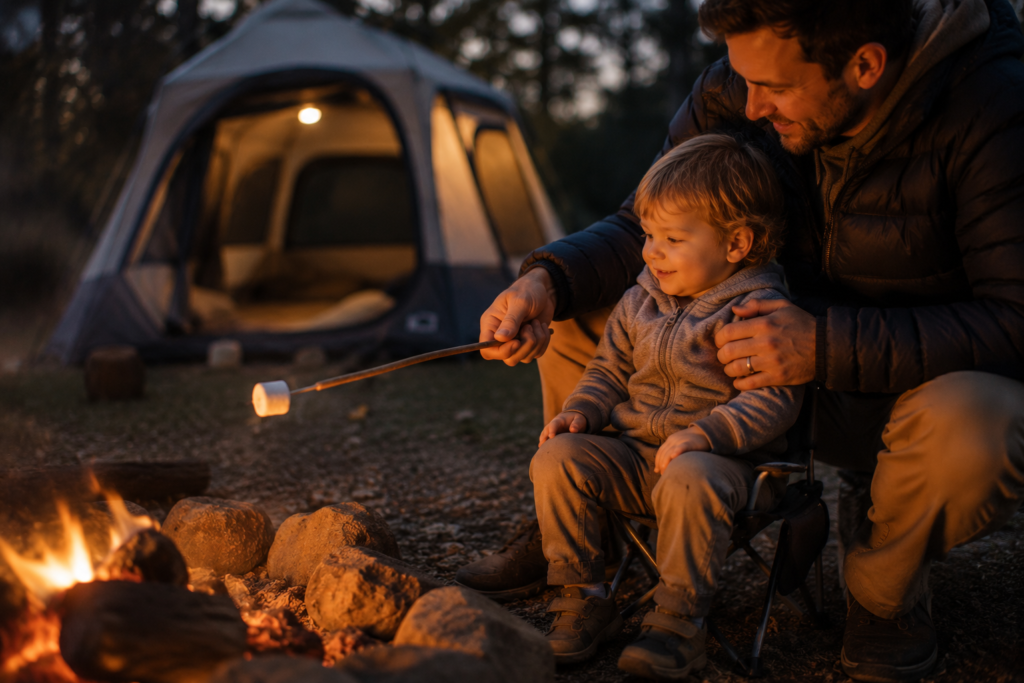
The campfire is the most magnetic thing at any campsite for young children — and the one that requires the clearest
boundaries.
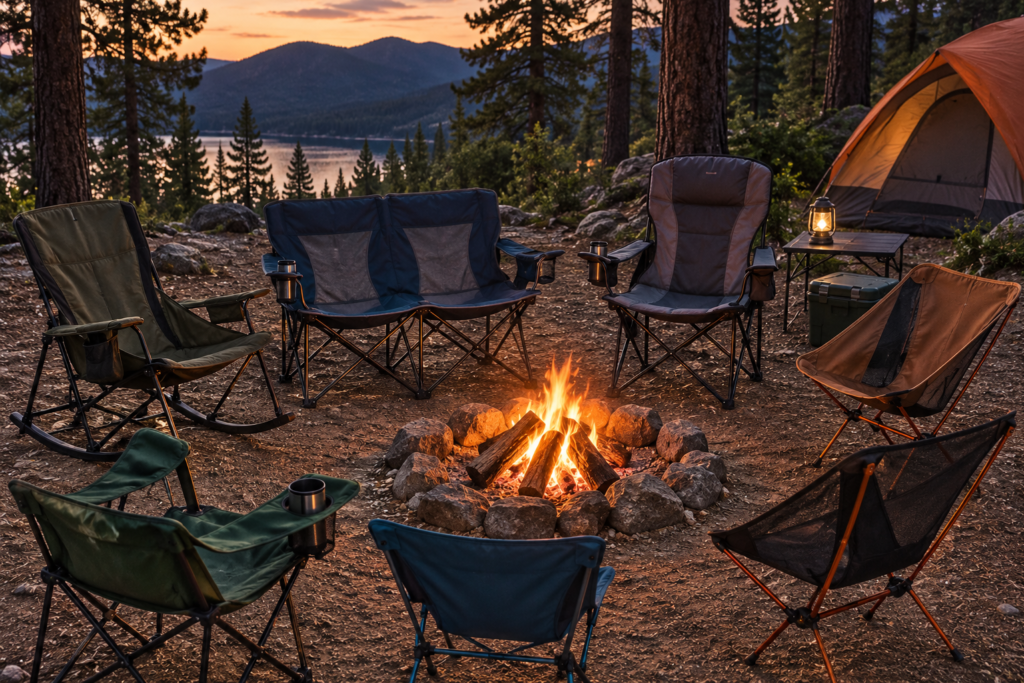
- Establish a no-cross zone around the fire before lighting it — a physical marker (camp chairs in a ring, a rope boundary) that even a toddler can understand
- The three-foot rule: children must always be at least three feet from any active fire
- Never leave a campfire unattended with children in the area
- Hot dogs on sticks and marshmallow toasting: always with a parent directly supervising and holding the stick together with young children
- Extinguish the fire completely before sleeping — drown with water, stir, drown again until cold to the touch
- Keep a bucket of water or sand at the campfire area at all times
Give Children a Safety Job
One of the most effective campsite safety strategies for older toddlers and young children is giving them a specific safety role — a job that keeps them engaged and builds their sense of responsibility.
- The stick monitor: responsible for keeping sticks and sharp objects away from the tent area
- The fire watcher: watches that nobody goes inside the fire boundary and calls out if anyone does
- The headtorch keeper: in charge of knowing where the torches are and making sure they are always returned to the same spot
Children who have a job at camp take it seriously. They also become more aware of the rules around the thing they are in charge of — which is, in itself, a safety outcome.
Keeping Kids Engaged and Happy at Camp — Without Screens
The worry that children will be bored at camp usually evaporates within about twenty minutes of arriving. Nature provides more entertainment than most parents expect. The challenge is less often boredom and more often redirecting their attention when it has fixed on something you would rather they left alone.
Activities That Work at Any Age
- Collecting: Stones, pinecones, interesting sticks, different leaves — children are natural collectors. Give them a bag or a small container and let them fill it.
- Water play: A bucket of water and some containers provides an extraordinary amount of entertainment for children under five. Add mud and the entertainment extends significantly.
- Campfire involvement: Collecting small sticks for the fire, helping to stack them, watching it light — children who are given a role at the campfire are considerably less likely to wander toward it unsupervised.
- Trail walks: Match the distance to the child’s age, not your ambitions. A one-year-old can walk about 500m comfortably. A five-year-old can manage 3-5km. A ten-year-old can do a full day hike. Adjust accordingly.
- Stargazing: Even very young children are captivated by a sky full of stars. The Stellarium app identifies constellations in real time — point it at the sky and it tells you what you are looking at.
For a full guide to activities at camp for all ages, our outdoor camping activities guide covers everything from geocaching and nature walks to campfire storytelling and wildlife tracking.
Nature Scavenger Hunts: The All-Ages Winner
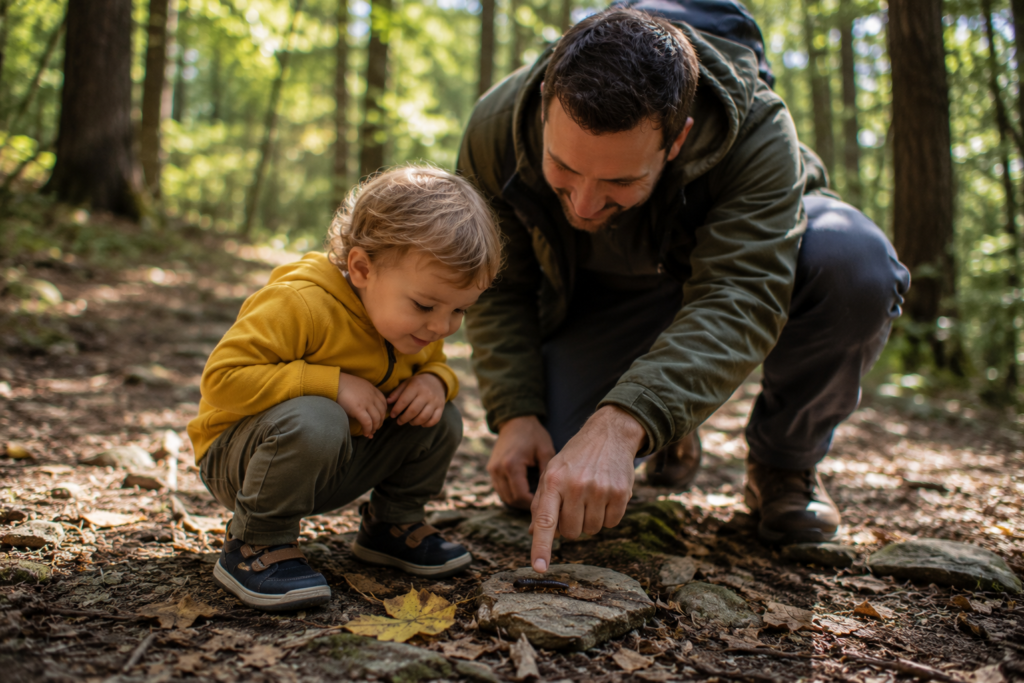
A nature scavenger hunt works on children from about age two upward, and the only equipment it requires is a list and some enthusiasm. Before a morning walk, write down ten things to spot, touch, or collect: something red, a bird feather, a smooth stone, something that smells interesting, the sound of water, an insect, a hole in the ground, something soft, a different-colored leaf, and any animal track.
The act of looking for specific things transforms a walk from something to be endured into something genuinely engaging. Children who have a scavenger hunt list walk further, complain less, and pay more attention to the environment around them. Download the iNaturalist app for identifying plants and insects in real time.
What to Do When Boredom Actually Does Strike
It happens. Usually around day two, around 3pm, when the initial novelty has worn off and energy is starting to flag. Have a plan for this moment.
- A small bag of activities kept back and revealed only when needed: playdough, a colouring book, a simple craft kit
- Camp chores as entertainment: letting children help with washing up, pegging out wet kit, or rearranging the tent works better than it should
- A walk to somewhere specific: not just a walk, but a walk to find the big tree, or the stream, or the campground’s animal enclosure
- An early start on campfire prep: collecting wood, building a fire structure, telling children they are in charge of it
- Involving older children in planning tomorrow’s activities — giving them a voice in what happens next redirects energy productively
Camping Food for Kids: Keep It Simple, Keep It Fun
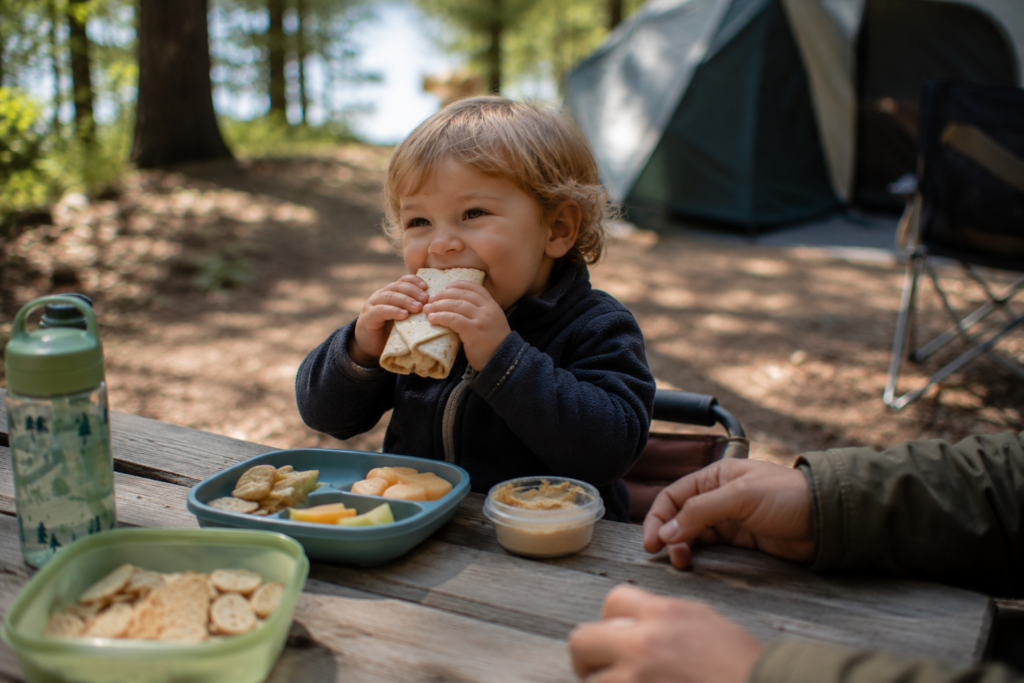
Camping food with young children has one rule above all others: familiar food first. A camping trip is not the moment to introduce a new food or a new flavor. Bring what they reliably eat, prepare it simply, and make eating part of the activity rather than a chore.
- Breakfast: Overnight oats prepared the night before (no cooking required in the morning), instant porridge, or cereal with UHT milk. The simplest breakfasts are the best on family camping trips.
- Lunch: Sandwiches, wraps, or pittas assembled from pre-prepped fillings. Cheese, cured meat, hummus, and salad items that travel well. Let children build their own.
- Dinner: One-pot pasta or rice, hot dogs on the campfire, hobo pie sandwiches, foil packet vegetables with sausage. The campfire element makes dinner an event rather than just a meal.
- Snacks — the most important category: Trail mix, energy bars, crackers, fruit, cheese portions, cereal bars. When children are flagging on a walk or getting difficult in the afternoon, a snack often resolves the situation more effectively than any other intervention.
- Hydration: Children dehydrate faster than adults outdoors. A dedicated water bottle each, replenished frequently, with a squash tablet for flavour if they resist plain water.
For recipes that work well at camp with children helping, our easy camp cooking for beginners guide covers one-pot pasta, foil packet meals, and campfire pancakes — all simple enough to make with little ones involved.
Rainy Days, Tired Kids, and Unexpected Moments — How to Handle the Imperfect Parts
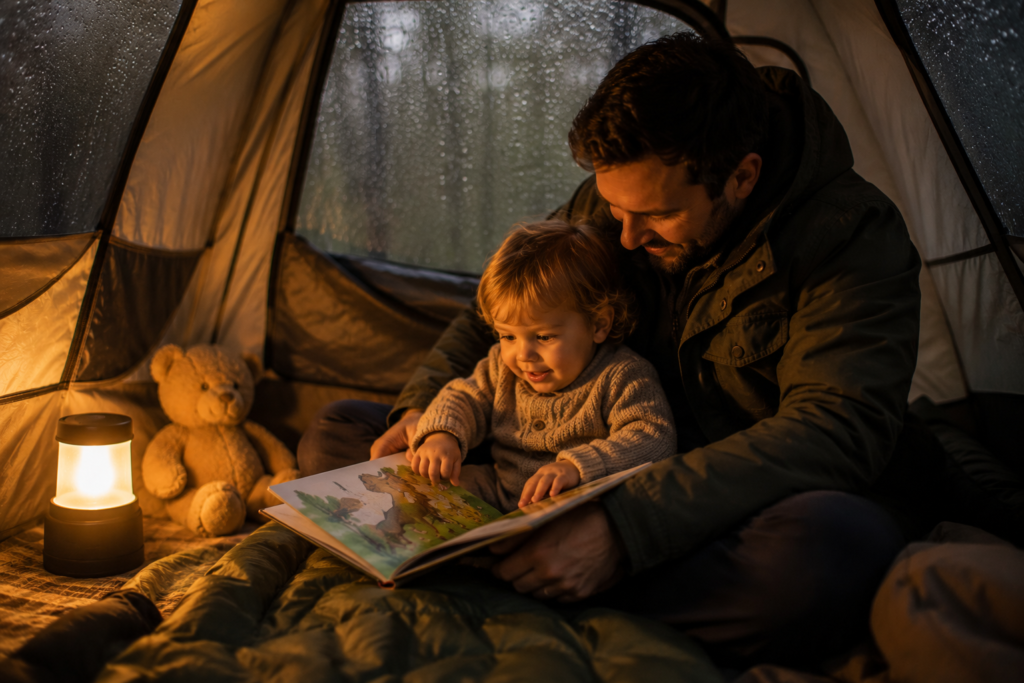
Every family camping trip has moments that were not in the plan. The child who gets soaked and then cold and then upset. The nap that did not happen and the afternoon that suffered for it. The rain that arrived at noon and stayed until the following morning. The snack that was definitely in the bag and has now vanished.
How you respond to these moments shapes how the children experience them — and how they remember the trip. Children who see their parents respond to a rainy afternoon with a card game and a good attitude learn something genuinely valuable about how to be outdoors. Children who see their parents become stressed and flustered learn that camping is a fragile, stressful thing.
- Have a dedicated rainy day kit: card games, a small roll of paper and crayons, a couple of books, a torch for tent play
- A large tarp rigged over your main sitting area gives you a dry outdoor space even in sustained rain — one of the most useful investments in family camping
- Keep the routine as consistent as possible during difficult patches — tired children need structure more, not less
- Lower your expectations for day two and three — that is when the initial enthusiasm has passed and real camping happens. Real camping is usually fine.
The child who cried for forty minutes because their marshmallow fell in the fire is the same child who will talk about this camping trip for the next three years. They will not mention the marshmallow. They will talk about the deer they saw, and the fire, and sleeping in the tent with you. Children’s memories work in your favor here. The chaos does not stick. The good stuff does.
Frequently Asked Questions About Camping with Toddlers
What age is best to start camping with children?
You can start from birth, though the sweet spot for most families is around 18 months to 2 years when children are mobile enough to enjoy the environment but old enough to have some routine. Babies under 12 months are actually quite manageable campers — they sleep in carriers during the day and a warm sleeping bag at night. The toddler years (1-3) require the most supervision. From age 3-4 onward, children start to become genuine camping companions who actively enjoy and remember the experience.
How do I get my toddler to sleep in a tent?
Three things make the biggest difference: practise sleeping in the tent at home before the trip, bring everything from their usual bedtime routine (same pyjamas, same comfort item, same story), and address the light problem with portable blackout fabric over the tent windows. A travel white noise machine masks unfamiliar campsite sounds that wake light sleepers. The first night is usually the hardest — the second night is almost always significantly better as children adjust to the new environment.
What should I pack for camping with a toddler?
Beyond the standard camping gear: a sleeping bag rated colder than you expect, a sleeping pad for insulation from the ground, merino wool or synthetic base layers for sleep, a carrier or hiking backpack, portable blackout fabric, a travel white noise machine, a comprehensive first aid kit with children’s medications, familiar snacks from home, and their bedtime comfort items. Pack one set of clothes you do not mind getting completely destroyed — camping with toddlers is messy and that is exactly as it should be.
What are good camping activities for young children?
Nature scavenger hunts are the single most reliable camping activity for children aged 2-10 — write a list of things to find, spot, or collect on a walk, and the walk becomes genuinely exciting. Collecting interesting stones, sticks, and pine cones. Water play with a bucket and some containers. Campfire involvement (collecting sticks, watching it light). Short trail walks matched to the child’s actual walking ability. Stargazing with a constellation app. For rainy days: card games, coloring, and torch play inside the tent.
How do I keep a campfire safe with young children?
Establish a clear physical boundary around the fire before lighting it — chairs in a ring, a rope marker, or any consistent visual that even a toddler can understand as a ‘do not cross’ line. The three-foot rule is standard practice: always maintain at least three feet between a child and any active fire. Never leave a campfire unattended with children nearby. For marshmallow and hot dog toasting, hold the stick together with young children rather than handing it to them independently. Extinguish the fire completely before anyone goes to sleep.
The Messiest, Most Magical Memories You Will Ever Make: Now Go Camp
Here is the honest summary of camping with toddlers: it is harder to organise than camping without them, and better in almost every way than camping without them.
The preparation matters — a good tent, the right sleeping setup, a well-chosen campsite, a realistic plan for the first night. But beyond that, the trip mostly takes care of itself. Children are easier to entertain outdoors than anywhere else. They are more tired at bedtime. They eat well after a day of fresh air. They find the campfire magical every single evening. And the memories they build from camping trips are some of the most durable and specific of any childhood experience.
Pack the basics, lower your expectations for perfection, bring the blackout fabric and the white noise machine, and go. The imperfect bits become the stories you tell afterward. The good bits become the reason you book the next one before you have even packed up from this one.
When the toddler years are behind you and you are ready for bigger adventures, our camping with kids guide covers activities, planning, and gear for families with children aged 5 and up.