Best Camping Sleeping Bags: Warm, Comfortable Picks Tested
-
| Founder & Content Creator

Latest Posts
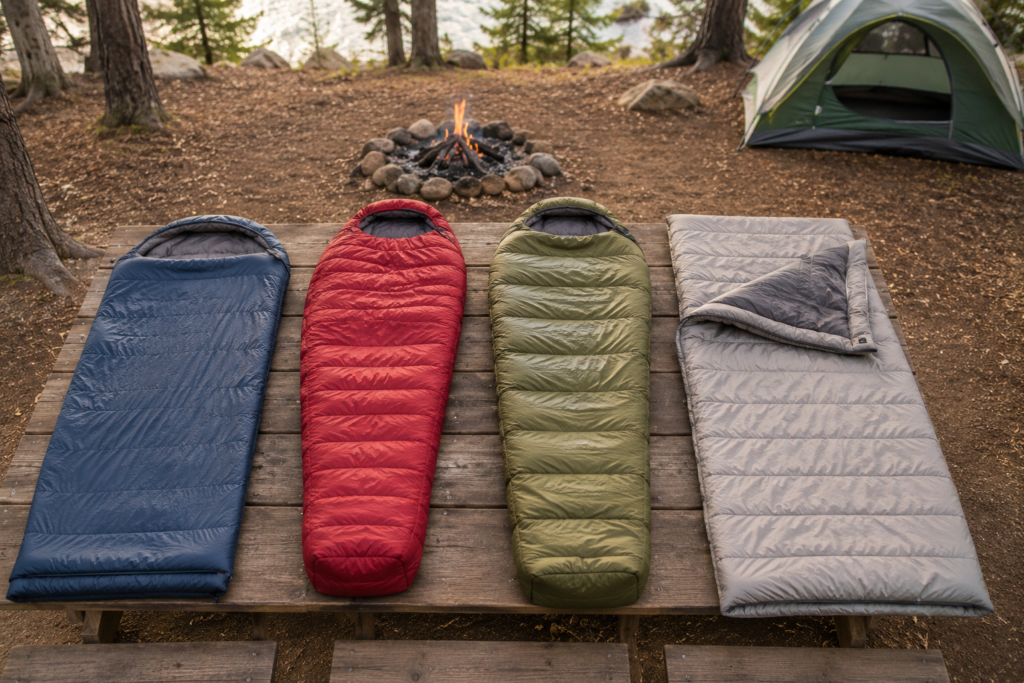
A sleeping bag is the one piece of camping gear that can ruin a trip when you get it wrong. Too cold and you spend the night shivering in layers, watching the clock until sunrise. Too warm and you’re kicking at the zipper at 2am trying to cool down. Choose based on the wrong number printed on the label and you’ll discover the problem somewhere around midnight, which is not ideal.
This guide to the best camping sleeping bags cuts through the spec-sheet confusion and tells you what actually matters — starting with the thing no one explains clearly enough before you buy.
If you’re building your camping kit from scratch, our complete camping checklist for new campers covers everything else you’ll need alongside a good sleeping bag.
The Number on the Bag Is Not the Real Number
Every camping sleeping bag has a temperature rating on the label. That number is almost never the temperature at which you will feel comfortable.
This is the most important thing to know before buying: The number on a camping sleeping bag is typically the survival rating — the lowest temperature at which the bag is designed to keep you alive, not comfortable. The comfort rating — the temperature at which an average sleeper actually sleeps well — is usually 10 to 15 degrees warmer than that number.
So when you see a sleeping bag labeled 20°F, expect it to feel comfortable down to around 32-35°F for most people, not 20°F. At 20°F in that bag, you’ll survive. You won’t sleep well.
This is the single most common complaint from first-time buyers across camping forums, and it happens because manufacturers have used survival ratings as their headline number for decades. Some premium brands now publish both ratings — if you see an EN or ISO comfort rating listed separately, use that number. If you only see one number, add 10-15°F to find your realistic comfort temperature.
Comfort Rating vs. Survival Rating — the Difference That Changes Everything
Survival (Lower Limit) rating: the temperature at which the bag keeps a cold-sleeping adult alive without dangerous cold injury. Not comfortable. Just alive.
- Comfort rating: the temperature at which an average adult sleeps comfortably through the night without waking up cold. This is the number you actually need.
- EN/ISO Comfort rating: an independently tested comfort rating — when you see this, it’s the most reliable number on the label. Treat it as your real guide.
Quick rule: if your overnight lows are typically 45°F, look for a bag rated 30°F or lower by the survival rating — not 45°F. That buffer is not over caution; it’s just math.
How to Find Your Real Temperature Number (Hot Sleeper vs. Cold Sleeper)
Your body’s natural thermostat is probably the second most important variable after the temperature rating. People who ‘sleep hot’ — who wake up too warm at home, kick off blankets, and always have warm hands and feet — can often use a bag rated 5-10°F warmer than the overnight low comfortably. People who ‘sleep cold’ — who always feel chilly, have cold feet regardless of socks, and tend to pile on blankets at home — need a bag rated 10-15°F lower than the overnight low.
| If overnight lows are… | Hot Sleeper — buy a bag rated… | Average Sleeper — buy rated… | Cold Sleeper — buy rated… |
| 50°F | 40°F bag is fine | 35°F bag | 20-25°F bag |
| 40°F | 30°F bag | 20-25°F bag | 10-15°F bag |
| 30°F | 20°F bag | 10-15°F bag | 0°F bag |
| Below 20°F | 0°F bag | 0°F or lower | Winter-specific bag, below 0°F |
For camping in wet climates, see our wet weather camping tips guide — moisture affects how warm a sleeping bag feels, especially synthetic fill.
Down vs. Synthetic Insulation — Which Type Is Right for You
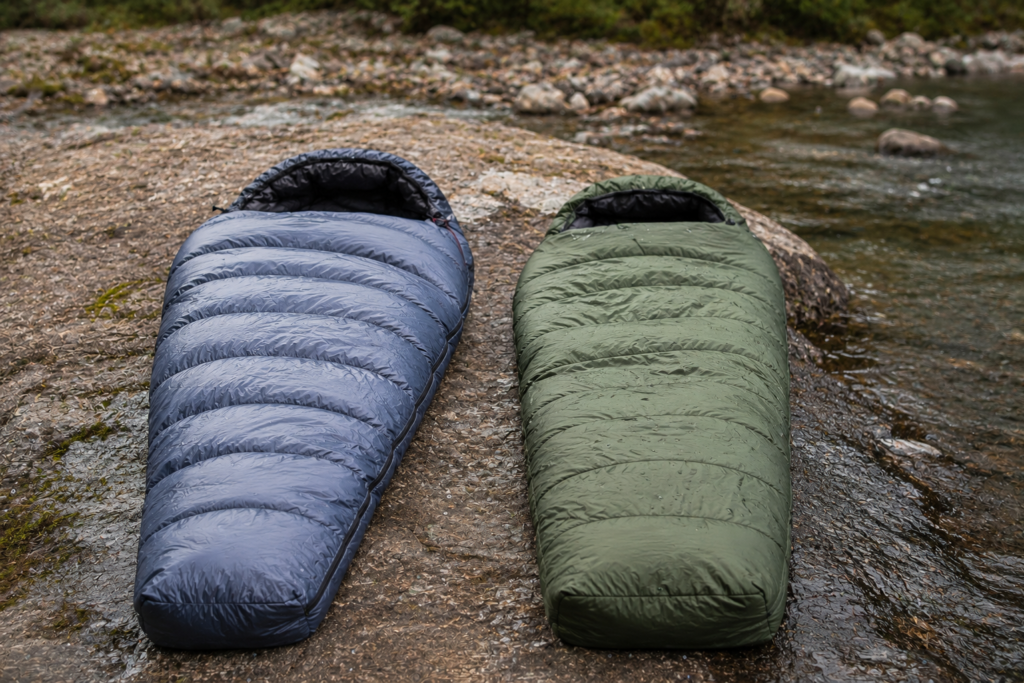
Most gear guides spend a lot of words on this debate. The honest version is shorter than you think.
When to Choose Synthetic
- You camp somewhere wet or humid — Pacific Northwest, Southeast US, coastal areas — where dampness is a real possibility overnight
- This is your first sleeping bag and you’re not sure how often you’ll use it or how well you’ll care for it
- You’re buying for kids, who are likely to leave it in a wet tent or stuff it wrong
- Budget is the main constraint — synthetic bags at equivalent warmth cost noticeably less than down
- You’re a hot sleeper — synthetic breathes slightly differently and can feel less clammy on warmer nights
Synthetic honest trade-off: It compresses less efficiently than down, loses its loft faster over years of use, and weighs more for equivalent warmth. But it keeps insulating even when damp — which down does not.
When Down Makes Sense
- You camp in dry climates or reliably keep your tent and bag dry
- You want a bag that lasts a decade or more — down’s loft can outlast synthetic by a significant margin with proper care
- Packability matters — down compresses noticeably smaller than synthetic at equivalent warmth
- You sleep cold — down’s warmth-to-weight ratio means you can get more warmth without adding bulk
Down honest trade-off: If it gets wet — really wet, not just slightly damp — wet down is colder than no insulation. Store it with a stuff sack liner on wet trips. Never leave it stuffed long-term; always store lofted.
Best Camping Sleeping Bags — Our Honest Picks for Every Camper
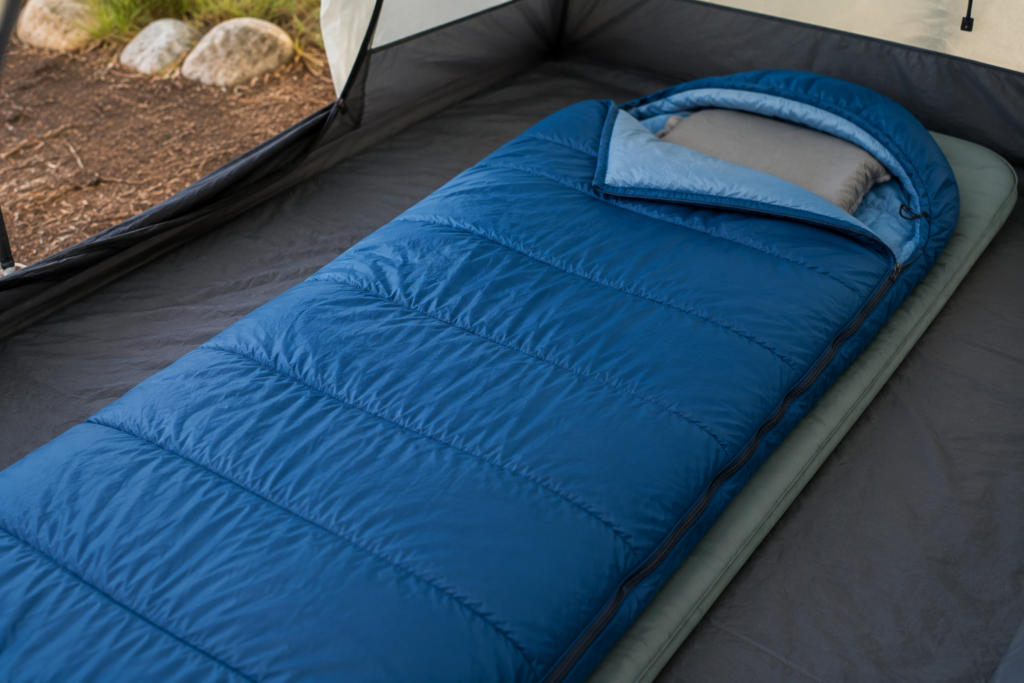
Best Overall — REI Co-op Siesta Hooded 20
The picks below are structured around how you actually camp and how you actually sleep — not just by a generic best-overall ranking. Check which category fits your situation before looking at price.
The REI Siesta Hooded 20 is the closest thing camping sleeping bags have to a consensus pick — and after putting it through its paces across different conditions and comparing it against the field, it’s easy to see why it keeps landing at the top. The reason is straightforward: it combines a genuinely roomy rectangular shape with the rare addition of a hood, at a price that doesn’t require any justification.
Most rectangular camping bags don’t have a hood — they’re cheaper to make without one and hoods feel redundant when you’re not trying to pack light. The Siesta has one anyway, and it’s large enough to hold a full-size pillow from home in place while you sleep, which is the kind of small detail that makes a real difference on a cool night.
- Temperature rating: 20°F survival / comfort from approximately 32-35°F for average sleepers
- Weight: approximately 5 lbs — fine for car camping, too heavy for backpacking
- Insulation: synthetic — performs well in damp conditions, easy to care for
- Shape: rectangular with insulated hood — maximum comfort for tossers and turners
- 2-way main zipper opens fully to use as a quilt; partial side zipper folds the top down for a bed-like feel
- Interior stash pocket for phone, headlamp, or lip balm
- Available in four sizes — Medium, Medium Wide, Long, Long Wide
- Best for: most car campers, especially beginners, first-time buyers, families looking for a reliable workhorse bag
- Who it is NOT for: backpackers (too heavy), cold sleepers in genuinely cold conditions (comfort rating tops out around 35°F)
Where to buy: https://www.rei.com/product/245457/rei-co-op-siesta-hooded-20-sleeping-bag
Best Budget — Coleman Brazos 30
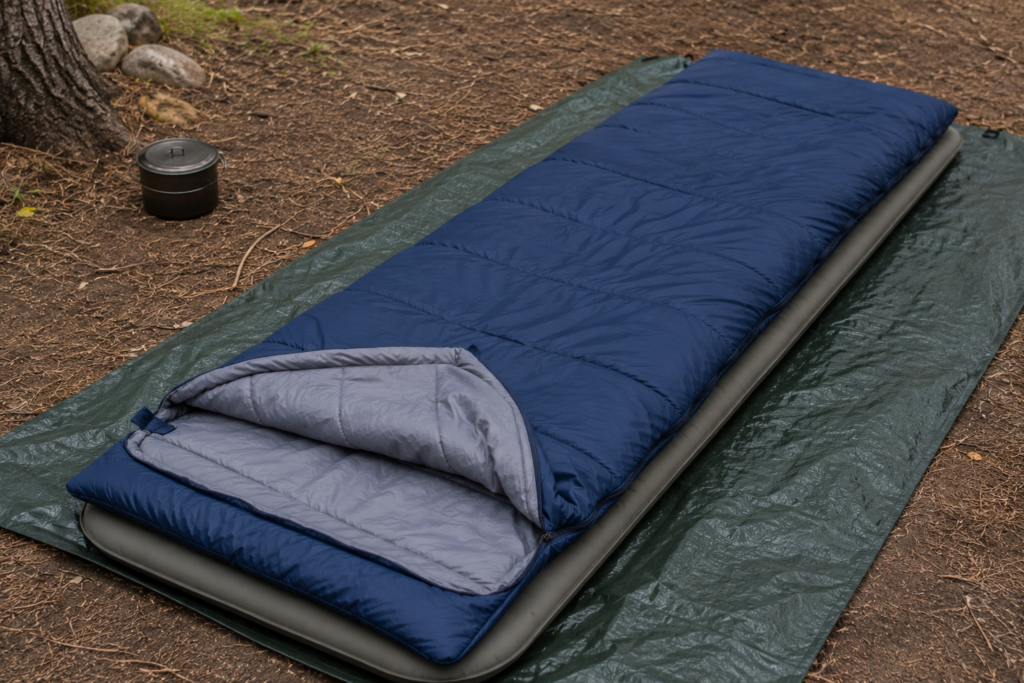
The Coleman Brazos sits in a price tier where expectations should be appropriately managed — this is not a premium bag and does not pretend to be. What it is: an honest, simple, durable rectangular sleeping bag at a price that makes buying one for every member of a family genuinely reasonable. The tricot lining feels comfortable against skin, it unzips completely to use as a blanket, and it can be zipped to a second Brazos bag for a doubles configuration.
Where it falls short is also honest: no hood, narrow draft tubes, zipper occasionally catches on material, and the comfort rating is genuinely closer to 45°F than 30°F for most sleepers. On warm summer camping nights it’s fine. Push it into the low 30s and you’ll want a base layer and a hat inside the bag.
- Temperature rating: 30°F survival / comfortable approximately 42-47°F for average sleepers
- Weight: approximately 5 lbs — comparable to the REI Siesta at lower price
- Insulation: synthetic — durable and low maintenance
- No hood — the main difference at this price point vs the Siesta
- Unzips fully to a blanket; two bags zip together for a doubles setup
- Best for: warm-weather summer camping, backup/loaner bags, buying for kids, large families on a budget
- Who it is NOT for: cool evenings below 45°F, cold sleepers, anyone camping into shoulder season
Honest verdict: The Brazos earns its budget pick not because it’s exceptional but because it’s reliable within its limits. Know its limits before you buy.
Where to buy: https://www.amazon.com/Coleman-Sleeping-Cool-Weather-No-Snag-Washable/dp/B0D6416YYW/
Best Down Value — Kelty Cosmic 20
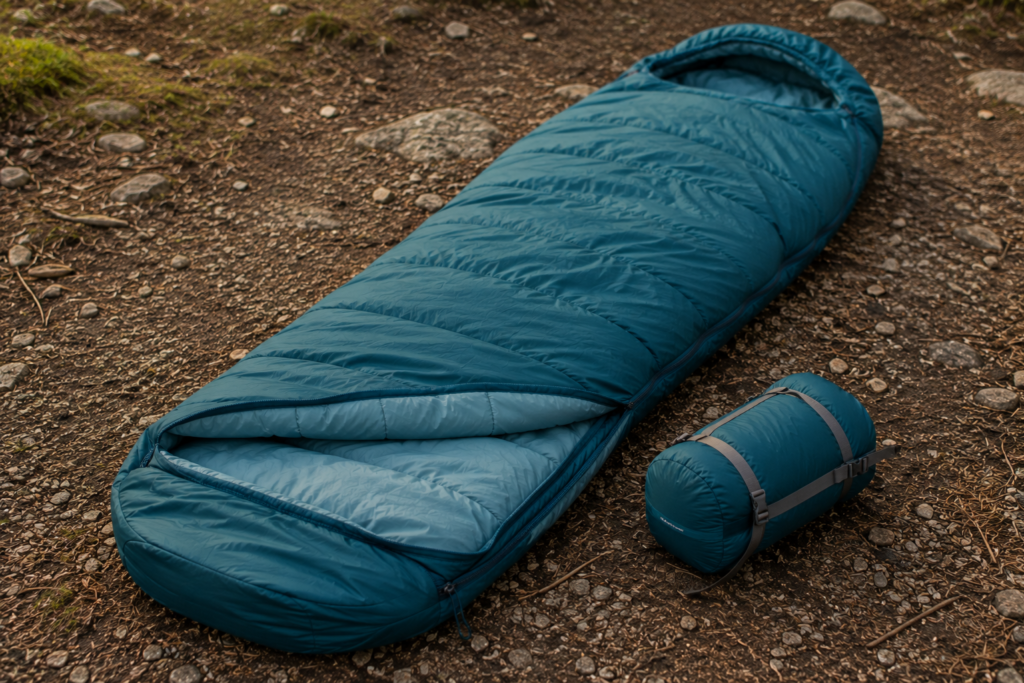
The Kelty Cosmic 20 makes the case for choosing down over synthetic for camping even on a modest budget — it’s priced competitively against premium synthetic bags but brings the durability and silky feel that down insulation delivers. The 550-fill duck down is not the lightest or most compressible you can get, but it’s enough to make a bag that still lofts well after years of regular use, which is more than most synthetic bags can say.
The semi-rectangular mummy shape splits the difference between the full warmth-efficiency of a true mummy and the sprawl room of a rectangular bag — a good compromise if you want warmth without feeling constrained. The natural-fit footbox gives your feet room to relax rather than stay pointed all night, which is a small but noticeable comfort detail.
- Temperature rating: 20°F survival / comfort approximately 30-32°F for average sleepers (EN rated)
- Weight: approximately 2 lbs 10 oz — light enough for the occasional backpacking crossover
- Insulation: 550-fill duck down with DriDown water-resistant treatment
- Shape: semi-rectangular mummy — hood included, tapered but not claustrophobic
- Dual-slider locking zipper; anti-snag draft tube; full draft collar; stash pocket
- Best for: campers who want a down bag without spending premium prices; dry-climate campers; those who want a bag that lasts a decade
- Who it is NOT for: wet-climate camping (down loses its warmth when damp); those who want maximum toss-and-turn room
Where to buy (Men’s): https://www.amazon.com/Kelty-Sleeping-Backpacking-Recycled-PFAS-Free/dp/B0F673C47Y/
Where to buy (Women’s): https://www.amazon.com/Kelty-Cosmic-Degree-Down-Sleeping/dp/B08M6VSCWM/
Best for Cold Sleepers — Teton Sports Celsius XXL 0°F
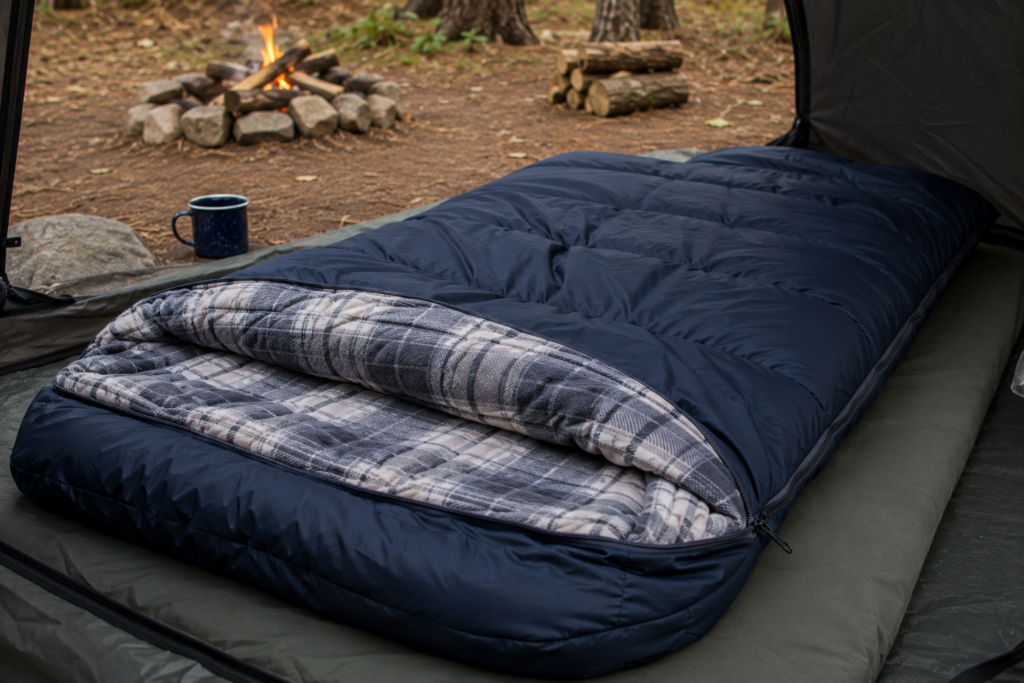
This is the pick for people who have already been cold in a sleeping bag that should have been warm enough — and have decided never to let that happen again. The Celsius XXL is rated to 0°F, but in practical terms it’s a bag that feels genuinely warm and comfortable well into cold shoulder-season conditions for people who run cold. The poly-flannel lining is soft against skin and the L-shaped zipper opens the entire bag flat into a blanket for summer use.
A note on the temperature rating: 0°F bags are occasionally dismissed as ‘overkill for camping.’ They are not overkill for cold sleepers. A bag that’s designed for colder than you’ll encounter means you sleep comfortably instead of sleeping at the edge of the bag’s performance envelope. Cold sleepers specifically will appreciate having the thermal buffer.
- Temperature rating: 0°F survival / comfortable approximately 10-15°F for average sleepers
- Weight: approximately 7.2 lbs — this is a large, heavy bag for car camping only
- Insulation: synthetic — performs in damp conditions, extremely lofty
- Shape: rectangular — roomy enough for larger bodies and active sleepers
- Updated hood, flannel lining, L-shaped zipper that opens to a full blanket
- Best for: cold sleepers specifically; late-season shoulder camping where nights dip near or below freezing; desert camping where days are warm but nights drop sharply
- Who it is NOT for: hot sleepers (this bag will be uncomfortably warm above 50°F); backpackers (far too heavy); anyone camping only in warm summer conditions
Where to buy: https://www.amazon.com/TETON-Sports-Celsius-Sleeping-Compression/dp/B001D6MF26/
Best for Side Sleepers — NEMO Disco Endless Promise 30
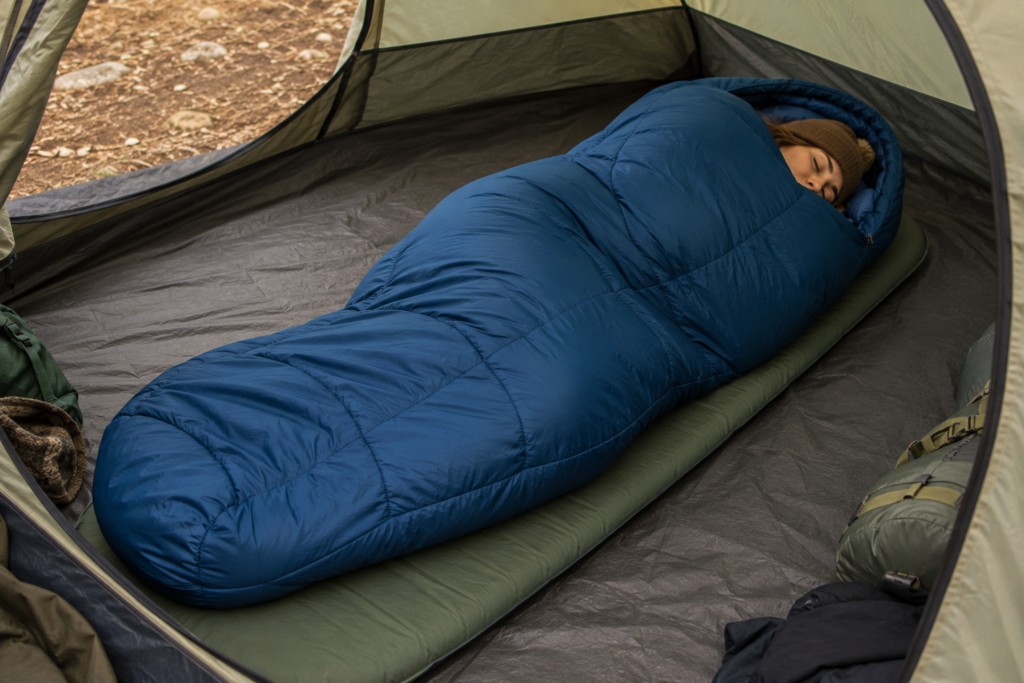
Side sleepers and stomach sleepers consistently report being uncomfortable in traditional mummy bags — the narrow taper at the feet and the snug shoulder fit that makes mummies thermally efficient is exactly what makes them feel restrictive for people who don’t sleep on their back. The NEMO Disco’s spoon shape is a genuine design solution to this problem: extra room at the elbows and knees means the bag doesn’t twist or pinch when you shift positions, without wasting thermal efficiency the way a rectangular bag does.
The Disco also earns points for its sustainability credentials — the Endless Promise designation means the bag is made of 100% recycled materials and can be returned to NEMO for recycling at end of life. The two ventilation gills that open along the top of the bag let you dump heat without unzipping the whole thing.
- Temperature rating: 30°F survival / comfortable approximately 40-45°F for average sleepers
- Weight: approximately 1 lb 15 oz (men’s) / 2 lbs 4 oz (women’s) — light enough for backpacking crossover
- Insulation: 650-fill duck down — packs small, lofts well
- Shape: spoon / hourglass — extra room at elbows and knees for side and stomach sleepers
- Thermo Gill vents on top of the bag for temperature regulation without full unzipping
- Two bags zip together for a couples configuration
- 100% recycled materials, end-of-life return program
- Best for: side sleepers and stomach sleepers who feel restricted in standard mummy bags; backpacker-camper crossover users; sustainability-minded campers
- Who it is NOT for: cold sleepers (comfort rating tops out around 40°F — buy the 15°F version if you sleep cold)
Where to buy (Men’s 30°): https://www.amazon.com/NEMO-Disco-Degree-Sleeping-Endless/dp/B0BMZLP11B/
Where to buy (Women’s 30°): https://www.amazon.com/NEMO-Disco-Womens-Sleeping-Endless/dp/B083BDMCFP/
Best for Couples or Sharing — Kelty Tru.Comfort 20 Doublewide
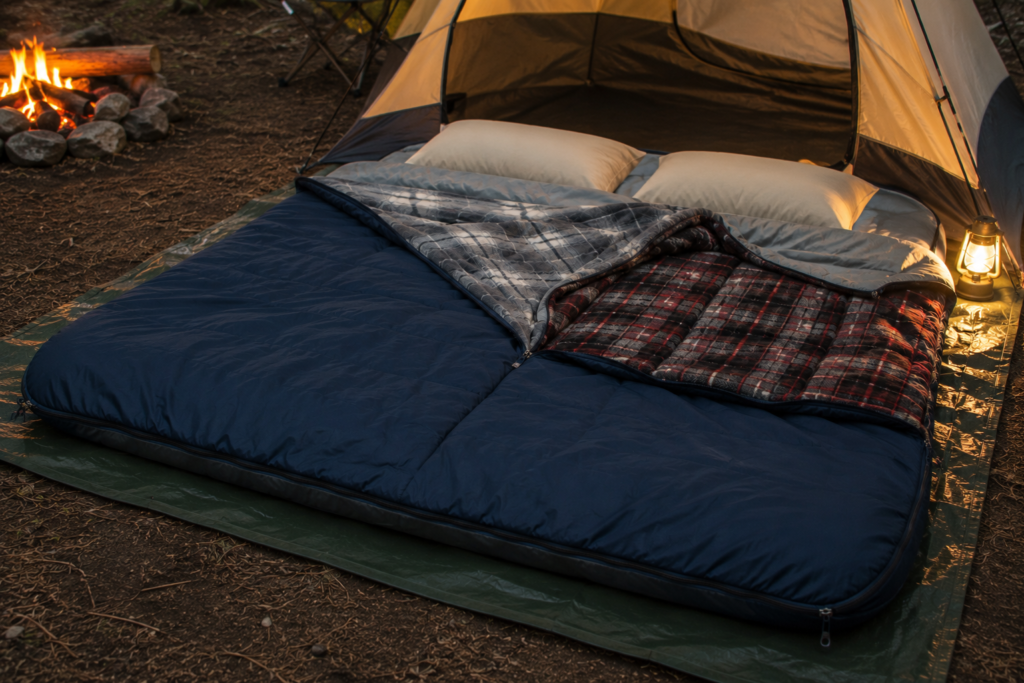
Couples who want to share a sleeping bag at camp tend to hit one of two problems: either the bag isn’t actually wide enough for two adults to sleep comfortably, or it’s so wide and drafty that neither person stays warm. The Kelty Tru.Comfort Doublewide addresses both by being genuinely wider than a queen mattress and including two integrated blankets — one per person — so neither of you is fighting for the covers at 3am. That detail is more important than it sounds.
- Temperature rating: 20°F survival / comfortable approximately 40-45°F with two people sharing body heat
- Weight: approximately 9.5 lbs — a large bag, car camping only
- Insulation: synthetic — easy care, moisture resistant
- Shape: oversized double rectangle — wider than a queen mattress
- Two integrated blankets (one per side), oversized hood for two pillows, wrap-around zippers with venting on each side
- Top cover layer zips off fully for ventilation on warm nights
- Best for: couples car camping together; parents who share a sleeping space with small children; anyone who wants shared warmth without fighting for covers
- Who it is NOT for: cold sleepers (even with shared body heat, this bag feels chilly below 40°F); backpacking; anyone needing anything more compact than a laundry bag for storage
Where to buy: https://www.amazon.com/Kelty-Tru-Comfort-Doublewide-Degree-Sleeping/dp/B07T9M73NN/
Best Versatility — The North Face One Bag
The North Face One Bag is the answer to a specific question: ‘If I can only buy one sleeping bag that works across every season and type of camping, what do I buy?’ The layered system gives you three temperature configurations in one bag — a 40°F synthetic base that works alone for warm summer nights, a 20°F down inner that adds serious cold-weather performance, and a combined system rated to 5°F for genuine winter use. You can mix and match the layers or use them separately.
The price is significant. But considered across the cost of buying two or three separate bags for different conditions, the One Bag is actually a reasonable investment for year-round campers who want to simplify.
- Temperature rating: 5°F / 20°F / 40°F depending on configuration
- Weight: approximately 3.8 lbs (all layers) — heavy for backpacking, fine for car camping
- Insulation: hybrid — synthetic outer layer, 800-fill down inner layer
- Glow-in-the-dark zipper pulls; stuff sack doubles as a fleece pillow; wide fit accommodates tossers and turners
- Best for: year-round campers who don’t want to own multiple sleeping bags; serious campers willing to invest in one long-term piece of gear
- Who it is NOT for: casual summer-only campers (spending $390 for one season is genuinely not worth it); budget-constrained buyers
Where to buy: https://www.amazon.com/North-Face-Sleeping-Bags-Heatseeker-Compression/dp/B0G1PQHFCH/
Sleeping Bags for Family Camping — What Most Guides Don’t Cover
This section doesn’t exist in most sleeping bag buyer’s guides — and it should, because family camping raises questions that a simple best-overall ranking do
Do Kids Need Their Own Sleeping Bag?
Yes — and not just because adult bags are too long. Children lose heat through their feet faster than adults, and a sleeping bag with dead air space at the foot (because the bag is sized for a 6-foot adult when the user is 4 feet tall) is meaningfully colder than a bag that fits. A child-sized bag that fits properly will keep them warmer than an adult bag that doesn’t.
That said, for very young children — under 3 or so — sleeping bags of any kind are a suffocation risk, and many parents opt for wearable blankets or sleeping sack designs instead. If you’re camping with very young children, a sleeping sack or a zip-up wearable fleece is safer than a traditional bag.
For school-age kids (5+), an appropriately sized sleeping bag is the right move. You do not need to buy premium gear for a child who will outgrow it in two seasons — a sub-$60 synthetic bag in the right size beats an expensive bag that doesn’t fit.
Our camping with kids guide covers the full sleep setup for family trips, including what to do when a child refuses to sleep in their bag in the middle of the night, which is its own category of camping challenge.
Family Car Camping vs. Backpacking with Kids — the Setup Is Different
- Car camping with kids: prioritize comfort and ease over weight and packability. Budget rectangular synthetic bags work fine. Buy one per person at a reasonable price — not one premium bag to share.
- Backpacking with kids: weight matters for adults who may be carrying more of the total pack weight. A down bag for adults and a lightweight synthetic for kids is a reasonable division. Accept that kids’ bags will get dirtier and need more washing — synthetic is easier to launder.
- Sleeping bag liners for kids: worth considering — they add warmth, are washable easily, and reduce how often you need to wash the bag itself. A significant practical benefit on longer trips.
The Sleep System Nobody Tells You About — Your Sleeping Pad Matters Too
This is the piece of information that experienced campers consistently wish they’d had earlier: approximately 30% of your heat loss at night goes through the ground, not into the air. A sleeping bag insulates you from the air around you — but when you lie on it, the insulation underneath compresses and loses most of its effectiveness. The only thing standing between you and the cold ground is your sleeping pad.
Practical implication: A $300 sleeping bag on a thin foam pad is meaningfully colder than a $100 sleeping bag on a proper sleeping pad with a high R-value. If you’re cold at night and your sleeping bag is rated for the temperatures you’re camping in, check your sleeping pad first.
R-Value Explained in Plain English
R-value measures how much a sleeping pad resists heat transfer to the ground. Higher R-value = more insulation from the cold ground. Here’s the rough guide:
- R-value 1-2: summer camping only, above 50°F overnight — a thin foam pad or basic inflatable
- R-value 3-4: three-season camping, most car camping conditions down to around 35°F overnight
- R-value 5+: cold-weather camping, shoulder season, or any camping where overnight temperatures drop near or below freezing
For the full sleeping pad picture, our mountain camping for beginners guide covers cold-ground sleeping setup in detail for campers heading into higher elevations where the combination of cold air and cold ground both apply.
How to Store and Care for Your Sleeping Bag
This is the section nobody includes, and it’s directly relevant to whether your $150 sleeping bag lasts two years or ten.
- Never store compressed: the most common way to ruin a sleeping bag — keeping it in the stuff sack between trips — permanently compresses the insulation and reduces its loft and warmth. Store it hanging in a closet, or stuffed loosely in a large mesh bag, not compressed in the stuff sack. The stuff sack is for transport only.
- Wash infrequently: washing a sleeping bag stresses the insulation and the shell. Spot-clean where possible. Wash the whole bag only when genuinely necessary — a handful of times per season at most.
- Wash with the right product: standard detergent can strip the DWR finish and damage down clusters. Use a product specifically designed for sleeping bags or down gear — the cost difference is minimal, the impact on longevity is real.
- Air it out after every trip: unzip fully and leave the bag to air for a few hours before storing. This prevents moisture and odor from building up in the insulation over time.
- Reapply DWR: the Durable Water Repellent finish on the shell wears off over time — tumble drying on low heat periodically refreshes it. When water no longer beads off the outside of the bag, it’s time to reapply with a spray-on DWR product.
Frequently Asked Questions About Camping Sleeping Bags
What temperature sleeping bag do I actually need for summer camping?
For most summer camping in temperate conditions where overnight lows stay above 45°F, a bag rated 30-35°F (survival rating) works for average sleepers. If you sleep cold, go lower — a 20°F bag is not overkill for a cold sleeper in summer. Check the overnight low temperatures for your specific campground rather than estimating by season.
Is down or synthetic better for a first camping sleeping bag?
For most beginners, synthetic is the safer first choice — it’s more forgiving in damp conditions, easier to care for, and cheaper if the bag gets roughed up or used carelessly. Once you know you’ll camp regularly and can commit to proper storage and care, upgrading to down delivers noticeably better longevity and comfort.
Why am I cold in my sleeping bag even though it’s rated for lower temperatures?
Three most likely reasons: (1) the temperature rating is a survival rating, not a comfort rating — add 10-15°F to find your real comfort temperature; (2) your sleeping pad has a low R-value and you’re losing heat through the ground; (3) you’re a cold sleeper and the bag needs to be rated lower than the overnight temperature, not equal to it. Wearing base layers and a hat inside the bag is the fastest fix while you diagnose which issue applies.
Can I use a mummy sleeping bag if I’m a side sleeper?
Traditional mummy bags are designed for back sleepers and can feel restrictive for side and stomach sleepers — the taper at the feet and snug shoulder fit that make them thermally efficient are exactly what causes discomfort when you shift positions. If you’re a side or stomach sleeper, look for spoon-shaped bags (NEMO Disco) or semi-rectangular bags with wider footboxes — these preserve most of the warmth benefit while giving your elbows and knees room to move.
How do I stop my sleeping bag from sliding off my sleeping pad?
Some sleeping bags include pad sleeves or straps that anchor the bag to your pad — worth looking for if you’re an active sleeper. If your bag doesn’t have one, a non-slip sleeping pad surface (many camping pads have grip fabric) helps considerably. Alternatively, a sleeping bag liner creates friction that keeps the bag in position even on slippery pad surfaces.
FAQ Schema (WPCode — paste after FAQ section as Custom HTML block)The Right Bag Means a Better Morning — Here Is How to Find Yours
A good night in a camping sleeping bag is one of those things that seems straightforward until it isn’t — until you’re cold at 2am with an overrated bag, or hot and tangled in something too warm for the conditions, or lying on a sleeping pad that’s letting the ground win. The picks in this guide are chosen to prevent all three.
Use the temperature table to find the right rating for how you sleep. Use the sleeper type recommendations to pick a shape that won’t restrict you. Don’t skip the sleeping pad — the bag is only half the sleep system. And whatever you buy, store it uncompressed when you get home.
The morning after a genuinely good night of sleep at a campsite — coffee in hand, birds doing their thing, the tent still holding against the early dew — is one of the better things camping reliably delivers. A sleeping bag you chose correctly makes that experience consistent rather than lucky.
Still building out your camping kit? Our complete camping checklist for new campers covers every other piece of gear alongside your sleeping bag, and our seasonal camping gear guide helps you match the full kit to the conditions you’re heading into.