Camping with Dogs: What to Pack, Where to Go, and How to Make It the Best Trip Yet
-
| Founder & Content Creator

Latest Posts

There is a specific kind of happiness that dogs display when they realise they are coming with you. The moment the camping bag appears. The moment the lead comes out not for a fifteen-minute walk but for something that clearly involves the car and a very long time away. Every dog owner who has seen this knows exactly what it looks like — and it is one of the best arguments for camping with dogs that exists.
Dogs are exceptional camping companions. They are enthusiastic about everything the outdoors offers — the smells, the sounds, the sheer amount of interesting ground to cover — and they bring a kind of uncomplicated joy to the campsite that is genuinely contagious. They also require some additional preparation, some specific gear, and some knowledge about keeping them safe in an environment that is less controlled than home.
This guide covers everything: finding the right pet-friendly campsite, preparing your dog for the trail, what to pack, how to keep them safe around campfires and wildlife, and how to manage the first few nights in a tent for a dog who has never camped before.
Why Camping with Dogs Makes Every Trip Better — and What to Think About First
The statistics on dog camping have grown consistently over the last decade. According to the American Pet Products Association, more than 37% of dog owners take their pets on camping trips. Dog-friendly campsite bookings on platforms like BringFido and Hipcamp have grown year-on-year, and dog-focused campground facilities — off-leash parks, dog washing stations, dog-friendly trails — have become standard at quality campgrounds across the country.
The reason is straightforward: camping with a dog is genuinely better than camping without one. They provide company at camp, purpose on the trail, warmth in the sleeping bag (if you allow it), and a reason to wake up early enough to see the sunrise. The campfire evenings are more companionable. The morning walks are more motivated. The whole trip has a different energy.
The questions to ask before you go are about your dog, not yourself: are they fit enough for the trail you have planned, vaccinated for the environment, comfortable with strangers and other dogs, and genuinely ready for an experience this different from their usual routine?
Before You Book: Choosing the Right Pet-Friendly Campsite
Not all campsites welcome dogs. Some welcome dogs on sites but not on trails. Some have breed restrictions. Some have pet limits. Some charge fees. The campsite you choose determines whether your dog can actually enjoy the trip with you — and discovering a restriction on arrival is one of the most avoidable camping frustrations.
How to Find Pet-Friendly Campsites: The Tools That Actually Work
- BringFido (bringfido.com): The most comprehensive dog-friendly travel database available. Filter by campground, cabin, or RV site. Shows specific pet policies, breed restrictions, size limits, and pet fees for each property. Read the pet policy before booking, not after.
- Hipcamp: Excellent for private land campsites with dog-friendly filters. Many Hipcamp hosts specifically welcome dogs and the listing clearly states pet policies. Real-time availability makes last-minute planning genuinely possible.
- The Dyrt: User-generated campsite reviews with a pet-friendly filter. Recent reviews from other dog-owning campers are the most honest picture of what a site is actually like with a dog.
- KOA campgrounds: Most KOA sites welcome pets and many feature KampK9 — a fenced off-leash play area with agility obstacles and waste stations. A particularly good choice for a first dog camping trip because facilities are well-managed and staff are experienced with pet campers.
- National and state park websites: Check official pet policies directly — national park dog rules vary significantly by park and trail. Some parks are excellent for dogs; others restrict pets to paved areas only.
Leash Rules, Pet Limits, and What to Check Before You Arrive
The standard leash rule at most national parks and established campgrounds is a maximum of 6 feet. This is a legal requirement at many sites, not a suggestion — campers have been asked to leave and fined for non-compliance. A retractable leash that extends to 16 feet does not satisfy a 6-foot leash rule even when it is set short.
- Check the specific leash length rule for your site — 6 feet is standard but some sites vary
- Pet limits: many campgrounds allow a maximum of 2 dogs per site. If you have more, confirm in advance.
- Breed restrictions: some sites restrict specific breeds — Pit Bulls, Rottweilers, and Dobermans appear on restriction lists at several campgrounds. Check before booking.
- Never leave dogs unattended at a site: this is a rule at almost every campground, enforced by other campers if not by staff
- Noise: a dog that barks excessively will create conflict with neighbours. Most campgrounds have noise policies that apply to pets.
HONEST TIP: Read the pet policy of every campsite before you book, not after you arrive. The best-reviewed dog-friendly campsite you found on BringFido may have a 2-dog limit when you have three dogs, or a 6-foot leash rule when your dog needs more space. Five minutes of reading saves considerable embarrassment at the gate.
Is Your Dog Ready? How to Prepare Your Pet for the Trail
This is the section most camping-with-dogs guides skip — and it is the section that determines whether your first dog camping trip is a joy or a struggle. Preparation for your dog is as important as preparation for yourself.
Health Checks and Vaccinations for Camping with Dogs
Before any camping trip, especially to wilderness or rural areas, your dog needs to be current on specific vaccinations and treatments. A standard annual vaccination may not cover everything a camping environment exposes them to.
- Core vaccinations: rabies (legally required for access to many parks and campgrounds), distemper, parvovirus, adenovirus — ensure all are current before your trip
- Leptospirosis: highly recommended for dogs camping near water. Leptospirosis is a bacterial infection spread through contaminated water and soil — dogs who swim or drink from natural sources are at risk
- Lyme disease vaccination: recommended in tick-heavy areas. Check with your vet about the tick risk in your specific destination
- Bordetella (kennel cough): worth discussing with your vet if your campsite is busy and your dog will be in contact with other dogs
- Flea and tick treatment: apply before the trip, not on the day. Many treatments need 24-48 hours to become effective
- Worming: dogs who are likely to eat things off the ground (which is all of them, outdoors) should be up to date with worming treatment
Keep a copy of your dog’s vaccination records with you on the trip — some campgrounds require proof of rabies vaccination at check-in. A photo of the vaccination card on your phone is usually sufficient.
Condition Your Dog for the Trail Before You Go
This is the single most overlooked preparation step for first-time dog campers, and it is the one that prevents the most problems on the trail. Taking an unconditioned dog on a 10-kilometre mountain hike is the dog equivalent of signing yourself up for a marathon with no training — possible, but unpleasant for everyone involved and potentially dangerous.
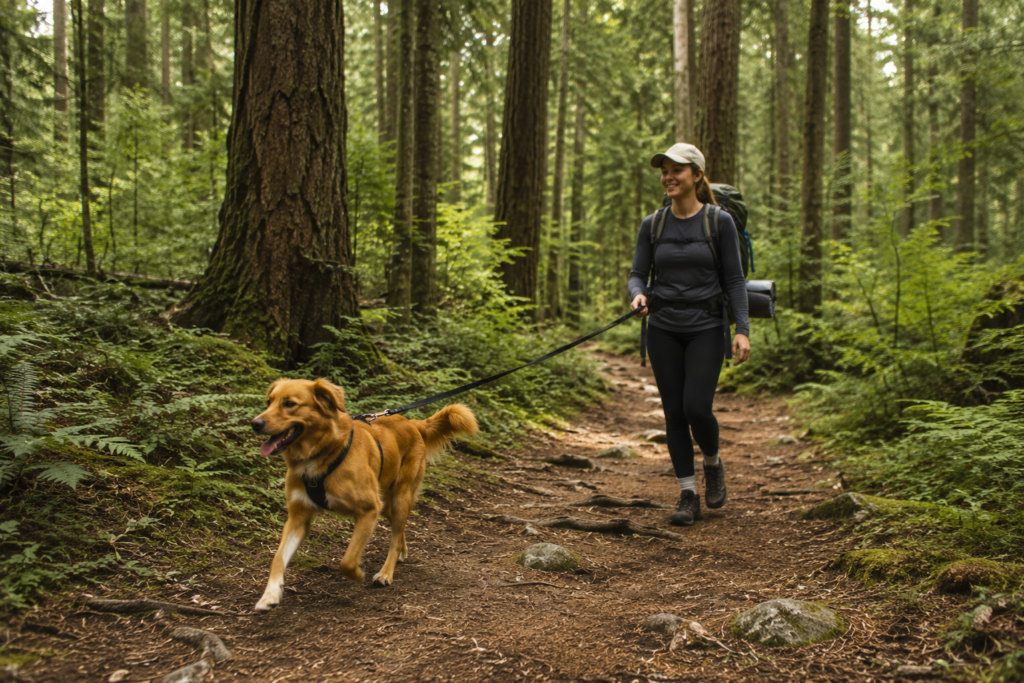
- Build up trail distance progressively in the weeks before your trip — start with your normal walk length and add 15-20% each week
- Walk on similar terrain to what you will encounter camping: if you are going to a rocky mountain area, include rocky paths. If you are going to soft forest trails, include unpaved ground.
- Check your dog’s paws after longer walks: redness, soreness, or worn pads indicate the terrain is challenging for them
- Note how they recover: a dog who is stiff the following morning after a longer walk needs more conditioning time before a multi-day trail
- Young dogs under 18 months should not be pushed on long trails — their joints and bones are still developing
- Older dogs need honest assessment — a dog who used to hike easily at age 4 may find the same trail much harder at 9
Mountain terrain is especially demanding on dogs — our mountain camping for beginners guide covers high-elevation challenges that affect both humans and their dogs.
Know Your Dog’s Temperament — and Be Honest About It
Not every dog is suited to the social environment of an established campground — and knowing this about your dog before you arrive is considerably more useful than discovering it at the campsite.
- A dog that is dog-reactive or people-reactive will be stressed at a busy campground with close neighbours and other dogs on short leashes
- A dog with high prey drive may be difficult to manage on a campsite with wildlife activity nearby
- An anxious dog may struggle significantly with new environments, unfamiliar sounds at night, and the disruption of routine
- If any of these apply: choose a quieter, more remote site with fewer other campers and dogs nearby. Many Hipcamp and BringFido listings include descriptions of how busy and social the site is.
- A dog that cannot sleep in a new environment will mean you cannot sleep either — and a sleep-deprived camping trip is nobody’s idea of a good time
Camping with Dogs Gear List: Everything Your Dog Actually Needs
The dog-specific gear list is more compact than most new dog-campers expect. The additions to your usual camping kit are specific and purposeful — not a wholesale second packing list.
Before adding dog-specific items, make sure your own camping kit is covered — our complete camping checklist for new campers covers the human essentials that your dog-specific gear builds on.
Food, Water, and the 200-Foot Rule for Dogs
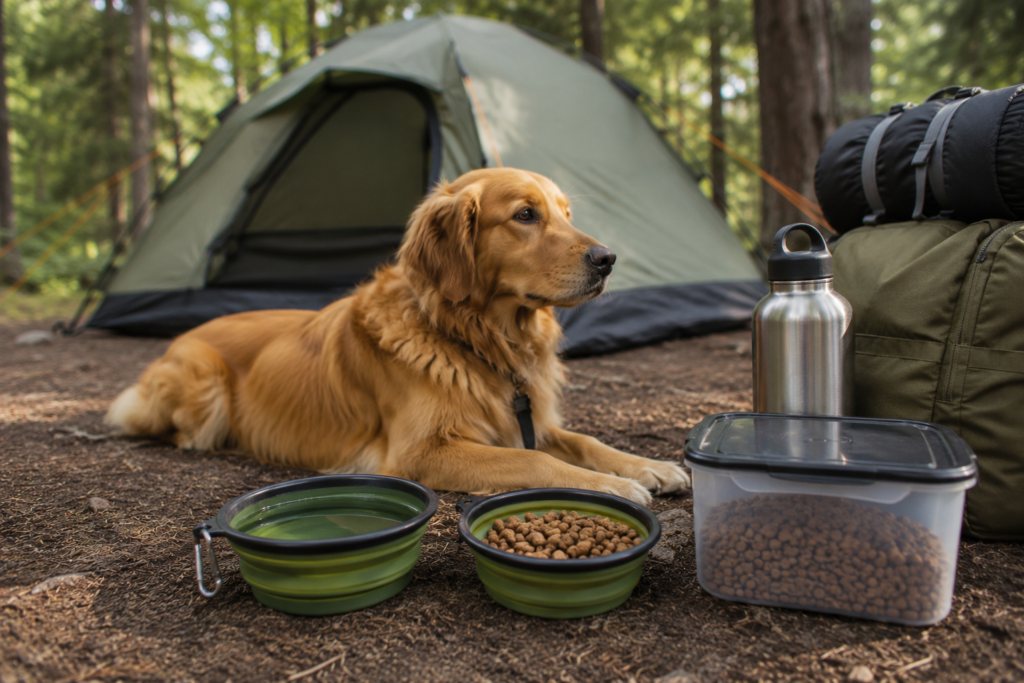
Water is the most critical practical consideration for camping with dogs. Natural water sources at campsites — rivers, lakes, streams, puddles — can carry bacteria, parasites, and algae that cause serious gastrointestinal illness in dogs. Still water is higher risk than flowing water. But no natural water source is risk-free.
- Carry enough water for your dog as well as yourself — calculate their daily water needs (approximately 30ml per kg of body weight per day, significantly more in hot weather or during exercise)
- Collapsible dog bowls: lightweight, packable, and worth bringing two — one for water, one for food
- Spill-proof travel bowls: useful for the journey to the campsite
- Treat natural water sources with the same caution you would for yourself — if you would not drink it without treatment, neither should your dog
Our guide to purifying water in the wilderness covers every water treatment method — use the same filtered or purified water for your dog as you drink yourself.
For food: pack the same food your dog eats at home — camping is not the time to switch brands or introduce new food. Pack enough for the trip plus two extra days as a buffer. Store in airtight, waterproof containers and keep food out of reach of wildlife just as you would your own food.
Shelter and Bedding: Keeping Your Dog Off the Cold Ground
Cold ground draws heat from your dog’s body throughout the night in exactly the same way it draws heat from yours. A dog sleeping on a bare tent floor will be cold, restless, and potentially stiff in the morning.
- Bring their regular bed or a familiar blanket from home — familiar smells from home are genuinely comforting to dogs in new environments
- A sleeping mat or folded tarp under their bedding provides insulation from the cold ground — especially important in cooler months
- A dog sleeping bag: available for dogs, useful in cold conditions, especially for short-haired breeds
- If your dog sleeps in your sleeping bag at home: this is considerably warmer for both of you at camp than separate sleeping arrangements, and most experienced dog campers end up doing this regardless of their initial intentions
Here is how the first night of dog camping usually goes: you have a plan, the dog has a cold nose and a determined expression, and by midnight the plan has been renegotiated. The sleeping bag that was exclusively yours at 10pm has a co-occupant by 1am. Nobody who has camped with a dog is surprised by this. Pack their blanket, bring low expectations about tent boundaries, and accept early that camping with a dog is a collaborative sleeping arrangement whether you planned it that way or not.
Dog Hiking Boots: When They Are Worth It
Dog boots polarize opinion in the dog camping community. Most dogs tolerate trail terrain without them. Some situations make them genuinely worth the investment.
- Rocky, sharp terrain where paw pad injuries are likely — granite scrambles, loose scree, sharp limestone
- Hot pavement or sand where ground temperature can burn paw pads — if the surface is too hot for the back of your hand after five seconds, it is too hot for your dog’s paws
- Icy or snowy terrain where salt and ice melt chemicals are present
- A dog already showing signs of pad sensitivity on shorter walks
Introduce boots at home before the trip — most dogs find them deeply confusing at first and need several sessions of wearing them in a familiar environment before they will walk normally in them.
Leash, Tether, and Harness Setup
- Lead leash (6-foot): the standard for campgrounds and most national parks. A fixed 6-foot lead with a sturdy clasp. Bring at least one spare — leads break, get chewed, or get lost in pack reorganisation.
- Long training lead (20-30 foot): useful for open areas away from the campground where a longer exploration radius is appropriate and safe. Not suitable for busy campgrounds.
- Camp tether: a spiral stake in the ground with a short lead, allowing your dog to move around a defined area without being held or tied to something fragile. Useful at your pitch while you cook or set up.
- Harness: for trail hiking, a well-fitted harness distributes load better than a collar and gives you more control on uneven terrain without neck pressure. A front-clip harness reduces pulling significantly.
Dog Life Jacket for Water Activities
If your campsite is near water and your dog is likely to swim — or is the sort of dog who enters water without being asked — a life jacket is worth serious consideration.
- Not all dogs are strong natural swimmers — brachycephalic (flat-faced) breeds like Bulldogs and Pugs struggle particularly
- Cold water, strong currents, and unexpected depths are hazards even for good swimmers
- A life jacket with a handle on the back allows you to lift a dog out of water in an emergency
- Introduce the life jacket at home before the trip — it needs to fit correctly and the dog needs to be comfortable in it
Pet First Aid Kit: What to Pack
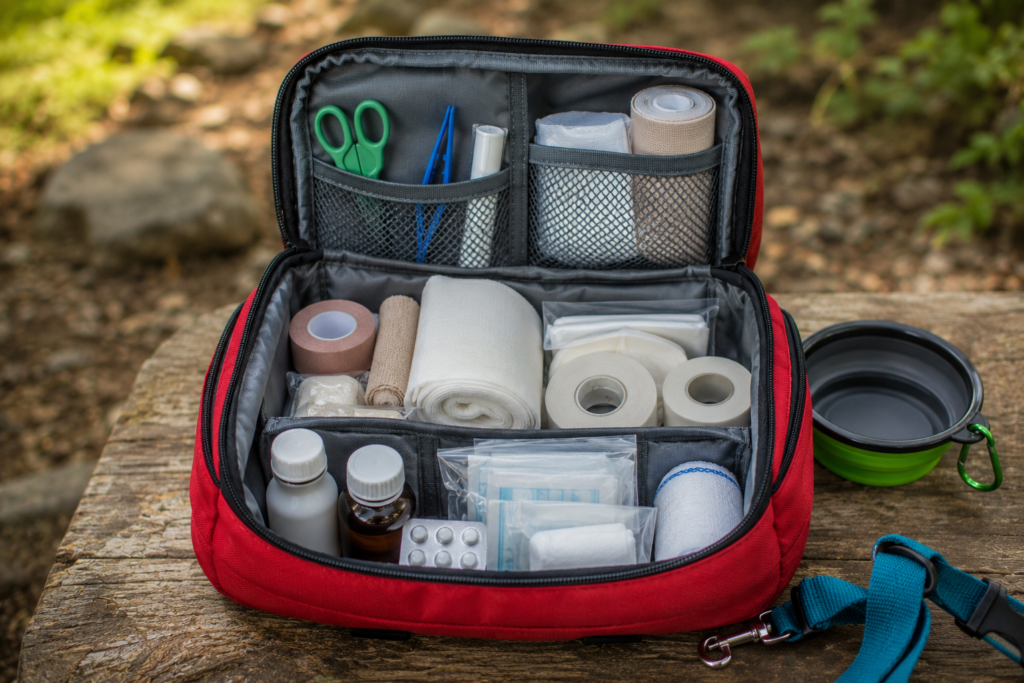
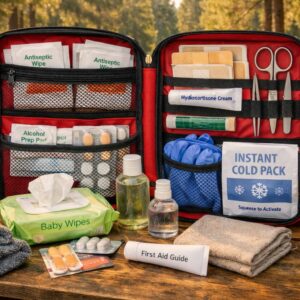
A pet first aid kit is not optional for camping with dogs in any environment more than a 30-minute drive from veterinary care. Build one specifically for camping rather than relying on your human first aid kit.
- Bandages and wound closure strips — sized for dog wounds, not human ones
- Self-adhesive bandage wrap (Vetrap): sticks to itself, not fur — the most useful bandaging material for dogs
- Antiseptic wound spray and sterile gauze pads
- Tweezers: for tick removal and splinter extraction from paw pads
- Tick removal tool: purpose-built hook tools remove ticks more cleanly than tweezers
- Nail clippers: a broken nail on the trail can cause significant pain if not managed
- Liquid Benadryl (diphenhydramine): for allergic reactions to insect stings. Confirm appropriate dose for your dog’s weight with your vet before the trip.
- Electrolyte powder for dogs: for rehydration after vomiting, diarrhoea, or heat exhaustion
- Any prescription medications your dog takes regularly, with copies of scripts
- A copy of your vet’s contact number and the number of the nearest emergency vet to your campsite
For the human side of your camping first aid setup, our essential camping first aid kit guide covers everything you need in one place.
Eco-Friendly Waste Bags — Non-Negotiable
Dog waste at a campsite is not only antisocial — it is a genuine environmental and public health issue. Faecal bacteria in water sources, on trails, and in shared campsite areas is a real concern. Pick it up, bag it, and carry it out.
- Bring significantly more bags than you think you need — always
- Some campgrounds provide bag dispensers; do not rely on this being the case
- In wilderness areas with no waste facilities: pack it out. In established campgrounds: use the designated waste bins
- Never bury dog waste near water sources
- Biodegradable bags where possible — though note that standard biodegradable bags do not break down meaningfully in landfill, so the priority is always correct disposal
Dog ID, Microchip, and Health Records
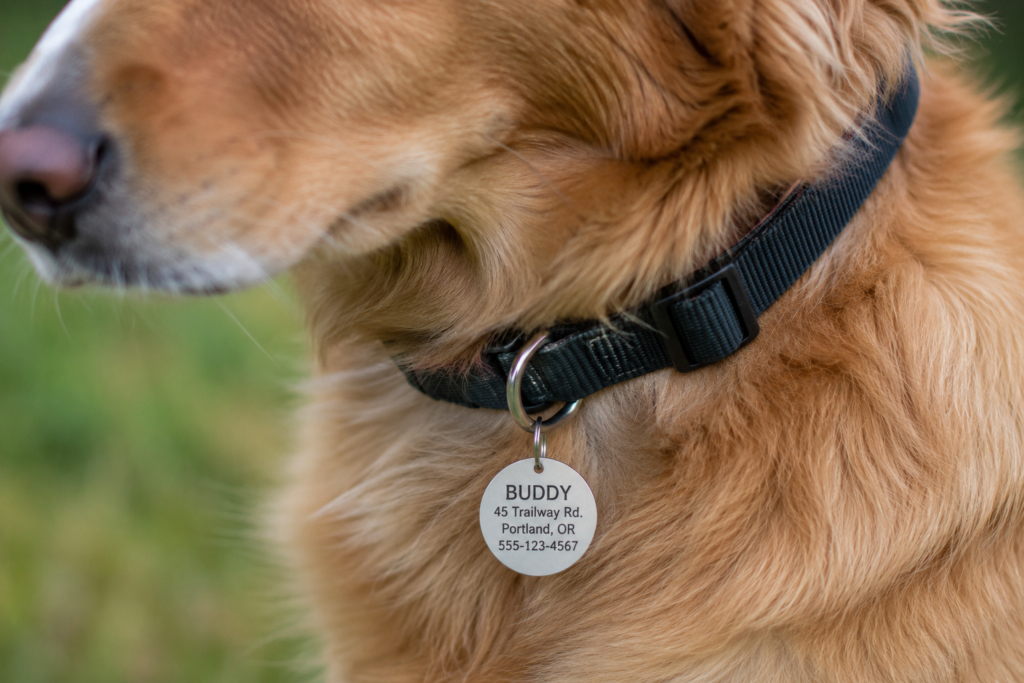
A dog that gets loose on a trail or at a campsite needs to be identifiable and retrievable. This requires preparation before the trip, not improvisation when it happens.
- ID tag: current with your mobile number — not your home phone. Check it is securely attached to the collar and the engraving is still readable.
- Microchip: the most reliable form of permanent identification. Ensure the chip registration is updated with your current contact details — many microchips are registered but never updated after a house move.
- Collar: check it fits correctly and the clasp is secure before the trip. A dog can slip a loose collar in an unfamiliar environment when startled.
- Photo: save a clear, recent photo of your dog on your phone. If they go missing, you will need it immediately for sharing and for identifying them.
- Health records: carry a copy of vaccination records — some campgrounds require proof of rabies vaccination at check-in.
Campsite Safety for Dogs: The Checks That Give You Peace of Mind
Campfire Safety for Dogs
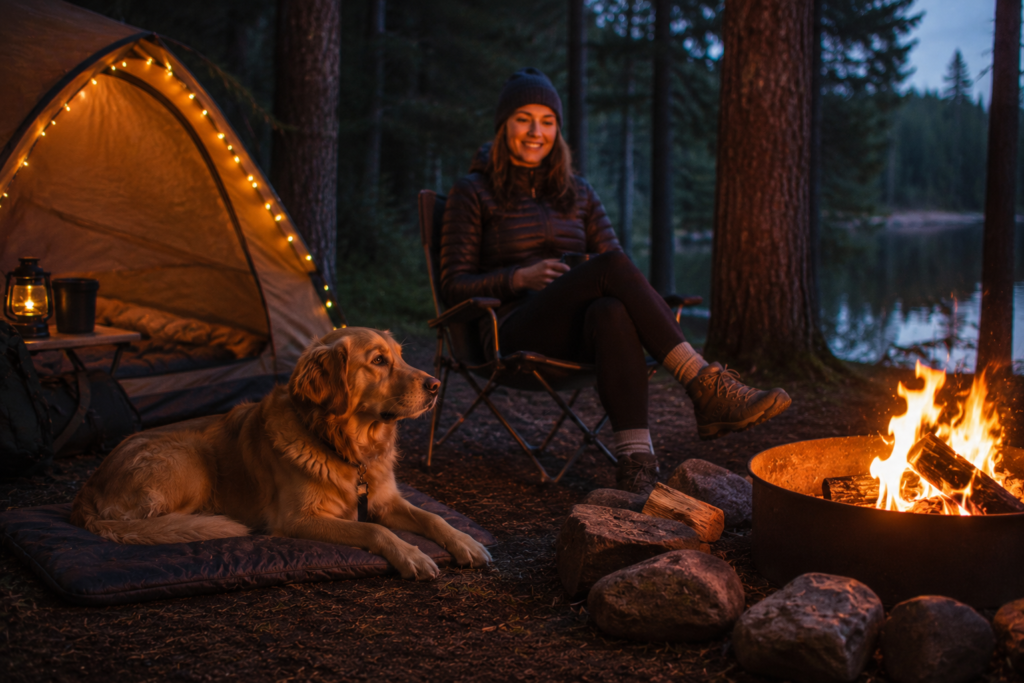
Dogs are drawn to campfire heat in the same way children are — and they require the same kind of active boundary management.
- Establish a safe zone around the campfire before lighting it — a physical marker your dog can associate with a boundary
- Dogs can burn their paws on hot embers even after a fire appears out — keep them away from the fire area until ashes are completely cold
- Never leave a dog unattended near a fire
- Hot coals hidden under ash are invisible and can burn paw pads seriously — the same extinguishing rule applies for dogs: drown, stir, drown again until cold
Wildlife Encounters With Your Dog
A dog on a lead can still create a wildlife encounter if the lead is long enough to allow them to approach an animal. A dog off-lead in wildlife-rich territory is an invitation for a genuinely serious encounter.
- Keep your dog on a 6-foot lead at all times in wildlife areas — even if the trail appears empty
- A dog barking at or chasing wildlife can provoke defensive behaviour from animals that would otherwise avoid humans
- In bear country: a dog that runs at a bear and then returns to you with the bear following is a specific and documented hazard — your dog’s escape strategy and yours diverge completely
- Skunk encounters are common at campgrounds — a tomato juice bath is a popular emergency fix but enzymatic sprays (Nature’s Miracle Skunk Odor Remover) are significantly more effective
Our wildlife safety while camping guide covers how to read animal behavior and respond calmly — the advice applies directly to situations where your dog is on the lead beside you.
Heat Exhaustion and Hydration — Signs Every Dog Owner Should Know
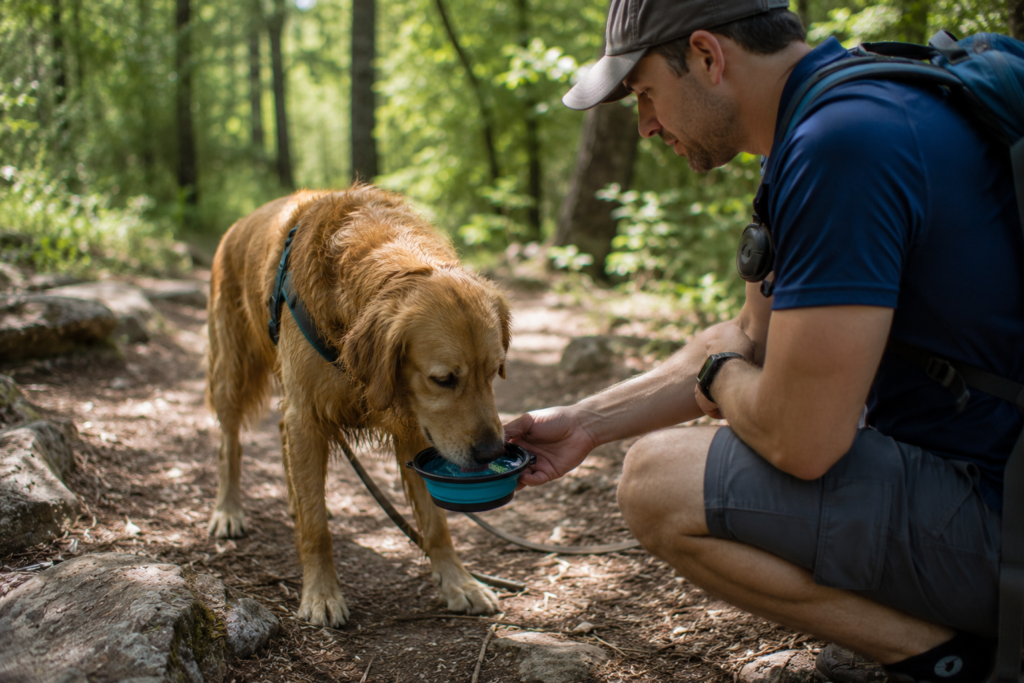
Dogs cannot regulate their body temperature as efficiently as humans. They cool primarily through panting and through the pads of their feet — two mechanisms that are significantly less efficient than sweating. In hot conditions or on demanding trails, heat exhaustion in dogs can develop faster than most owners expect.
- Warning signs: excessive panting beyond normal exertion levels, heavy drooling, bright red gums, stumbling or weakness, vomiting, or glazed eyes
- Immediate response: move to shade immediately, apply cool (not cold) water to paws, armpits, and groin area, offer water in small amounts frequently — do not force drinking
- Prevention: offer water every 20-30 minutes on active trail days, seek shade during peak heat hours (11am-3pm), watch your dog’s pace rather than your own as the indicator of effort level
- High-risk breeds: brachycephalic (flat-faced) breeds — Bulldogs, Pugs, French Bulldogs — are significantly more heat-vulnerable than other breeds and should not be taken on demanding summer trails
Insect Protection Safe for Dogs
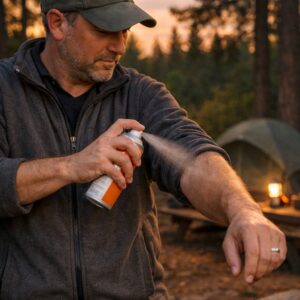
Many standard insect repellents used by humans are toxic to dogs. DEET — the active ingredient in most human-grade repellents — is harmful to dogs if ingested, which happens when a dog licks treated skin or fur. This does not mean leaving your dog unprotected — it means using the right products.
- Use only veterinary-approved insect repellents on your dog — products specifically formulated for dogs
- Permethrin-treated clothing on yourself is effective and does not transfer dangerously to dogs through brief contact — though permethrin itself is highly toxic to cats
- Flea and tick preventatives from your vet (Bravecto, NexGard, Simparica) provide tick protection for the duration of the trip
- Check your dog for ticks after every trail session — behind ears, between toes, around collar, groin and armpits
Our guide to keep mosquitoes away while camping covers the full range of campsite insect management strategies — check which approaches are safe to use around your dog.
Find the Nearest Emergency Vet Before You Leave Home
This is the preparation step that almost no casual camping guide mentions and that experienced dog campers consider essential: before you leave home, find and save the contact details of the nearest emergency veterinary clinic to your campsite.
Searching for an emergency vet on your phone at 11pm with a distressed dog and patchy signal is exactly the wrong time to be doing this research. Doing it at home, before you leave, when you have full connectivity and complete composure, takes five minutes and could matter enormously.
- Search ’emergency vet near [your campsite location]’ and save the name, address, and phone number in your phone
- Note their hours — 24-hour emergency vets versus those with limited evening hours
- Keep a printed copy in your first aid kit as a backup in case of phone battery or signal issues
- Some experienced dog campers also look up the nearest 24-hour animal poison control hotline — ASPCA Animal Poison Control
Making Camp Life Work for Your Dog — Routine, Comfort, and the Familiar
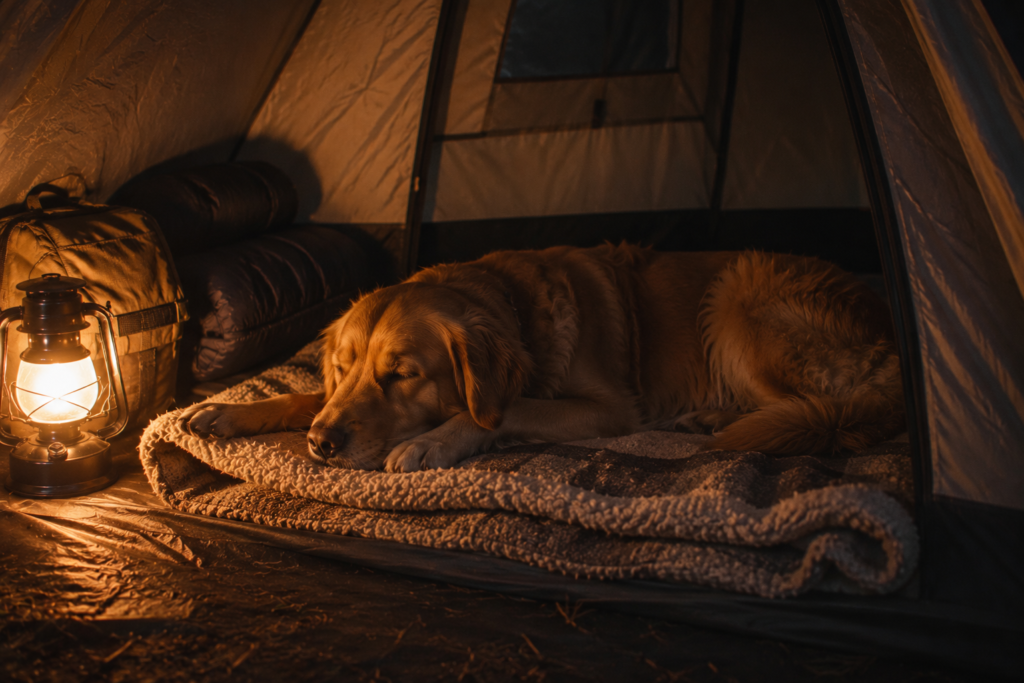
Dogs are creatures of routine in a way that humans often underestimate. A dog taken suddenly from a familiar home environment to a strange tent, with unfamiliar smells and sounds, may take a night or two to settle. This is normal and does not mean they are miserable — it means they are adjusting.
- Bring the familiar: a blanket or bed from home, their regular toys, their regular food. The more familiar items in an unfamiliar environment, the faster the adjustment.
- Maintain your usual routine as much as possible: feeding times, walk times, and bedtime routines tell your dog what to expect. A dog that knows dinner is at 6pm and the evening walk is at 7pm is calmer at camp than one with an entirely unpredictable day.
- The first night in the tent: most dogs are unsettled on night one. They hear things they have not heard before — other campers, animals, wind in different trees, rain on canvas. By night two, most dogs are significantly calmer as their brain recategorises the sounds as normal.
- Car practise before long journeys: if your dog is not used to long car journeys, build up gradually in the weeks before the trip. A dog that is car-sick or anxious on a 4-hour drive arrives at camp already stressed.
- Never leave your dog unattended at the campsite: this is both a campground rule and a welfare issue. A dog left alone in an unfamiliar environment may bark continuously, become destructive, or develop separation anxiety that makes subsequent camping trips harder.
The first night camping with a dog typically involves lying awake listening to your dog investigate the tent from the inside, accidentally standing on your face, deciding the sleeping bag is better without you in it, and perking up sharply at approximately every sound made by anything within 200 metres. By night two, they are usually asleep before you. Night one is the price of admission. Night two is the reward.
Frequently Asked Questions About Camping with Dogs
What vaccinations does my dog need before going camping?
At minimum: rabies, distemper, parvovirus, and adenovirus should all be current. For camping specifically, leptospirosis vaccination is strongly recommended if your dog will be near or in natural water sources. Lyme disease vaccination is worth discussing with your vet if you are camping in a tick-heavy area. Ensure flea and tick prevention is applied before the trip — many treatments need 24-48 hours to activate. Carry a copy of your dog’s vaccination records as some campgrounds require proof of rabies vaccination at check-in.
Can all dogs go camping?
Most dogs can camp, but not all dogs suit all camping environments. Dogs with high reactivity to other dogs or strangers will be stressed at busy campgrounds with neighbors. Brachycephalic breeds (Bulldogs, Pugs, French Bulldogs) struggle with heat and demanding trails. Young dogs under 18 months should not be pushed on long hikes. Older dogs need honest fitness assessment. The camping environment should be matched to your dog’s temperament and fitness level — a quieter, less busy site works better for an anxious dog than a large, social campground.
What should I pack in a dog first aid kit for camping?
A camping dog first aid kit should include: self-adhesive bandage wrap (Vetrap), antiseptic wound spray, sterile gauze pads, a tick removal tool, nail clippers, liquid Benadryl (confirm dose with your vet), electrolyte powder for dogs, any prescription medications, and your vet’s contact number plus the nearest emergency vet. Also carry a photo of your dog on your phone and a copy of vaccination records. Store everything in a waterproof container labelled PET FIRST AID so it is easy to find under pressure.
How long can a dog hike when camping?
This depends entirely on the individual dog’s fitness, age, breed, and the terrain difficulty. As a rough guide, a fit adult medium dog who hikes regularly can manage 15-20km on moderate terrain in reasonable conditions. An unconditioned dog should not be taken beyond their current comfortable walking distance, which for most pet dogs is 5-8km. Build up trail distance progressively in the weeks before your trip. Watch your dog’s pace, not your own — when they start slowing down, lagging behind, or showing signs of fatigue, it is time to rest or turn back.
How do I find pet-friendly campsites?
BringFido.com is the most comprehensive resource for pet-friendly campsites — it shows specific pet policies, breed restrictions, size limits, and pet fees for each property. Hipcamp has a dog-friendly filter and is particularly good for private land sites. The Dyrt offers user reviews with a pet-friendly filter. KOA campgrounds are a reliable choice as most sites welcome dogs and many feature KampK9 off-leash dog parks. Always read the specific pet policy before booking — not all pet-friendly sites allow all sizes, breeds, or numbers of dogs.
The Trail Is Better With a Dog — Now Go Find Out for Yourself
Every experienced dog camper has the same story: they were not sure how their dog would handle it on the first trip, and by the second evening they could not imagine ever camping without them again. The dog who had no idea what a tent was on Thursday becomes the dog who heads straight for the tent entrance by Saturday, ready to claim their corner of the sleeping bag.
Camping with dogs takes a bit more preparation than camping alone. It takes vaccinations, conditioning, the right gear, a campsite that actually welcomes dogs, and a realistic understanding of your individual dog’s temperament and fitness. All of which is in this guide.
What it gives back is the camping trip with the company that never complains about the pace, never argues about where to stop for lunch, and is genuinely, visibly delighted by the fact that you brought them along. Pack well, prepare thoroughly, and go find out what your dog thinks of a campfire evening. They will have opinions.