Family Camping Tips: The Complete Stress-Free Guide for Your Best Outdoor Adventure
-
| Founder & Content Creator

Latest Posts
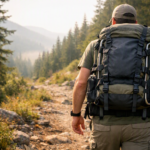
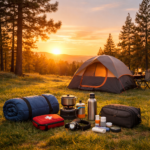
There is a particular kind of joy that only happens outdoors with your family — the child who spots a deer at dawn and grabs your hand without thinking, the campfire evening that stretches past bedtime because nobody wants it to end, the morning that smells like coffee and pine and something genuinely different from everything at home.
These are the moments that family camping tips are ultimately in service of. Because the planning matters — and this guide covers all of it — but the plan is only the structure that makes room for the moments. Get the structure right and the magic takes care of itself.
This guide covers everything that makes a family camping trip genuinely enjoyable rather than just survivable: choosing the right campsite, packing without losing your mind, involving the children so they are excited rather than reluctant, keeping everyone fed and safe, and what to do with the evenings when the campfire is going and there is nowhere else to be.
Why Family Camping Is One of the Best Things You Will Ever Say Yes To
Research consistently shows that time in nature improves children’s concentration, reduces anxiety, and builds resilience. But you do not need a study to tell you what a camping trip makes obvious: children who spend three days without screens, with open space, physical activity, and real experiences, come back different. Calmer. More curious. More willing to just be somewhere.
Family camping is also one of the few activities where the age gap between adults and children collapses. A campfire is as good for a forty-year-old as it is for a seven-year-old. A morning walk that finds animal tracks in the mud is exciting for everyone. The generational knowledge that grandparents and parents carry — how to read clouds, how to light a fire, how to cook over a flame — passes naturally from person to person around a campsite in a way it rarely does anywhere else.
According to the Outdoor Foundation’s 2023 Outdoor Participation report, camping is the single most popular outdoor activity for families with children under 12. More than 50 million Americans camp every year. The most common reason families give for going? To spend quality time together away from daily life. The most common reason they say they do not go? They are not sure where to start. This guide is where to start.
Start With Smart Planning — and Involve the Whole Family From Day One
The most consistent insight across every family camping resource is this: the families who have the best camping trips are not the ones with the most expensive gear or the most elaborate plans. They are the ones who involved their children in the planning process from the beginning.
When children help choose the campsite, know the route, have ownership of one part of the preparation, and understand what to expect — they arrive engaged rather than passive. The trip is something happening to them rather than something happening around them. The difference is significant.
Choosing a Family-Friendly Campsite: What to Look For
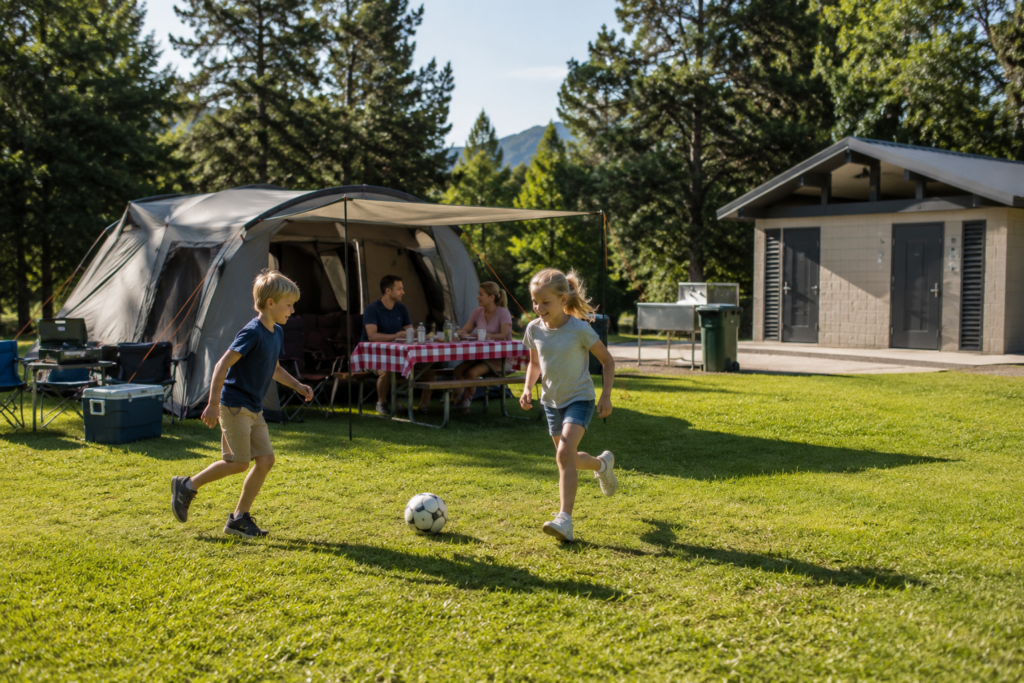
Your campsite choice shapes everything that follows. A well-chosen site removes problems before they start — a poorly chosen one creates them at the worst possible moments.
- Accessible facilities: flush toilets and running water within a reasonable walking distance make a significant practical difference, especially with young children and at night
- Open space near your pitch: children need somewhere to move freely within your sightline. A pitch hemmed in by other tents or near a road is harder to manage
- Distance from water features: rivers, lakes, and streams are beautiful and magnetic to children — a pitch not directly adjacent to open water gives you more margin
- Other families nearby: a campsite with other children present is significantly easier than one where yours are the only young people
- On-site activities: many established campgrounds offer playgrounds, swimming, bike rentals, and organised activities — worth checking in advance for a first family trip
If your children are under five, the campsite selection needs a different approach entirely — our camping with toddlers guide covers the specific considerations for the under-5 age group, from sleep setup to water safety.
Book Early — Popular Family Campsites Fill Up Months in Advance
This is the practical detail most first-time family campers discover too late: popular family-friendly campsites during school holidays book out months in advance. Summer weekend bookings at well-reviewed sites can go in minutes when they open.
- Book as early as you possibly can — 3-6 months in advance for peak season summer dates
- Midweek trips offer significantly better availability and often lower prices than weekends
- Use booking platforms that show real-time availability: Recreation.gov for public land sites in the US, Hipcamp for private land sites, The Dyrt for user reviews alongside availability
- Read recent reviews — not just the star rating. Reviews from the last 3-6 months tell you about the current condition of facilities, noise levels, and family-friendliness that photographs never show
- Have a backup date and a backup site: families with children need a plan when first choice is unavailable
Give Everyone a Job Before You Even Leave Home
The single most effective family camping tip that most guides skip: give every member of the family a specific role in the preparation, matched to their age.
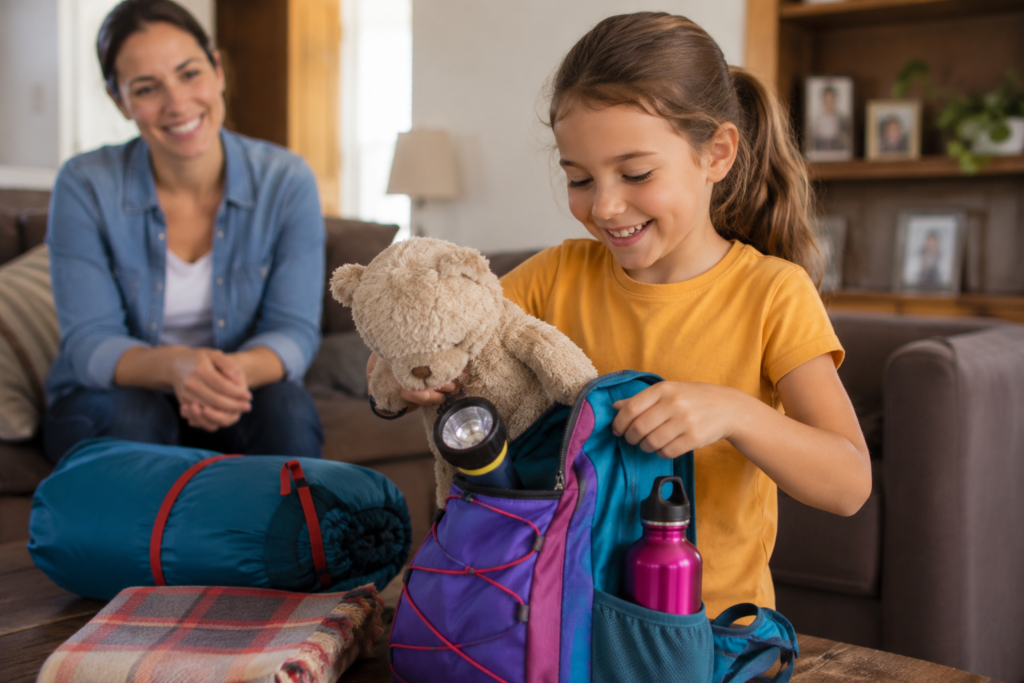
- Children aged 4-6: pack their own small backpack with their own comfort items — a stuffed animal, a favourite book, a headtorch. The ownership of this bag is significant.
- Children aged 7-10: responsible for their own clothing choices for the trip, their own activities bag, and one specific campsite task (collecting small sticks for the fire, keeping track of the family headtorches).
- Children aged 10+: can help with meal planning, researching the campsite, learning to read the trail map, and taking on a meaningful campsite job like fire safety monitor or morning water fetcher.
- Adults: resist doing everything yourself. A camping trip where children have genuine responsibility teaches them something valuable about self-sufficiency — and keeps them genuinely busy.
Giving children a job at camp is simultaneously the best parenting strategy and the most effective crowd management technique available. A child who is the official headtorch keeper has something important to do. A child with nothing to do will find something to do, and the thing they find will almost certainly involve the campfire boundary.
Pack Smart, Pack Light — and Stop Packing Everything Just in Case
Overpacking is the most common family camping mistake, and it is almost always driven by anxiety rather than necessity. The ‘just in case’ instinct produces a car full of gear that takes 45 minutes to load, half of which will never leave the boot.
Before adding child-specific items to your kit, make sure the camping fundamentals are covered — our complete camping checklist for new campers is the baseline to build your family kit from.
The Family Camping Checklist That Covers the Essentials
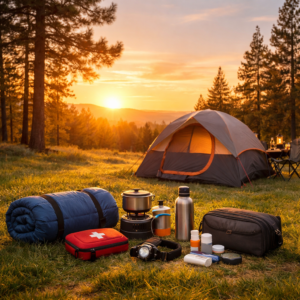
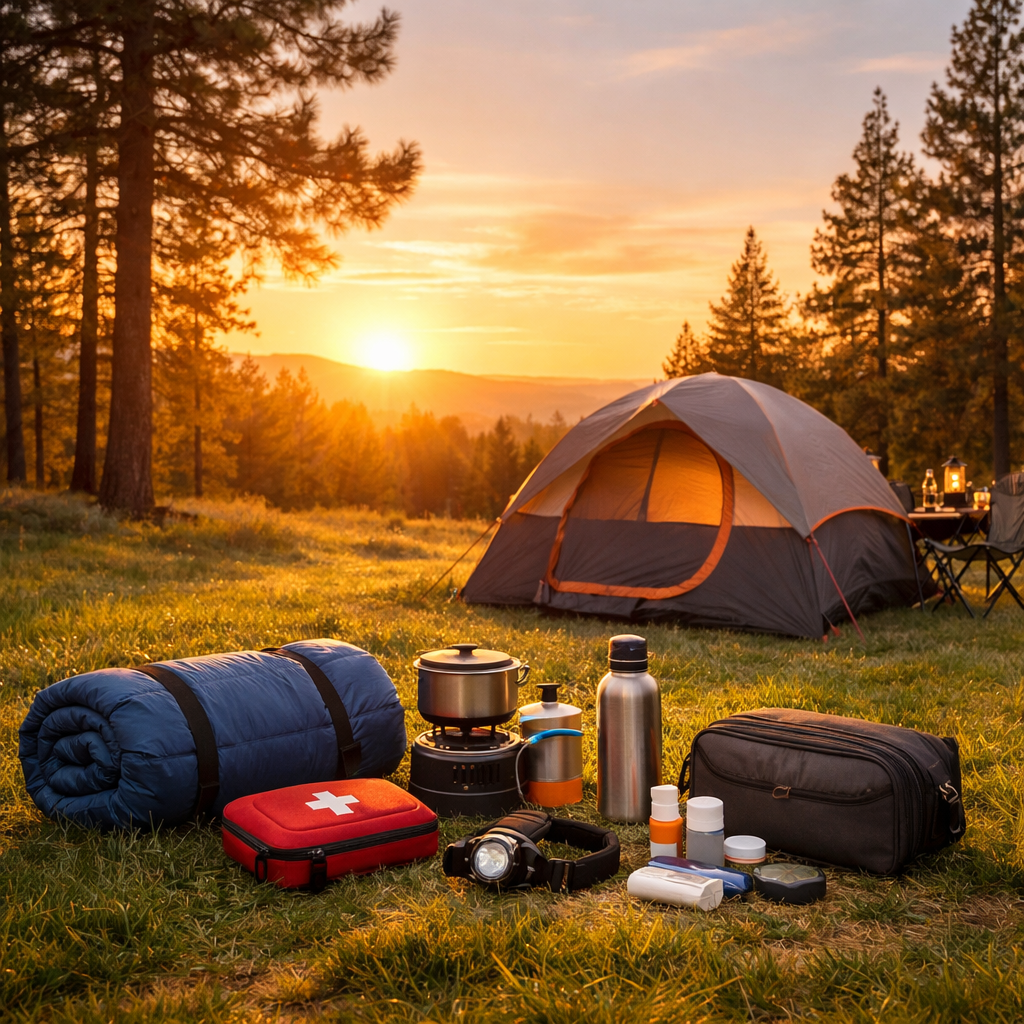
- Shelter: A family tent one size larger than your group needs (a 4-person family is most comfortable in a 6-person tent). Stakes, groundsheet, guylines.
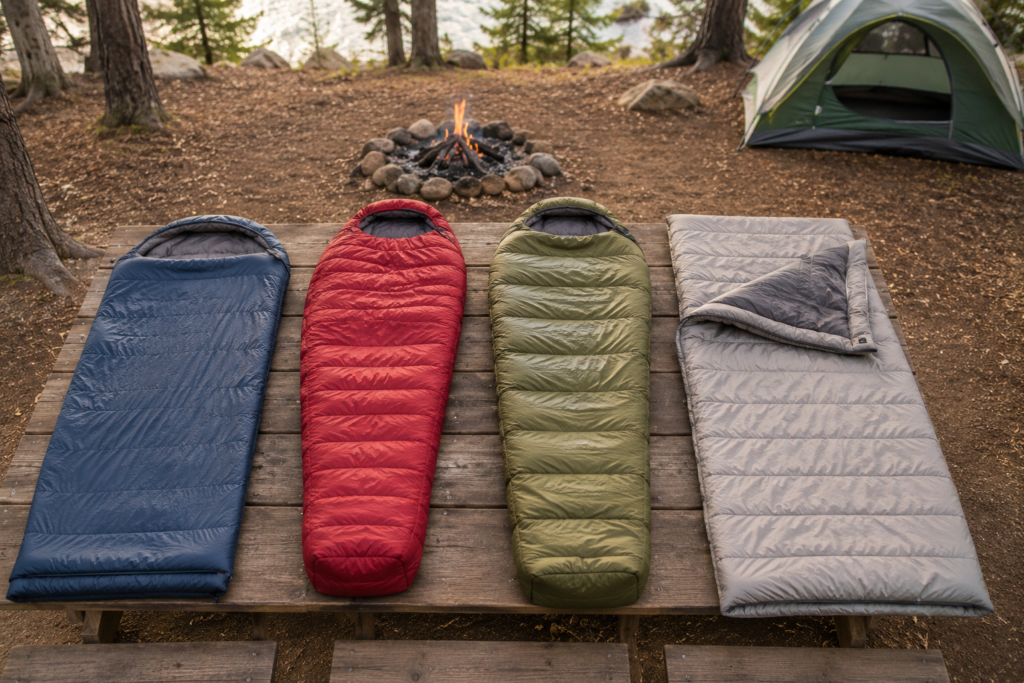
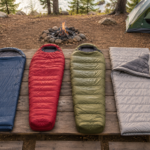
- Sleep system: Sleeping bags rated for the temperatures you expect, sleeping pads for every person, children’s sleeping bags sized for children (adult bags do not work well for small bodies).
- Clothing: Layers, waterproofs, warm hats for cool evenings, spare dry clothes for each child, footwear appropriate for trails. Pack one set of clothes you do not mind being destroyed.
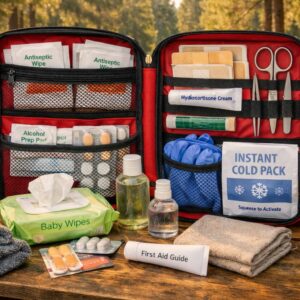
- First aid kit: A comprehensive family kit including children’s pain relief (paracetamol and ibuprofen in children’s doses), antihistamine, plasters, antiseptic, sunscreen SPF50+, tweezers, and any prescription medications.
- Cooking: Camp stove, fuel, pot, utensils, plates, cups, biodegradable soap. Simple food requires simple equipment.
- Lighting: A headtorch for every person including children — children who have their own headtorch use it, children who share one do not.
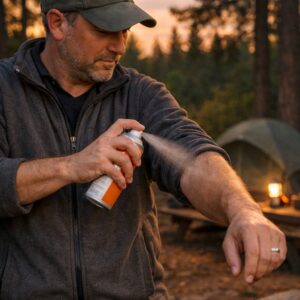
- Insect protection: Child-safe repellent, long-sleeved evening layers for children, a mosquito net for the tent if camping in a high-insect area.
Children’s skin reacts more strongly to insect bites — our keeping mosquitoes away while camping guide covers child-safe repellent choices and the campsite setup strategies that genuinely reduce exposure.
What to Leave at Home
The items that consistently end up unused on family camping trips:
- Heavy cookware sets — a single pot and a lightweight pan handle almost everything
- Multiple changes of shoes for each person — two pairs per person is enough for most trips
- Board games in full-size boxes — bring a deck of cards and travel-sized versions
- Everything in the ‘just in case’ category that has never been needed on a previous trip
- Toys that require power, batteries, or flat surfaces — nature provides better entertainment outdoors
The useful rule: after every trip, note what stayed in the boot the entire time. Those items do not come on the next trip.
Build a Loose Itinerary — and Leave Plenty of Room for the Unplanned
The secret of every good family camping trip that experienced outdoor families know and first-timers often learn the hard way: the stress in family camping almost never comes from too little planning. It comes from too much scheduling.
A packed day of organized activities leaves no room for the spontaneous things that become the stories you tell for years — the deer spotted at the creek at dawn, the wild berry find on the trail, the unexpected afternoon where everyone just played in the stream for three hours and nobody wanted to leave. Build a loose shape for each day and let the campsite fill in the details.
Activities That Work for Every Age at Camp
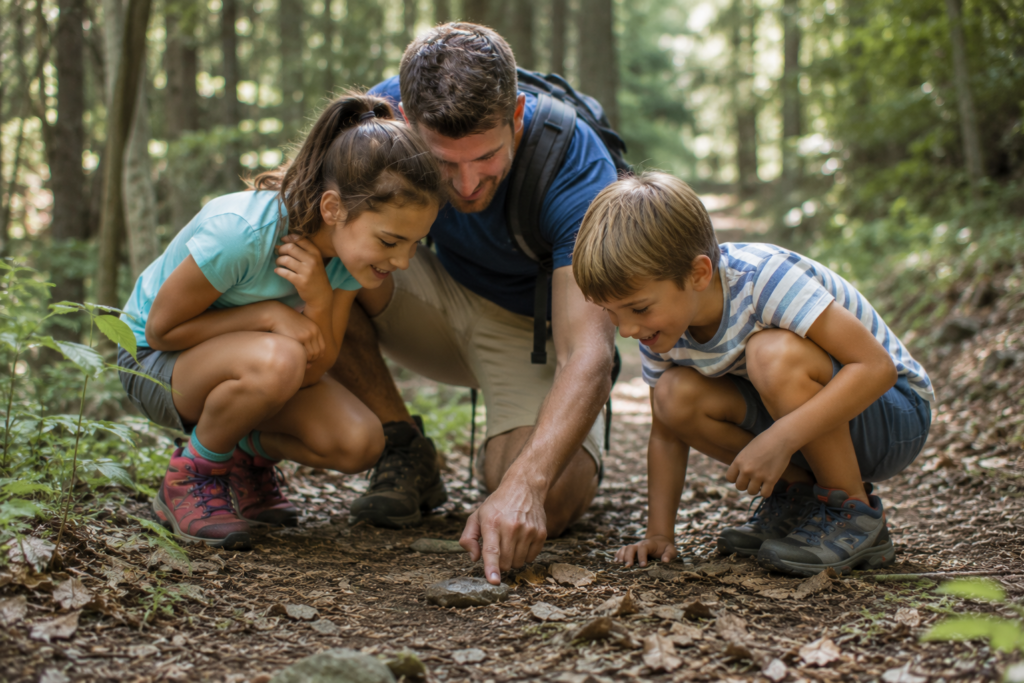
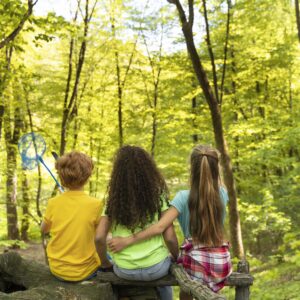
- Nature scavenger hunts: Write a list of things to find before any morning walk — a red leaf, an animal track, something that smells interesting, a bird feather. Works from age 3 upward and makes any trail genuinely exciting for children who would otherwise be asking how much longer.
- Fishing: Patient, competitive, and genuinely exciting when something bites. Check licensing requirements for your area before you go.
- Short trail hikes matched to the child’s actual ability: The single most important hike rule for families: match the trail to the least capable person in the group, not the most capable. A one-kilometre walk where everyone enjoys it beats a five-kilometre slog where nobody does.
- Stargazing: Even very young children are captivated by a sky full of stars. The Stellarium app identifies constellations in real time — use it together as a family activity after dark.
- Flashlight tag: The secret weapon for family camping evenings. Played after dark with headtorches, it combines hide and seek with a light-based catching game. Burns enormous amounts of children’s energy and — critically — makes them actually tired at bedtime.
- Junior Ranger programmes: If you are camping at or near a national park, most parks run Junior Ranger programmes where children complete activities, earn a badge, and take a pledge. Children take these very seriously. Worth researching your specific park before you arrive.
- Water play: A bucket of water and some containers keeps children under six genuinely occupied for extraordinary lengths of time. Add mud for extended entertainment.
For a full guide to activities at camp for every age — geocaching, wildlife tracking, foraging, campfire storytelling and more — our outdoor camping activities guide covers something for every energy level and weather condition.
Give Kids a Camp Job — It Solves More Than Just Boredom
A child with a specific campsite responsibility is a child who is engaged, purposeful, and significantly less likely to wander toward the campfire boundary out of curiosity. Camp jobs also build genuine competence — children who have real responsibilities at camp remember them as things they were trusted to do, not things they were managed through.
- The stick monitor: responsible for keeping sharp sticks and debris away from the sleeping area and tent
- The fire watcher: watches that nobody enters the campfire boundary and reports if anyone does (takes this very seriously)
- The water carrier: fetches water from the tap for cooking and washing — gives purpose and a physical task
- The headtorch keeper: responsible for knowing where every headtorch is at all times and making sure they are returned to the same spot
- The animal spotter: has a small notebook and pencil and records every animal, bird, or insect sighting during the trip. This becomes a cherished record of the trip.
The Screen-Free Boredom Kit: Your Secret Weapon for Day 2
Day 2 of a camping trip is when initial excitement starts to wear off and children who have been cooped up in a car and then very busy start to flag. Have a small bag of activities kept back and revealed only when genuinely needed. Not on day 1 when everything is new — on day 2 when things need a boost.
- A small roll of modelling clay or playdough
- A simple nature field guide for your area — identifying plants, birds, or insects
- A small craft kit: string and beads for making friendship bracelets, a simple whittling set for older children
- A pack of cards — the most reliable entertainment-to-weight ratio of anything you can pack
- A blank notebook and pencil — for drawing, writing, or the animal spotter’s log
Family Camping Food Tips: Keep It Simple, Make It Fun
Camping food with children has one principle above all others: familiar food first. A camping trip is not the time to introduce new flavors to a picky eater or experiment with an ambitious recipe you have never made at home. Bring what they reliably eat, keep preparation simple, and make cooking part of the activity rather than a chore the adults do while children wait.
Meals That Work Around a Campfire With Kids
- Breakfast: Overnight oats prepared the night before (zero cooking in the morning), instant porridge, or cereal with UHT milk. The simplest breakfast is the best breakfast when children are already awake and the day is waiting.
- Lunch: Sandwiches, wraps, or pittas built from pre-prepped fillings. Let children assemble their own. The act of building their own lunch takes time, creates ownership, and produces zero washing up.
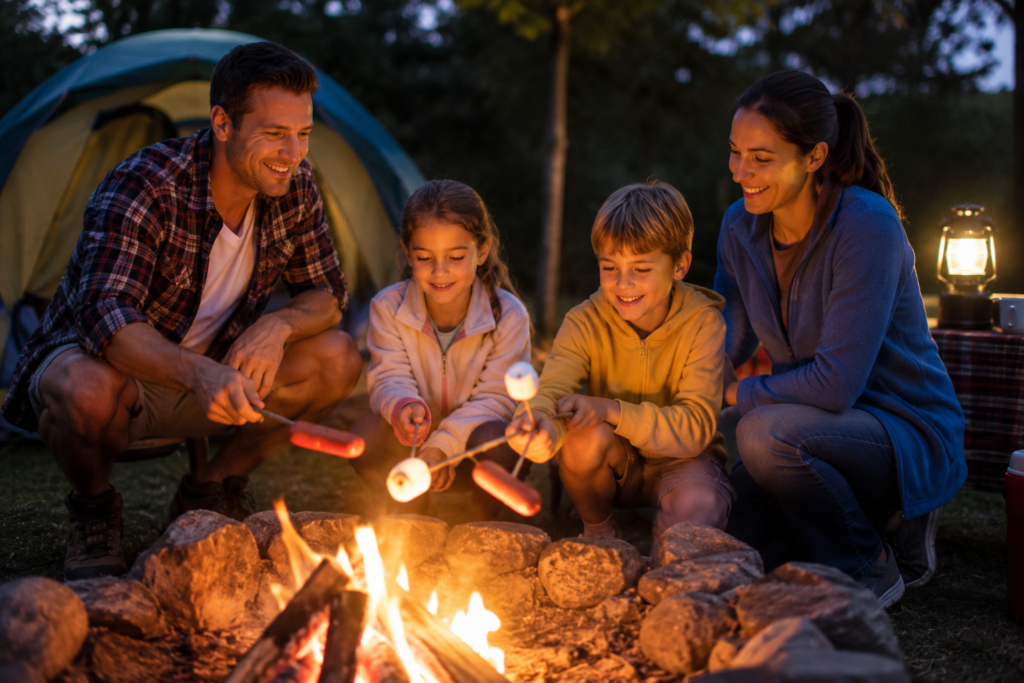
- Dinner: Hot dogs and marshmallows on sticks — dinner and entertainment simultaneously. One-pot pasta. Foil packet meals (sausage, vegetables, and potato sealed in foil and placed on campfire coals — assemble at home or at camp, minimal washing up). Hobo pies — toasted sandwiches made in a campfire sandwich press, which children will use to toast everything available.
- Involve children in cooking: Give each child a job at mealtime — mixing, timing, assembling, pouring. Children who helped make the food eat it more enthusiastically. This is not just camping wisdom; it is universally reliable.
For recipes that work beautifully with children helping — one-pot pasta, foil packet meals, campfire pancakes — our easy camp cooking for beginners guide covers them all with actual ingredients and method.
Snacks Are Morale Management
This deserves its own section because it is genuinely one of the most effective family camping strategies available: a well-timed snack resolves more difficult moments than any other single intervention.
- Trail mix, energy bars, crackers, fruit, cheese portions, cereal bars — keep a snack bag accessible at all times
- When children are flagging on a walk, getting irritable in the afternoon, or unusually difficult — offer a snack before trying anything else
- Bring more snacks than you think you need — outdoor air and physical activity increase appetite significantly
- Individual snack bags for each child prevent arguments about sharing and give children a degree of control over their own food
- A dedicated treat for the campfire evening — marshmallows, hot chocolate, a favourite biscuit — makes the campfire ritual feel special and something to look forward to each night
Family Camping Safety: The Checks That Give You Peace of Mind
Campsite safety with children is mostly about identifying hazards in advance rather than reacting to them in the moment. A five-minute walk around the campsite on arrival catches most things before they matter.
Water and Campfire Safety With Children
These are the two highest-priority safety considerations at any family campsite.
Water:
- Identify every water feature near your pitch immediately on arrival — lake, river, stream, drainage ditch
- Establish a clear rule before children have their shoes off: no approaching water without a parent
- Life jackets for any paddling or water activity involving children who cannot swim confidently
- Never leave young children unsupervised near water, regardless of how shallow it appears
Campfire:
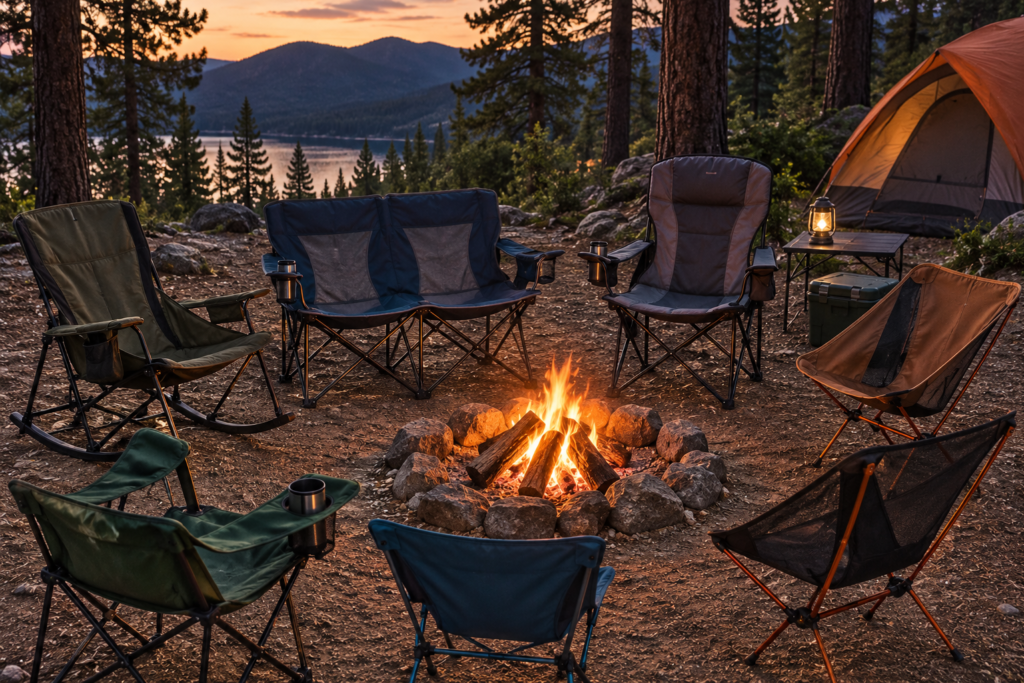
- Establish the campfire boundary — a physical marker (chairs in a circle, a rope boundary, a line of stones) — before lighting the fire
- The three-foot rule: children always maintain at least three feet from any active fire
- Never leave a campfire unattended when children are in the area
- Extinguish completely before sleeping: pour water, stir ashes, pour again until cold to the touch
Wildlife awareness with young children is equally important — our wildlife safety while camping guide covers how to read animal behaviour, food storage, and how to respond calmly if an encounter happens at camp.
What Every Child Should Know Before the Trip Starts
Before you leave home, make sure every child who is old enough to understand knows these four things:
- Your campsite name and number: Even young children can memorise a campsite name and number. If a child gets separated, this is what they tell an adult.
- What to do if they get separated: Stay where they are, find a family (not an adult alone), or find a campground host.
- The campfire rule: never cross the boundary, never touch fire-related equipment without a parent present.
- The water rule: never approach any water without telling a parent first.
Consider writing the campsite number and a parent’s mobile on a small card in each child’s pocket — a low-tech backup that costs nothing and could matter a great deal.
If the family includes a four-legged member, our camping with dogs guide covers everything from finding pet-friendly campsites and vaccination requirements to campfire safety and keeping dogs hydrated on the trail.
Leave No Trace — and Teach Your Children Why It Matters
Leave No Trace is one of the most valuable lessons a camping trip can teach children — and it is best taught not as a rule imposed from above but as a principle explained with a reason.
The reason is simple: the place you are in right now is beautiful because people before you left it that way. Your job is to leave it beautiful for the people who come after you. Children understand this. They often respond to it more strongly than adults do.
- Pack out everything you pack in: rubbish, food waste, packaging. If you carried it in full, you can carry it out empty.
- Leave what you find: stones, sticks, feathers, flowers. Looking and photographing is fine. Taking is not.
- Stay on marked paths: vegetation that looks tough is often fragile under repeated footfall. The path is there to protect the ground on both sides of it.
- The ‘better than you found it’ standard: pick up any litter you find even if it is not yours. This is the standard that makes a difference.
Making children responsible for their own camping waste — each child carries their own small rubbish bag — builds a habit that goes home with them.
The Magic That Happens Around the Campfire After Dark
Of all the family camping tips in this guide, this is the one that is hardest to put on a checklist: the campfire evening. The thing that happens after dinner when the fire is going, the sky is getting dark, and there is nothing requiring your attention.
It is the part of camping that families talk about most afterward. The conversations that go longer and deeper than any dinner table at home. The stories that get passed down from the generation that knows them to the one that has not heard them yet. The s’mores that become a ritual. The songs that may or may not be good but somehow sound exactly right in the dark with a fire and the people you love.
- Campfire storytelling: story chain games work perfectly for families — one person starts a story with a sentence, each person adds a sentence, the story goes wherever it goes. Children are remarkably good at this.
- Two truths and a lie: works for every age from about seven upward, produces genuine conversation and occasional revelation, and requires no equipment whatsoever.
- Stargazing: after the fire is low, lie on sleeping mats and look up. Use the Stellarium app together to identify what you are seeing. The Milky Way at a dark campsite is one of those things that produces silence in even the most excitable children.
- S’mores as a ritual: the making of a s’more is a communal activity. Everyone has an opinion on marshmallow technique. Nobody agrees. That is exactly the point.
The campfire debate about how to toast a marshmallow perfectly is one of the most reliably entertaining family arguments available — low stakes, high passion, and no actual correct answer. Golden and slow, or char-black and fast. Your family will develop a position on this. You will defend it. Years later, the children will remember this argument more clearly than anything else from the trip.
Frequently Asked Questions About Family Camping Tips
What age is best to start camping with children?
You can start from birth, though most families find that 3-5 years is the age when children begin to genuinely engage with the camping experience and remember it. Babies under 12 months are manageable campers — they sleep in carriers during the day and warm sleeping bags at night. The toddler years (1-3) require the most supervision. From age 5 upward, children become genuine camping companions who can contribute meaningfully to camp life and take on real responsibilities.
What should I pack for a family camping trip?
The essentials: a family tent one size larger than your group needs, sleeping bags rated for the temperatures you expect with separate children’s sized bags, a sleeping pad for every person, layers and waterproofs for everyone, a comprehensive first aid kit with children’s medications, a headtorch for each person, child-safe insect repellent, simple cooking equipment, and enough familiar food for your trip plus one extra day. Pack one dedicated boredom kit kept back for day 2. Leave behind anything in the ‘just in case’ category that has never been used on a previous trip.
How do I keep children entertained during a family camping trip?
The activities that work most reliably: nature scavenger hunts (works from age 3, makes any walk engaging), giving children a specific campsite job (keeps them purposeful and reduces boredom-driven wandering), flashlight tag after dark (burns enormous energy before bedtime), fishing (patient and competitive), and a small boredom kit kept back for day 2 when initial novelty wears off. The most important insight: children who are genuinely involved in the trip as participants rather than passengers are almost never bored.
What food should I bring on a family camping trip?
Keep it familiar and simple. Overnight oats or instant porridge for breakfast (zero morning cooking required), self-assembly wraps and sandwiches for lunch, and campfire-friendly dinners: hot dogs on sticks, one-pot pasta, foil packet meals, or hobo pies. Bring significantly more snacks than you think you need — outdoor air and physical activity increase appetite in children. Individual snack bags for each child prevent sharing disputes. A dedicated campfire treat each evening (marshmallows, hot chocolate) creates a ritual children genuinely look forward to.
How do I keep my family safe while camping?
The five most important family campsite safety actions: identify all water features on arrival and establish the rule immediately (no approaching water without a parent), set up the campfire boundary before lighting and enforce the three-foot rule, make sure every child knows your campsite number and what to do if they get separated, carry a comprehensive first aid kit with children’s medications, and tell someone outside your group where you are and when you expect to be back. A five-minute campsite walk-around on arrival catches most hazards before they matter.
The Best Family Camping Trip You Will Ever Have Is the One You Are Planning Right Now
The best family camping trips are not the ones where everything goes perfectly. They are the ones where someone suggests something unexpected and it becomes the story that gets told every time camping comes up. The rain that came on day two and became the afternoon everyone played cards and nobody wanted to leave the tent. The deer that walked through camp at sunrise while the children were still asleep and only the adults saw it. The marshmallow that fell in the fire and produced a grief response worthy of the stage.
The camping trip you are planning will have its own version of these moments. The plan creates the conditions. The moments create themselves.
Start close to home for your first trip. Book early. Involve the children from the beginning. Pack the snacks. Put away the phones. And go outside with your family and see what happens when you give nature and each other enough time.